The 32 Best Things to Do in Barcelona for First-Timers
Are you planning your first trip to Barcelona and wondering which of the famous attractions are actually worth your time, and which ones you can happily skip?
Then you have landed in the right place!
Let me say it straight away: some people find that Barcelona is absolutely worth the hype, while others leave disappointed and unsatisfied.
Personally, I believe that one of the best ways to avoid leaving Barcelona disappointed is to do a bit of research before you go and know how to plan around the crowds instead of walking straight into them.
Because let’s face it, Barcelona is one of the most popular destinations in Europe, and in certain areas of the city, overtourism is unbearable.
Barcelona’s popularity also comes with a catch. There are so many things to do in Barcelona that planning a first trip gets overwhelming fast, and some of the most hyped spots are simply not the best use of your day if you don’t know the best times to visit.
So, instead of spending hours online researching everything about Barcelona and what to do and what to skip, I have gathered all the best things to do in Barcelona for first-timers.
I lived in Barcelona for two and a half years, and in that time I visited pretty much every classic attraction in the city, some of them many times over. And if you’re staying longer in Barcelona, I also found a lot of the hidden gems in Barcelona that never make the standard lists.
In this guide, I will take you through my 32 favorite things to do in Barcelona, grouped by theme so you can plan your Barcelona itinerary around what you enjoy the most. I have also left my honest notes on where and when the crowds are worst and what I would skip.
Whether you are visiting Barcelona with friends or traveling to Spain solo, let’s dive into it!
An Expat’s Guide to the Best Things to Do in Barcelona for First-Timers
Disclosure: Some of the links below are affiliate links. This means that at no additional cost to you, Becci Abroad will earn a commission if you purchase through one of those links. This helps to pay the bills and the maintenance of the site.
The Short Version: What Are the Best Things to Do in Barcelona?
The five things to do in Barcelona that I would not let a first-timer miss are:
La Sagrada Família and Park Güell both need tickets booked well in advance, often weeks ahead in summer.
For Palau de la Música Catalana, it is a good idea to book your tickets in advance, but it’s generally less popular than the Gaudi buildings.
The Gothic Quarter is one of Barcelona’s most famous tourist attractions, and during the day its narrow streets get extremely crowded. So I strongly recommend getting up early to visit the Gothic Quarter.
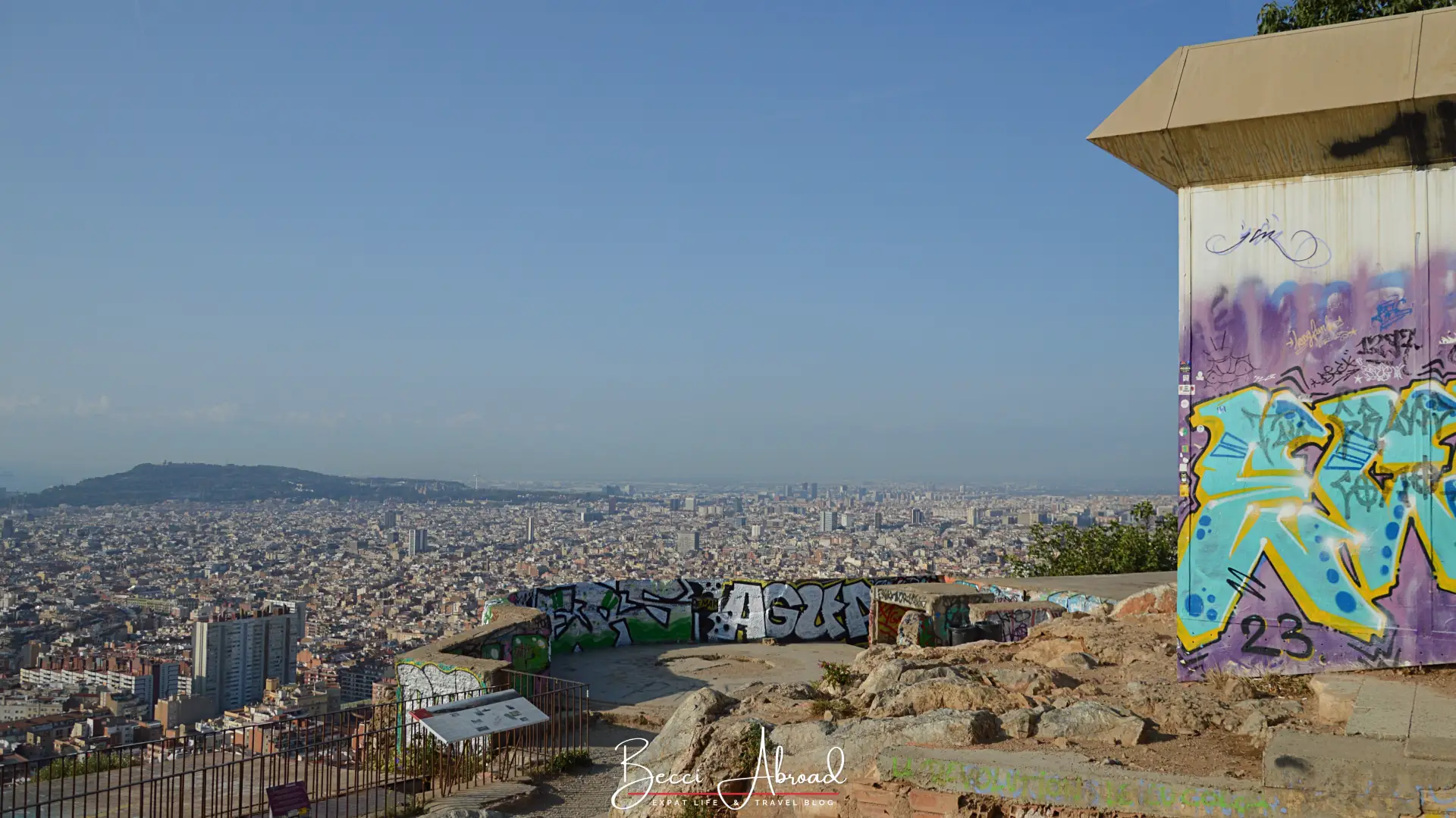
Bunkers del Carmel is completely free to visit, but it gets incredibly busy at sunset, especially in the summer months. So, go early and bring snacks or a light dinner with you.
With three days in Barcelona, you can cover the classic tourist attractions. But I would strongly recommend staying at least a couple of days extra, as with four or five days in Barcelona it lets you add a day trip!
The one thing to know before you book anything: Barcelona in July and August is genuinely uncomfortably hot and humid. August is the holiday season for locals, and many local shops are closed for either a couple of weeks in August or the whole month.
If you have any flexibility on when you’re travelling to Barcelona, I would recommend you go in May, June, September or October instead. Even during the winter months, I find Barcelona more pleasant than during July and August – even though you cannot really go to the beach in winter!
Is 2026 a Good Year to Visit Barcelona?
If you’re wondering whether 2026 is a good year to visit Barcelona, let me be straight with you:
2026 will be a very special year to visit Barcelona!
2026 will be celebrated as the Gaudí Year, when the city of Barcelona officially celebrates the 100th anniversary of Antoni Gaudí’s death. In addition, Barcelona will also hold the title of World Capital of Architecture for 2026.
The city has planned several activities and events around it, everything from special exhibitions at the Sagrada Família and Park Güell to a newly restored room at Casa Vicens. The centerpiece happened on June 10, 2026, exactly one hundred years after Gaudí’s death, when the Sagrada Família’s central Tower of Jesus Christ was finally blessed and inaugurated.
So, if you are wondering whether now is a good time to see Gaudí’s Barcelona, in my opinion, the answer is a thousand times yes. You are visiting during the one year that will not come around again!
The 32 Absolute Best Things to Do in Barcelona
To help you plan your travels to Barcelona, I have gathered some of my favorite things to do in Barcelona for first-timers.
Barcelona tourist attractions map
Check out all the best things to do in Barcelona on this map. In the top right-hand corner, you can click on the full-screen icon and have the map open directly in your Google Maps app.
Barcelona’s Iconic Architecture: Gaudí and Beyond
You cannot talk about the best things to do in Barcelona without talking about Antoni Gaudí and modernisme!
Modernisme is the Catalan version of Art Nouveau, a movement from roughly 1888 to 1911 that set out to replicate nature’s forms and colors in architecture.
Antoni Gaudí is the most famous name within the Catalan modernisme movement, but he was far from the only one.
In Barcelona, you will find several buildings by Gaudí, but not every building with curving lines, organic shapes, and colorful mosaics is necessarily a Gaudí creation.
Let’s explore some of the best architecture to visit in Barcelona – from Gaudí and beyond!
Be Amazed by La Sagrada Família
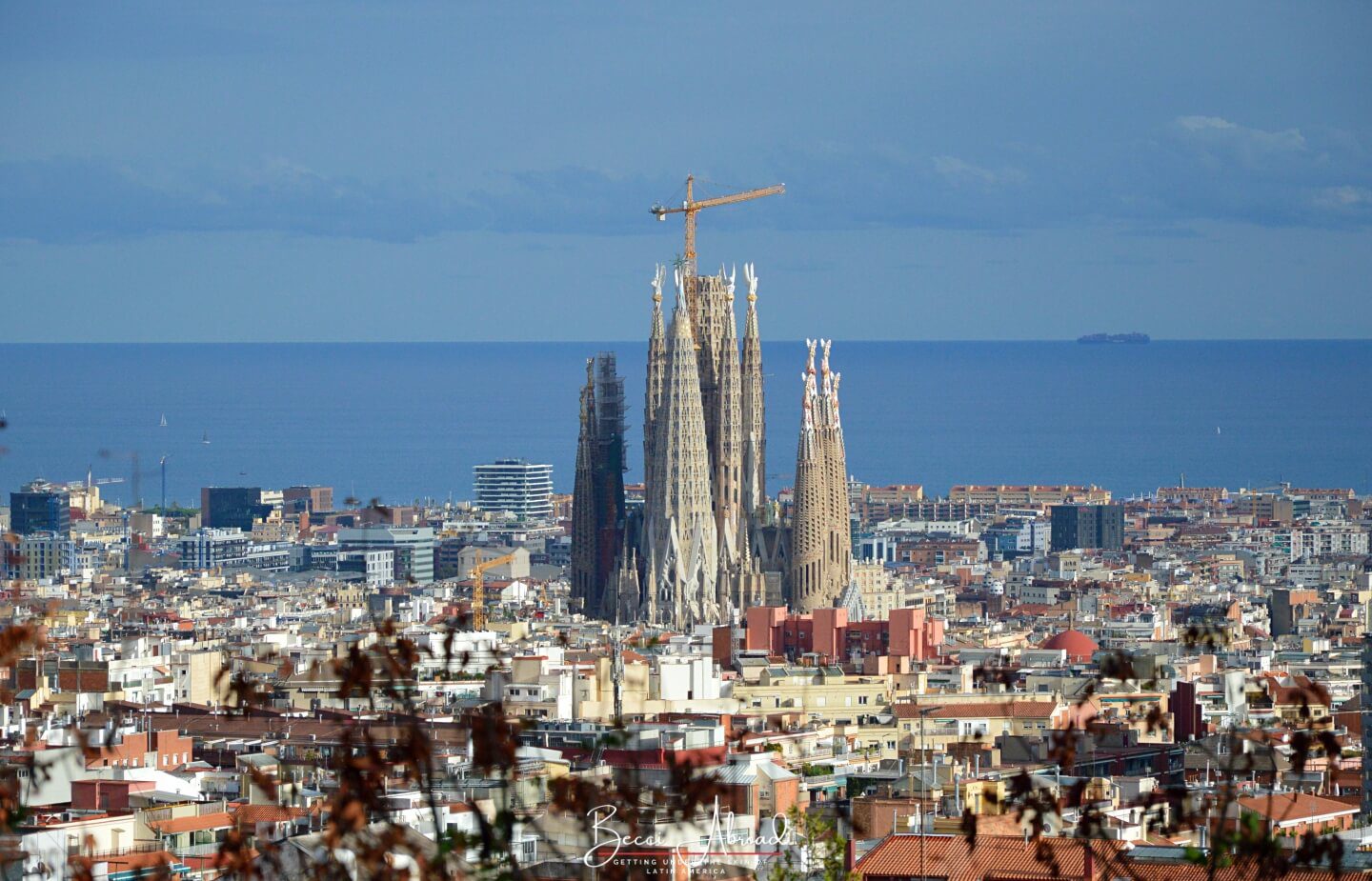
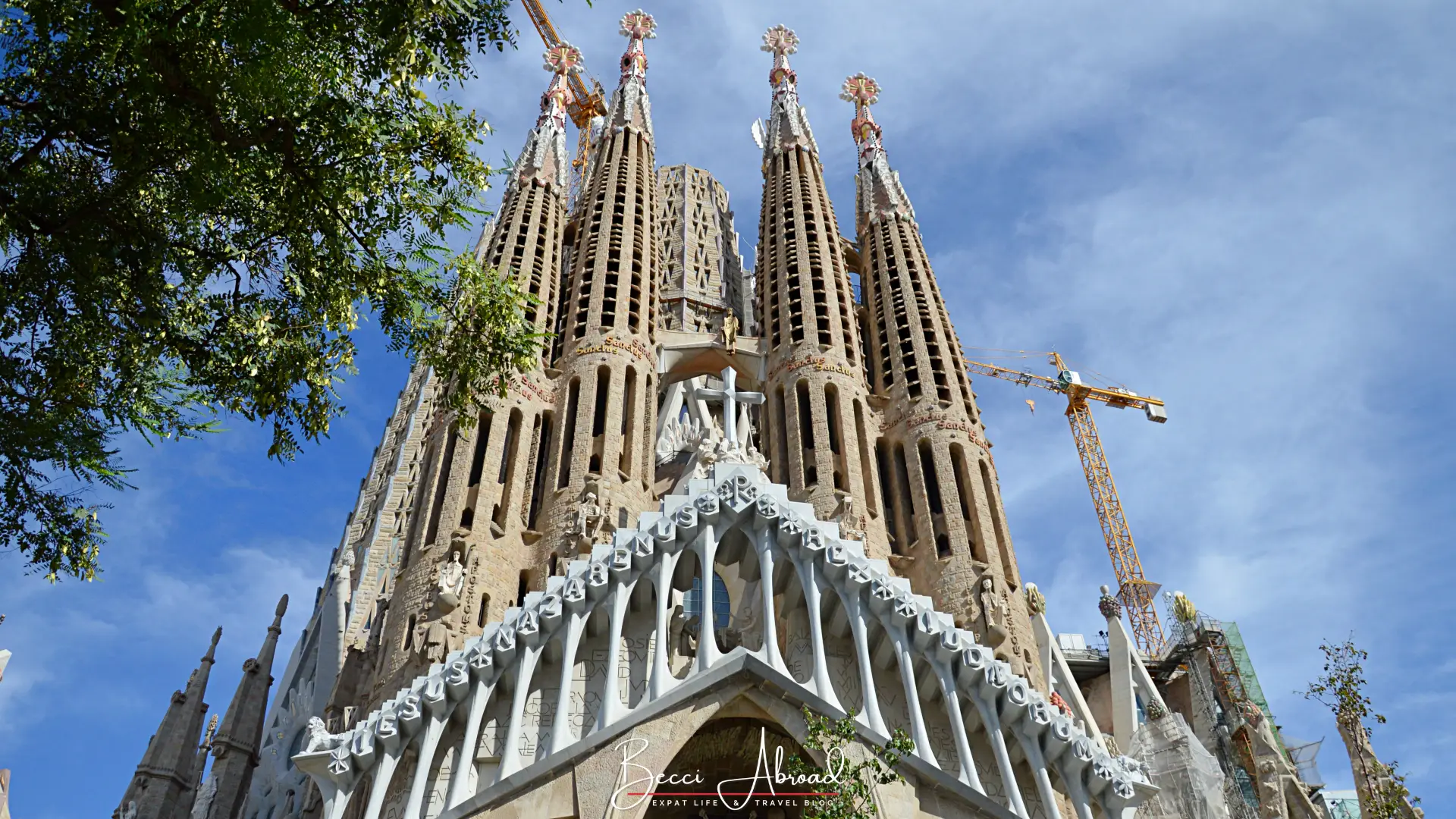
No list of things to do in Barcelona would be complete without the breathtaking La Sagrada Família, Antoni Gaudí’s masterpiece and one of the most recognizable landmarks in the world.
The construction of La Sagrada Família began back in 1882 and is only now, in 2026, reaching completion. That is 144 years of building!
It is no coincidence that 2026 ended up being the year that La Sagrada Família finally reached completion. 2026 is the centenary of Gaudí’s death.
On June 10th, 2026, on the hundredth anniversary of Gaudí’s death, the Tower of Jesus Christ was inaugurated at 172.5 meters (566 ft), making La Sagrada Família the tallest church in the world.
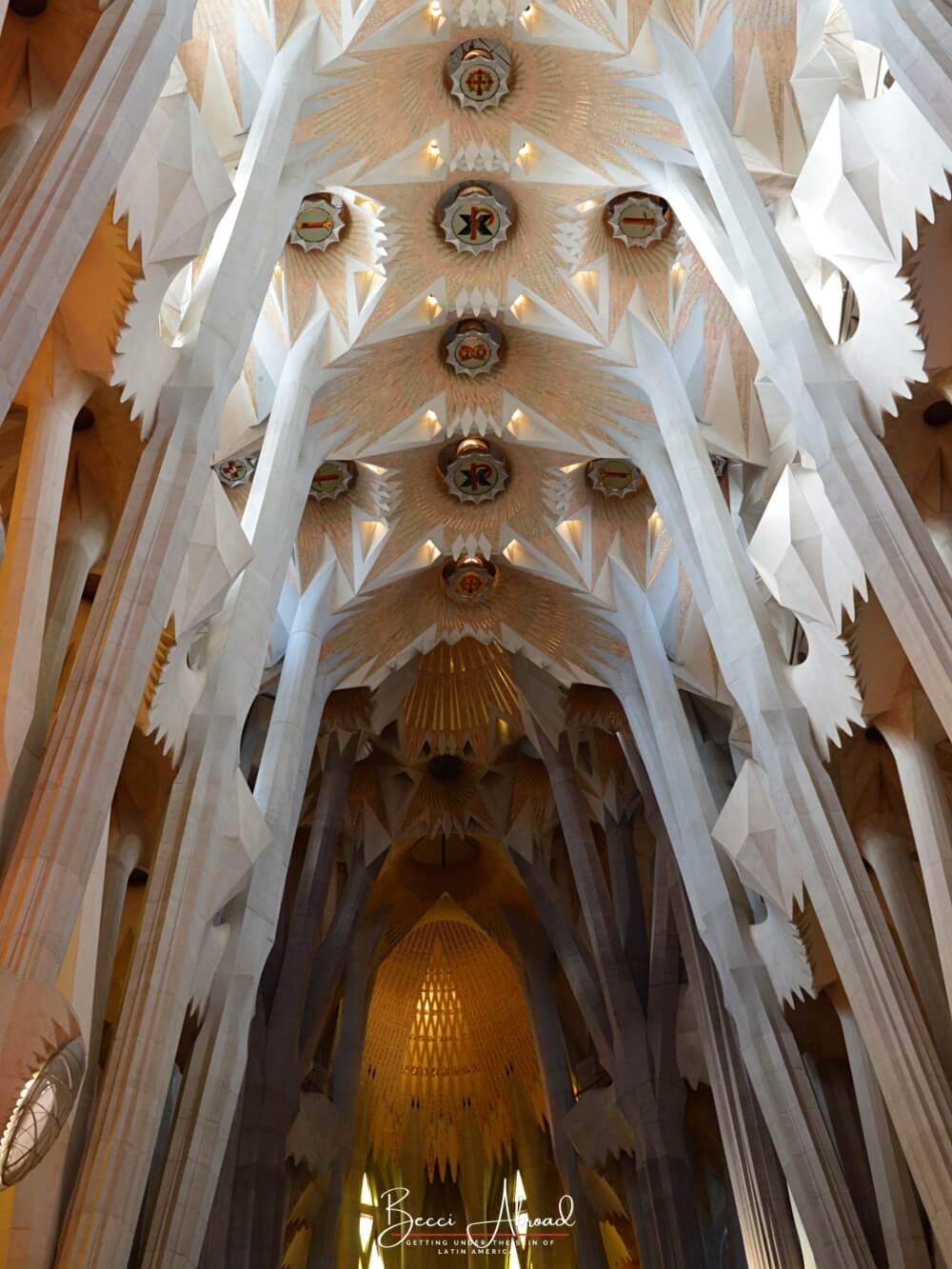
In La Sagrada Família, every corner is packed with meaning, from the façades depicting the life of Jesus to the forest-like columns inside that stretch endlessly toward the ceiling.
To step inside La Sagrada Família feels like walking into a magical forest. Especially on sunny days when the sunlight is pouring through the colorful stained-glass windows. Even if you have seen it a hundred times in photos, La Sagrada Família in person is hands down one of the best things to do in Barcelona!
Book your tickets online well in advance. Most days are sold out even before the church opens its doors, and the lines outside get very long (and I mean, very long!).
I strongly recommend that you only buy your tickets to Sagrada Familia through the official website or an established platform like GetYourGuide or Viator. There are far too many stories online of people getting scammed by third-party vendors!
In my opinion, you can skip the paid guided tour. The audioguide included with the standard ticket is thorough; you just need to remember to bring your own headphones and download the app before you arrive.
Despite living in Barcelona for 2.5 years, I have only visited La Sagrada Familia once, when two of my friends from Denmark visited Barcelona for a long weekend when we had just moved to Barcelona. But I have walked past La Sagrada Familia countless times, either on my way to a doctor’s appointment or to grab drinks with some friends.
One free tip: the basilica is flanked by two small parks, and the one with the little lake is the classic photo stop for that postcard reflection shot. No ticket needed for that one!
Admission: Tickets to La Sagrada Familia start at 26 euros for the basic ticket, including the app audioguide. With tower access, the tickets start at 36 euros.
Opening hours:
- Winter (November through February):
- Monday to Saturday: from 9 am to 6 pm
- Sundays: from 10:30 am to 6 pm
- Summer (April through September)
- Monday to Friday: from 9 am to 8 pm
- Saturdays: from 9 am to 6 pm
- Sundays: from 10:30 am to 8 pm
Please note that opening hours differ slightly in March and October; check the official website for Sagrada Familia before you go.
Nearest metro: Sagrada Família (L2 and L5).
Location: Sagrada Familia, Carrer de Mallorca, 401, Eixample
Book your Sagrada Família ticket


Wander Around Park Güell
Park Güell is Gaudí’s fairytale park on a hillside in the Gràcia neighborhood, with breathtaking panoramic views over Barcelona.
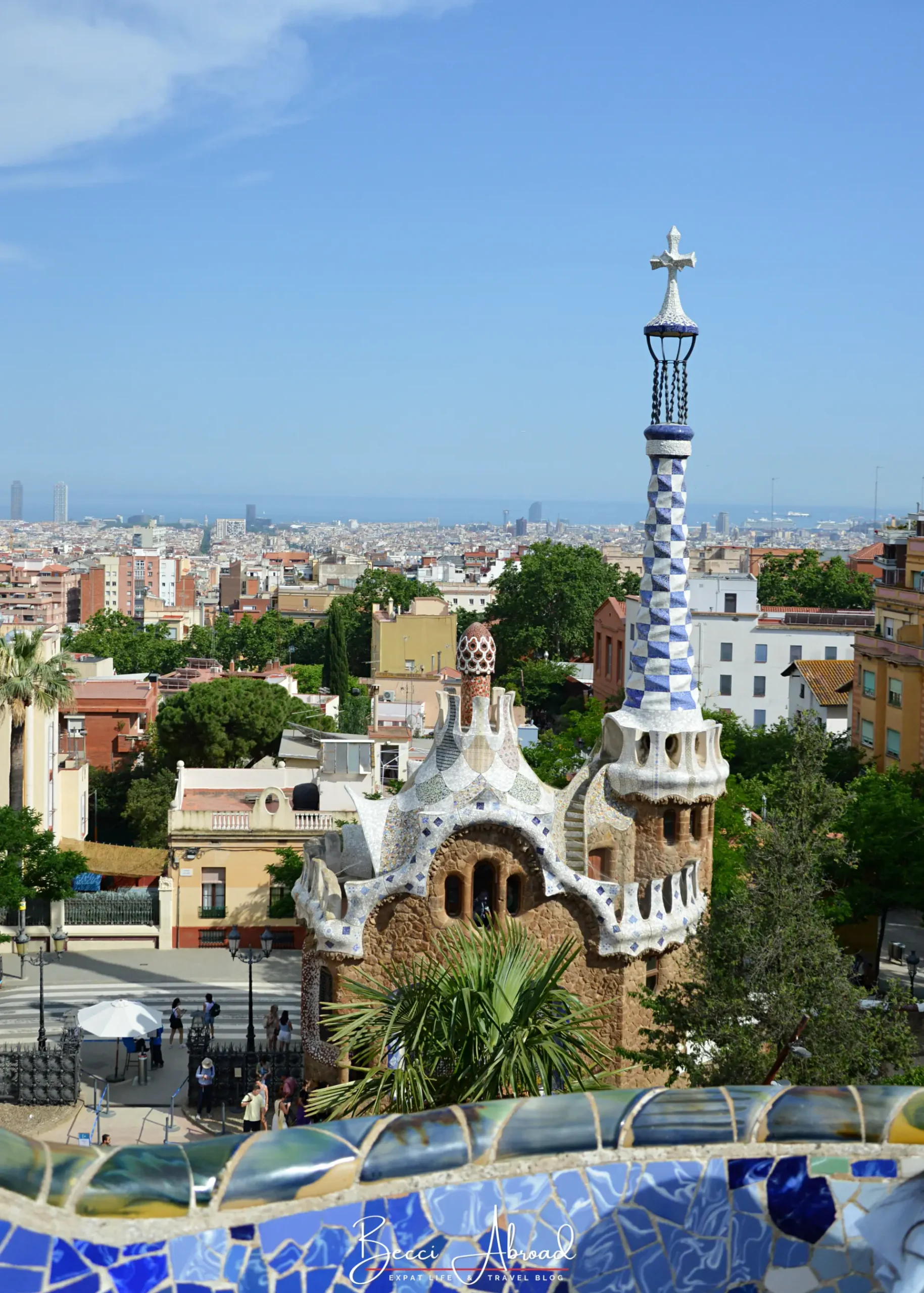
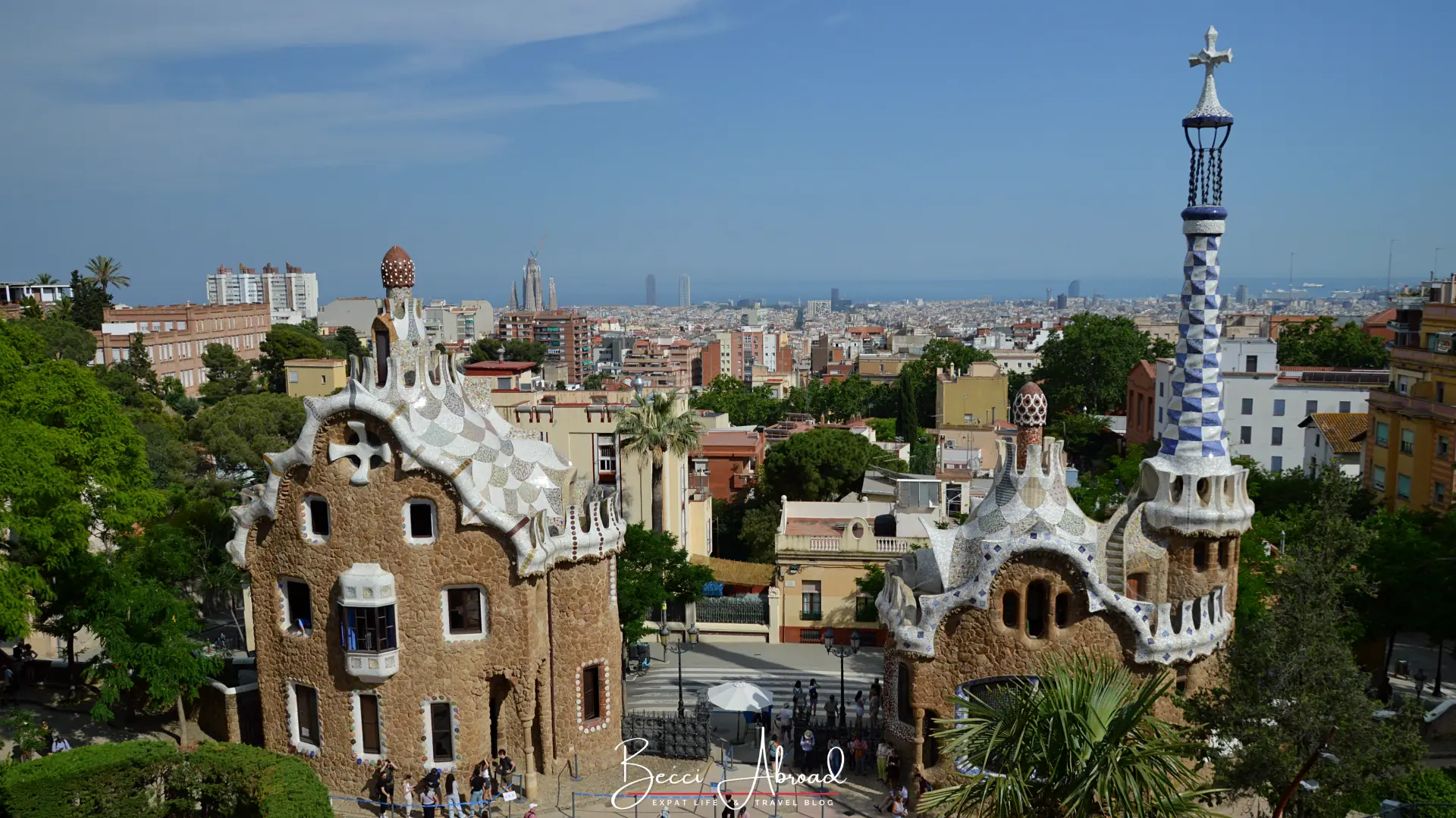
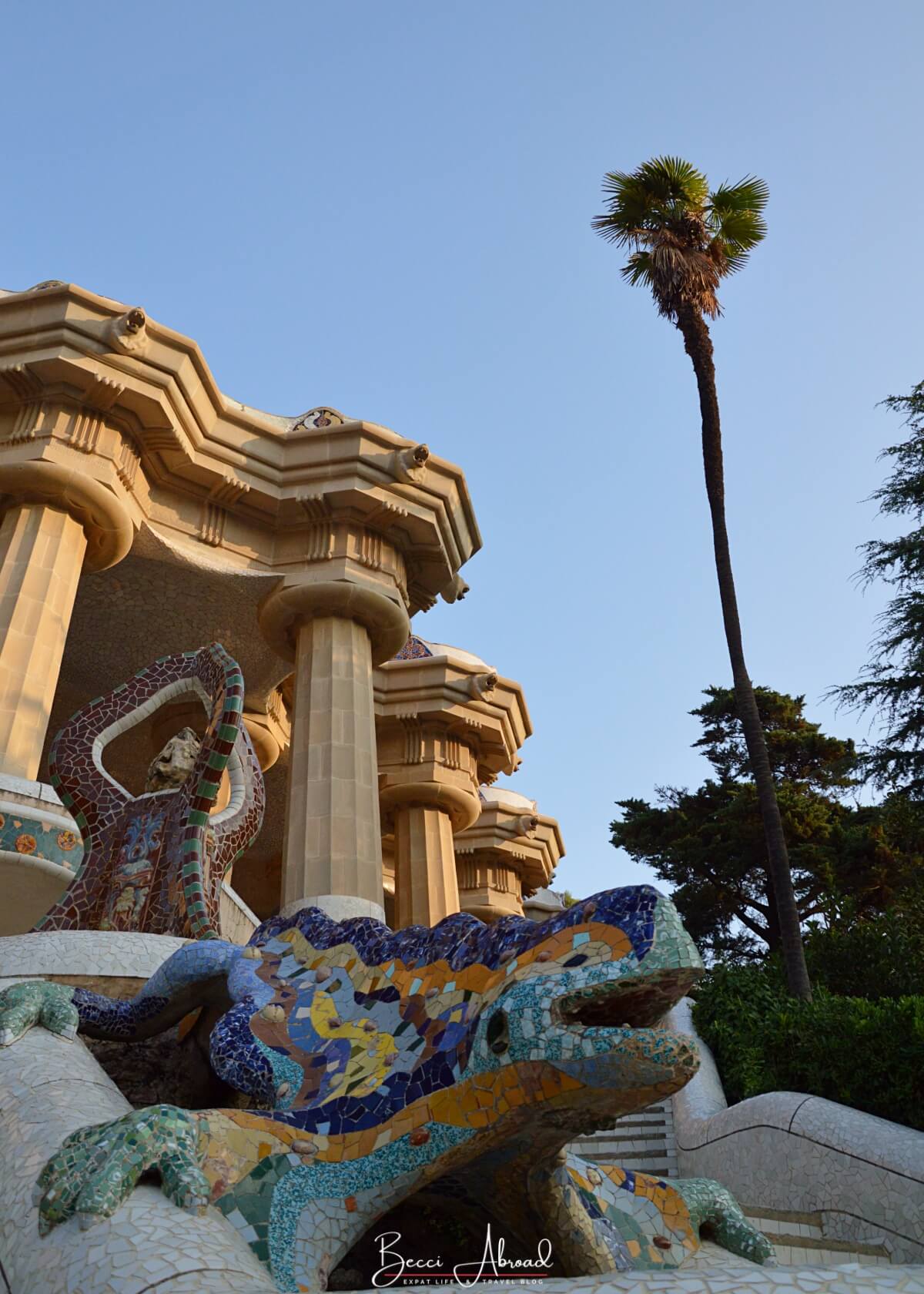
When you enter by the main entrance, you are greeted by a grand staircase flanked by two gingerbread-style Porter’s Lodge pavilions. In the middle of the staircase, you will meet Barcelona’s beloved mascot, the famous mosaic lizard El Drac.
Halfway up the staircase, you enter the Hypostyle Hall, a forest of columns crowned with a stunning mosaic ceiling.
Above the Hypostyle Hall sits the iconic Serpentine Bench, the curving tiled bench that is the most photographed spot in Park Güell!
From the Serpentine Bench, you have an amazing view over Barcelona’s skyline with La Sagrada Família towering over the city and the sea in the background.
The main area in Park Güell doesn’t take more than around 30-40 minutes to visit, but there are plenty of other parts of the park to visit and get even better views over Barcelona than from the Serpentine Bench. Read my complete travel guide to Park Güell for everything you need to know before visiting.
Park Güell was declared a UNESCO World Heritage Site in 1984, and today the monumental zone is a regulated, ticketed area to protect its delicate architecture.
There is a lot of debate online about whether Park Güell is worth it. Personally, it is one of my favorite places in Barcelona, because the mix of architecture, nature, and views is unbeatable!
In Park Güell, they only let 1,400 visitors in per hour, so same-day tickets regularly sell out – especially during the high season in the summer months. I strongly recommend that you buy your tickets to Park Güell well in advance through the official website, GetYourGuide, or Viator.
Personally, I would recommend getting tickets first thing in the morning for Park Güell to avoid the worst crowds and enjoy the morning sun in the park.
Admission: Tickets to Park Güell start at 18 euros for adults. Children 7 to 12 and seniors over 65 are 13.50 euros. Children under 6 are free.
Opening hours:
- Daily, from 9:30 am to 7:30 pm in summer
- Daily, from 9:30 am to 5:30 pm in winter
- Last entry is 30 minutes before closing.
Nearest metro: L3 to Vallcarca or Lesseps on the L3 metro line. The walk from Lesseps is around 10 minutes and slightly uphill. The walk from Vallcarca is very uphill and leaves you by the upper entrance of the park.
Location: Park Güell, Carrer d’Olot 16, Gràcia.
Admire Casa Batlló
Casa Batlló is one of Antoni Gaudí’s most spectacular works, and truly one of the most popular things to do in Barcelona!
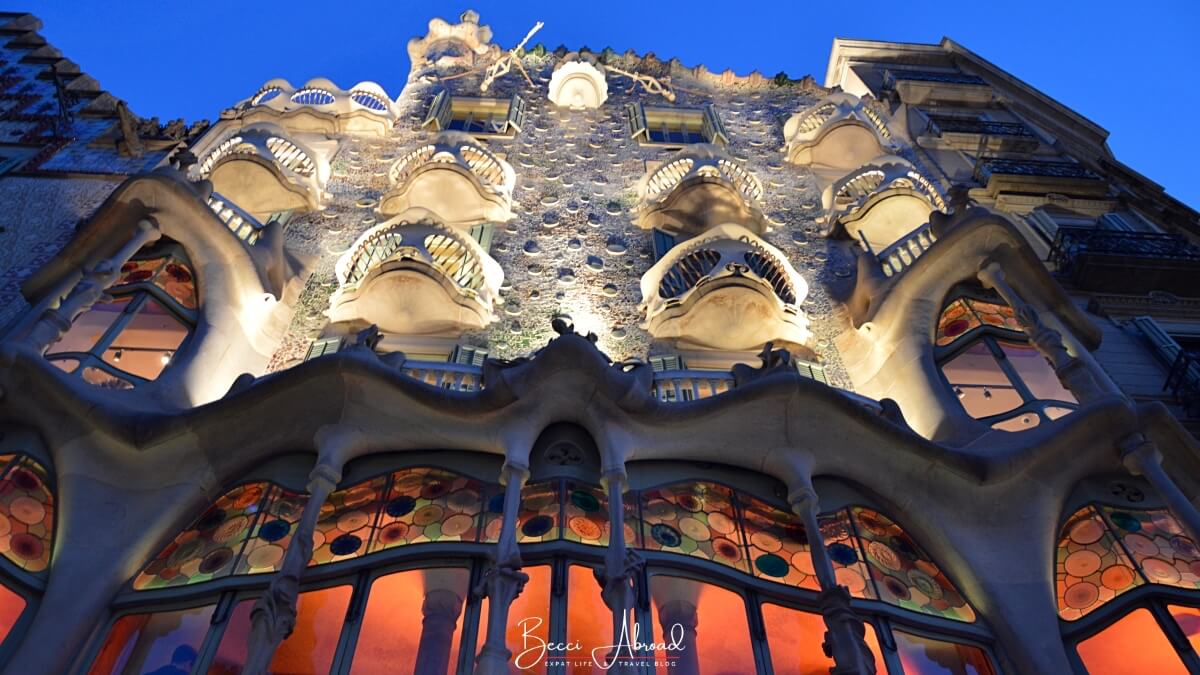
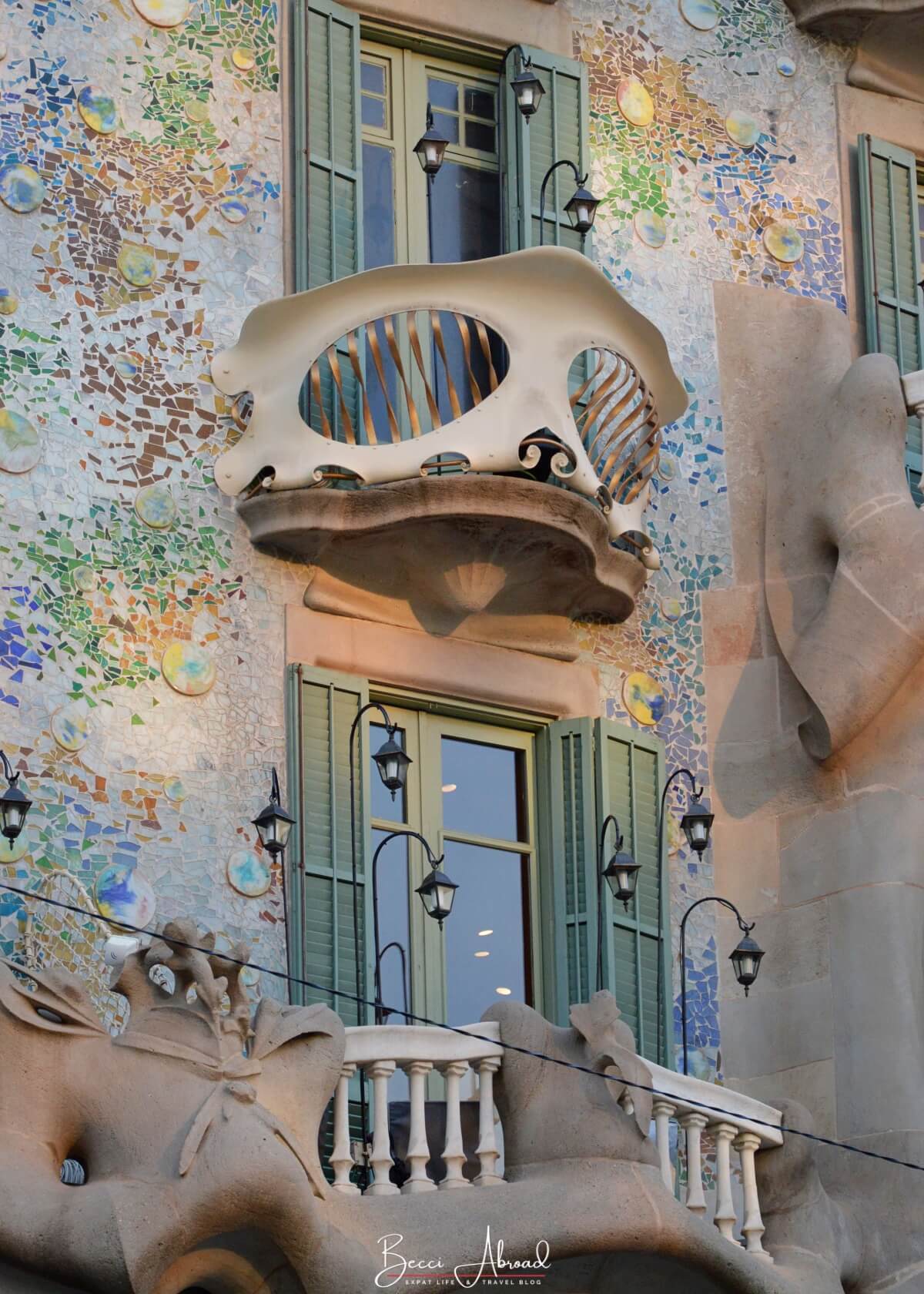
Casa Batlló is considered one of the most iconic modernist buildings in Barcelona, featuring the essence of Catalan modernism with curvy and colourful details everywhere. Catalan modernism is all about replicating nature’s forms and colours in the architecture.
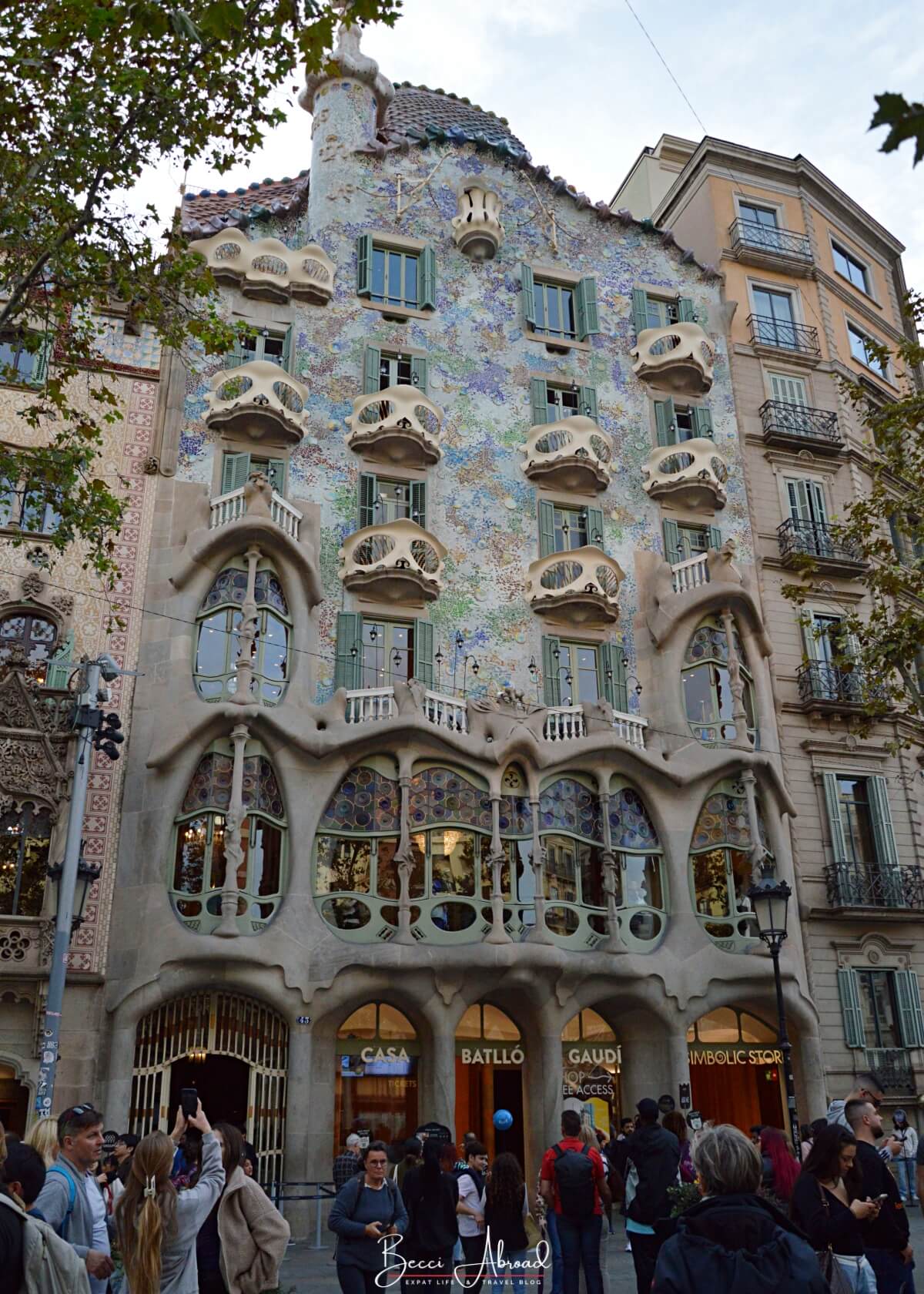
The most iconic part of Casa Batlló is the building’s facade. From top to bottom, the facade is covered in blue-toned mosaics with curvy windows and balconies. From the roof, you can see a dragon-like tail peeking up.
The construction of Casa Batlló began in 1904 when Gaudí was contracted by a wealthy industrialist, Josep Batlló, to redesign the house for him and his family.
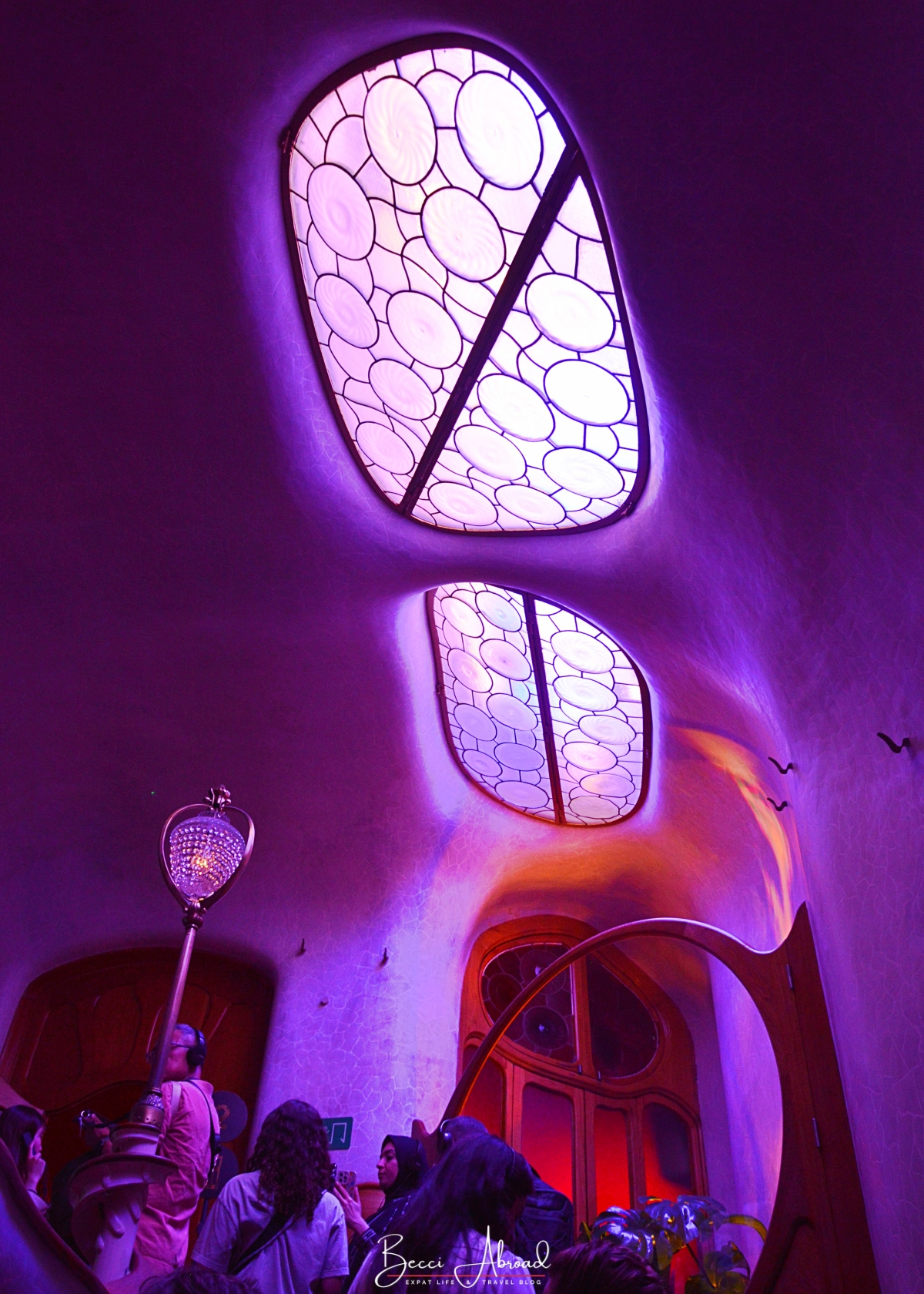
Gaudí used the most modern technology and techniques of his time to design a house where functionality, proper ventilation, and lighting are mixed with an exceptional design.
In 2021, Casa Batlló underwent a complete renewal, focused on using modern technology and embarking visitors on a journey through Gaudí’s creative and innovative world. As a result of the renewal efforts, in 2022, Casa Batlló was awarded Europe’s Best Immersive Experience.
Casa Batlló is hard to overlook with its central location on the iconic Passeig de Gràcia shopping street, its colorful mosaic facade, and the endless line of eager visitors waiting to visit the inside of Casa Battló.
Casa Batlló is one of the most visited Gaudí buildings in Barcelona, with more than two million visitors every year.
So, to get the best experience of this iconic Barcelona landmark, it is recommended to book tickets early in the morning or, at the latest spot in the evening to beat the crowds.
There are several different ticket options for visiting Casa Batlló, including different parts of the house. For all its ticket options, Casa Batlló uses dynamic pricing, so booking early saves you money as well as time!
Admission: Tickets to Casa Batlló start at 25 euros for adults for the “blue” ticket category. Children under 12 can enter for free.
Opening hours: Daily from 8:30 am to 10:30 pm.
Nearest metro: Passeig de Gràcia (L3 and L4).
Location: Casa Batlló, Passeig de Gràcia 43, Eixample
Learn more about Casa Batlló and how to visit with my complete guide to Casa Batlló!
Get Blown Away by the Palau de la Música Catalana
Not every modernist building in Barcelona is Gaudí! And some modernist buildings that are not Gaudí are even more worth visiting than Gaudí’s buildings.
For me, that’s Palau de la Música Catalana, or “Palace of Catalan Music” in English!
Palau de la Música Catalana is a concert hall designed by the Catalan architect Lluís Domènech i Montaner, and completed in just three years, from 1905 to 1908.
The façade impresses with a dramatic corner sculpture that seems to burst out of the wall. But it is when you step inside that the real magic begins!
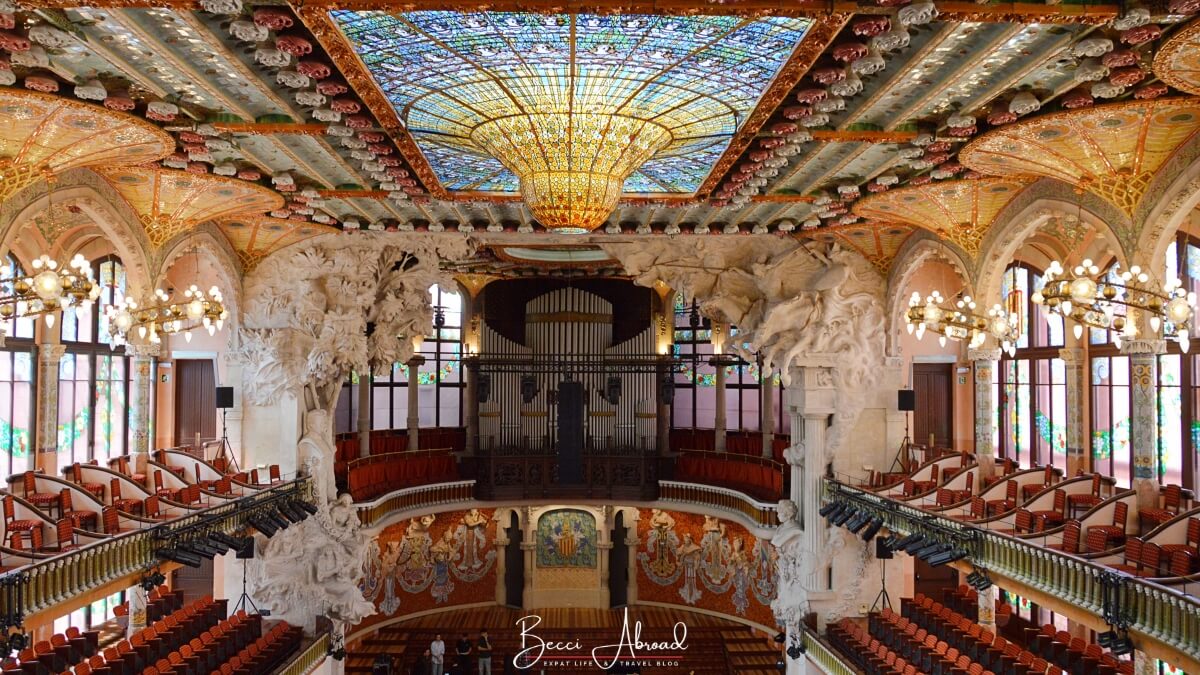
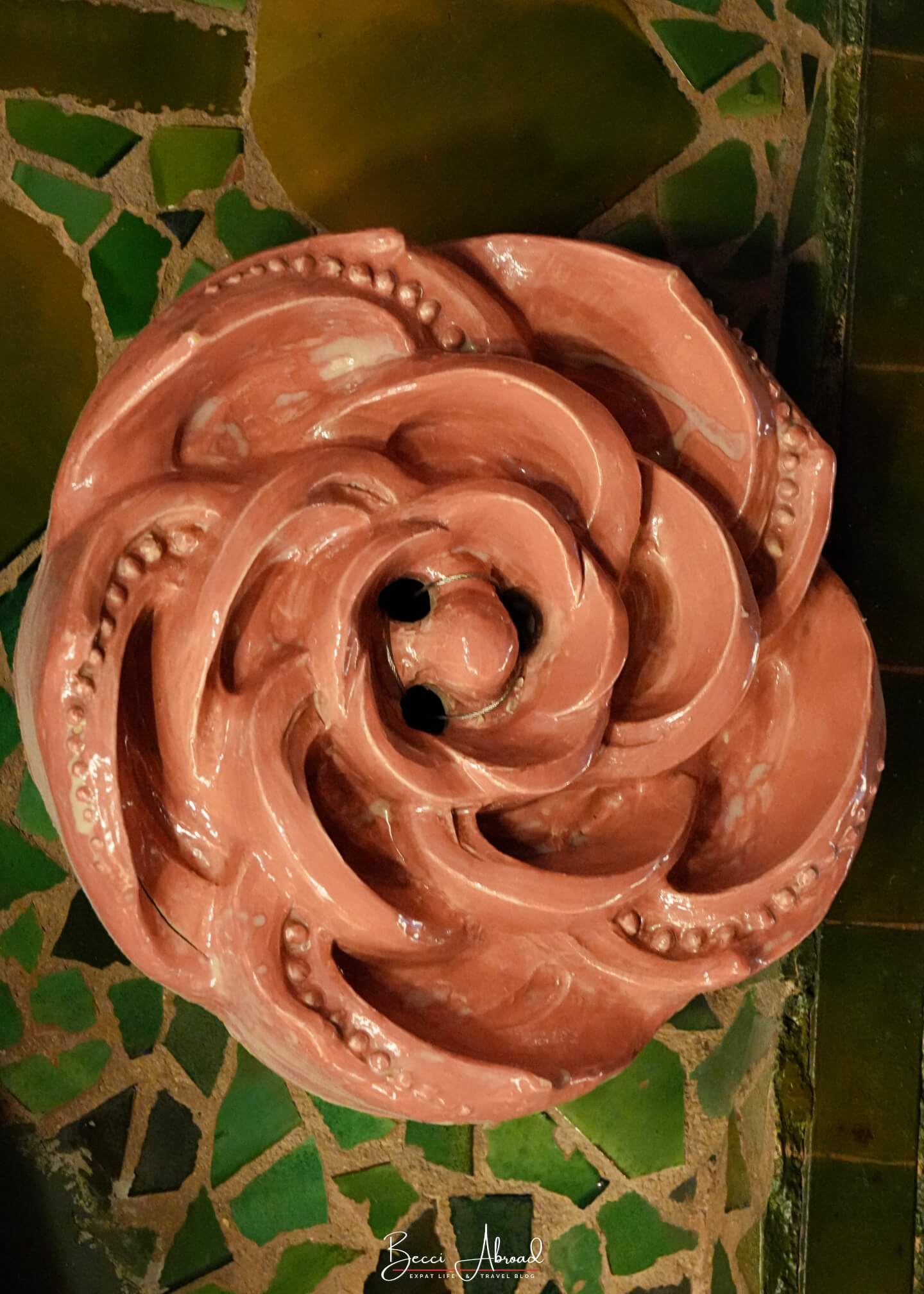
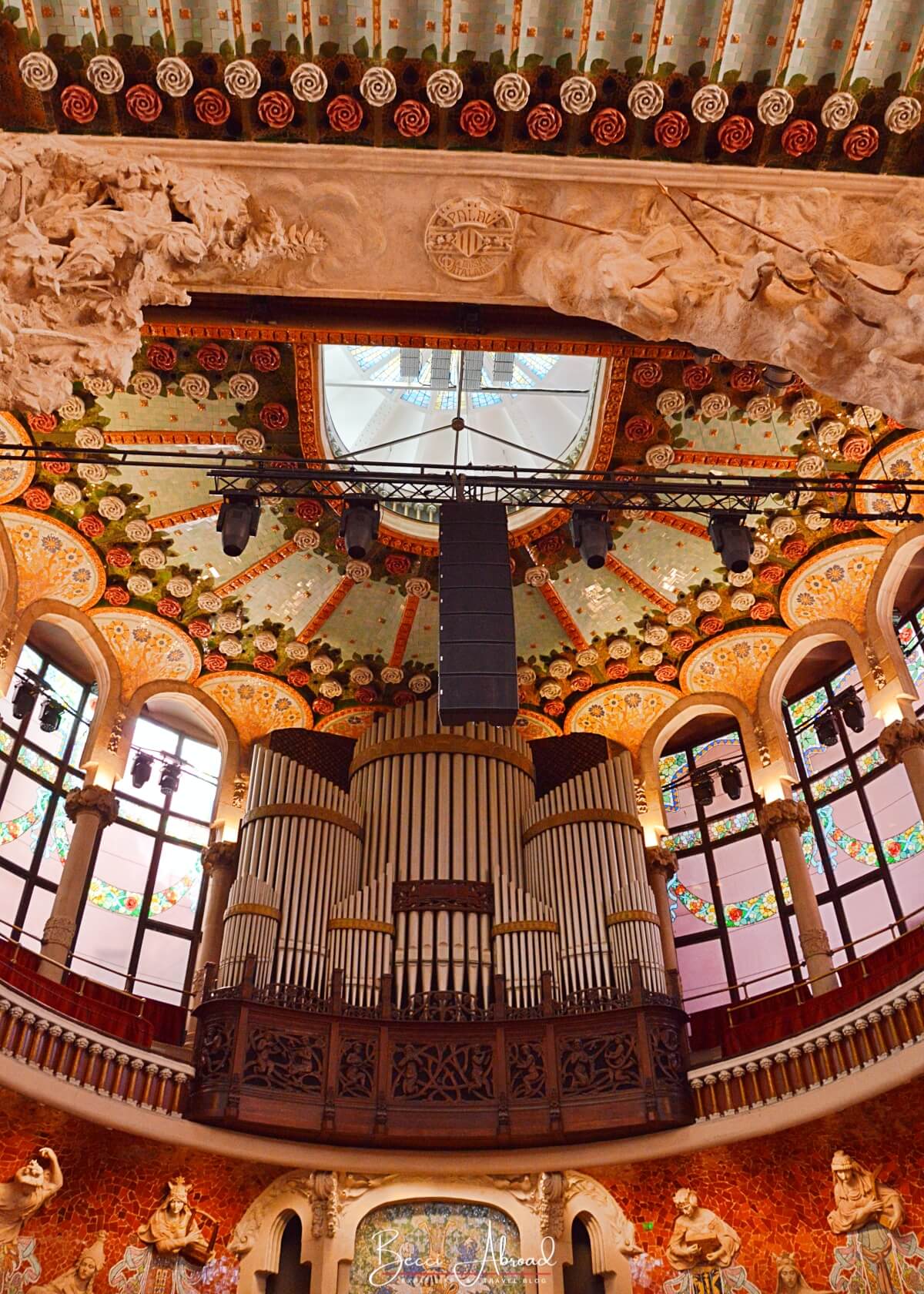
Inside Palau de la Música Catalana, it is like an explosion of colorful mosaics, stained glass, and beautiful flower motifs.
The main concert hall is the crown of the building with multicolored tiles, ornate carvings, and a spectacular stained-glass skylight that floods the room with rainbow light.
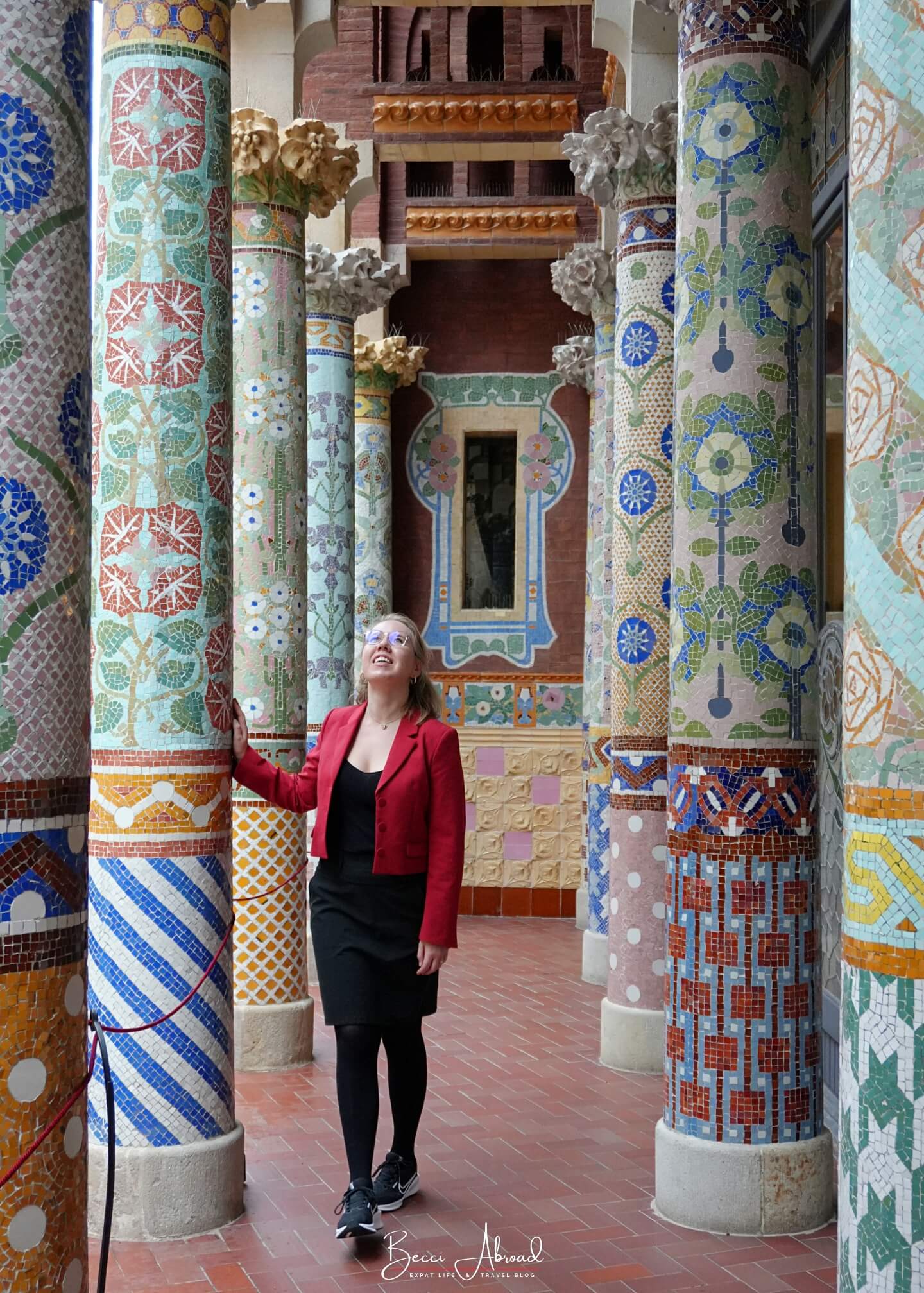
On your way to the main concert hall, you can also visit an outdoor balcony that goes by the name of the “stone garden”, because each of its columns is covered in mosaics representing different flowers.
The balcony is one of the most Instagrammable photo spots in Palau de la Música Catalana, and sometimes you need to have a bit of patience to get a photo in this spot.
In 1997, Palau de la Musica Catalan got UNESCO-listed, and in my opinion, it is one of the most beautiful and impressive landmarks in Barcelona.
You can visit Palau de la Música Catalana with a guided tour, with an audio guide, or by attending an actual concert. Performances range from classical and opera to jazz and flamenco, and tickets on the official website can be surprisingly reasonable!
Admission: Tickets to Palau de la Música Catalana start from around 20 euros for a self-guided or audio-guided visit.
Opening hours:
- Monday to Saturday: from 8:30 am to 9 pm
- Sunday and public holidays: from 8:30 am to 3:30 pm.
Nearest metro: Urquinaona (L1 and L4).
Location: Palau de la Música Catalan, Carrer Palau de la Música 4-6, Sant Pere.
Book your Palau de la Música Catalana entry ticket
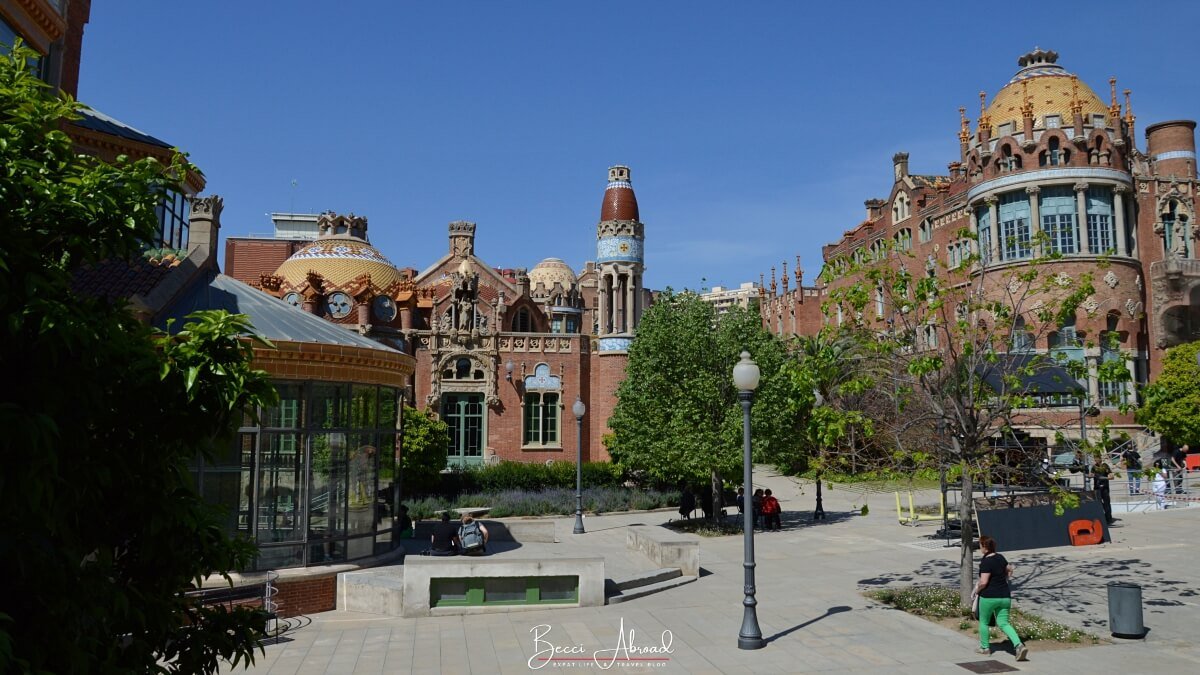
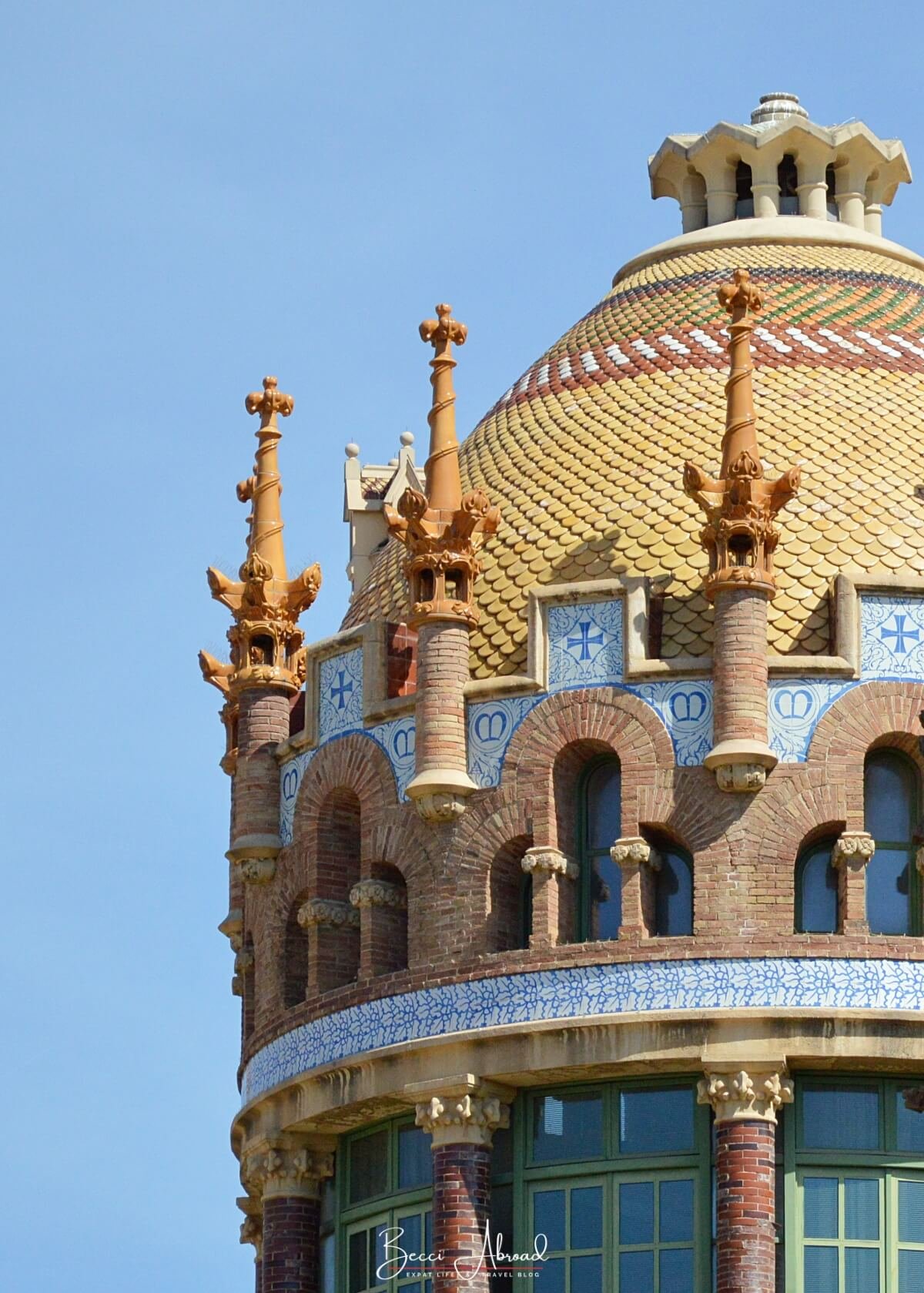
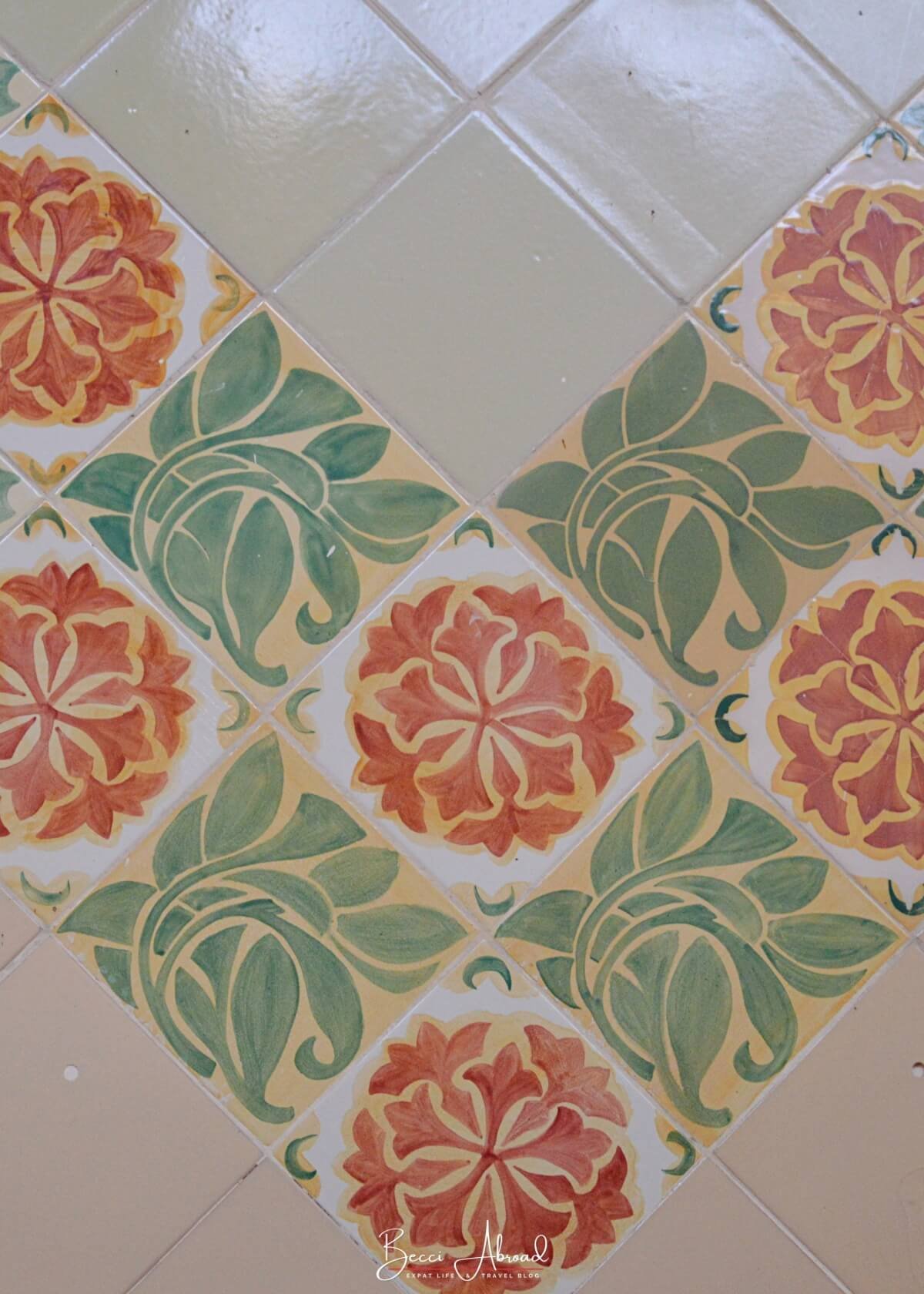
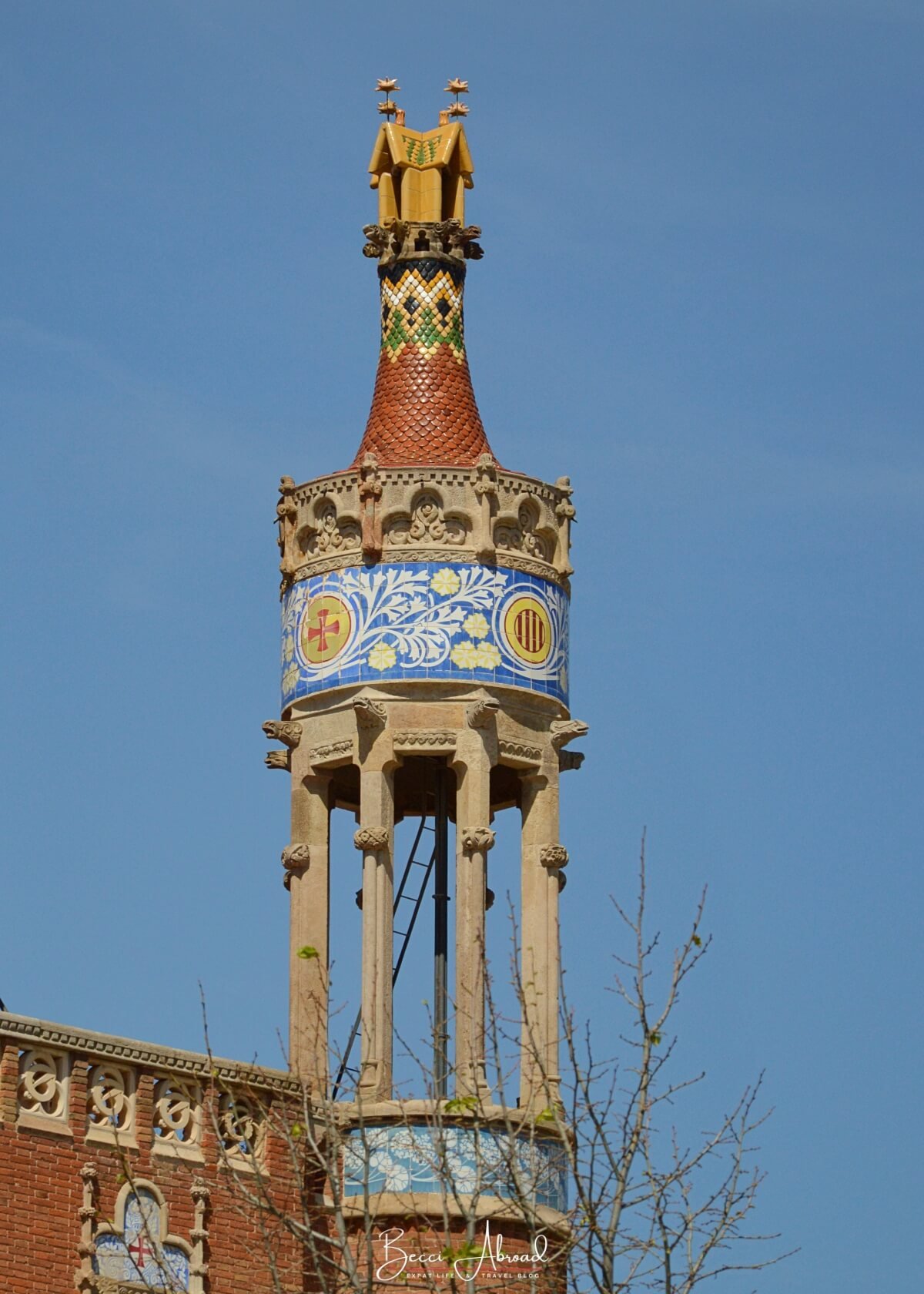
Visit Europe’s Most Beautiful Hospital: Recinte Modernista de Sant Pau
Exploring the Recinte Modernista de Sant Pau is, in my opinion, one of the most underrated things to do in Barcelona. Especially if you love architecture but don’t fancy the crowds in La Sagrada Familia or Casa Batlló!
The Sant Pau Hospital functioned as a working hospital all the way up until 2009, and is made up of beautifully decorated pavilions connected by underground tunnels, all set within peaceful gardens.
This former hospital complex was also designed by Lluís Domènech i Montaner (the same guy as the Palau de la Música Catalana) and was declared a UNESCO World Heritage Site in 1997.
Today it’s a museum and a cultural center with several pavilions being used by local NGOs and civil organizations. When I visited with my mum and stepfather on a Saturday morning, there was a yoga class taking place in the park behind the main building.
Sant Pau is only a 10-minute walk from La Sagrada Família, and it gets a tiny fraction of the visitors!
During the winter season in Barcelona, from late November to early January, Sant Pau hosts Els Llums de Sant Pau, a magical light experience that transforms the whole site after dark.
Admission: Tickets to Sant Pau start from 17 euros for adults. Free on April 23 (Sant Jordi), September 24 (La Mercè), and on the Night of the Museums.
Opening hours:
- Summer (April through October)
- Daily: from 9:30 am to 6:30 pm
- Winter (November through March)
- Daily: from 9:30 am to 5 pm
Nearest metro: Sant Pau | Dos de Maig (L5) or Guinardó | Hospital de Sant Pau (L4).
Location: Sant Pau Hospital, Carrer de Sant Antoni Maria Claret 167, Horta-Guinardó.
Book your ticket to Sant Pau Hospital!
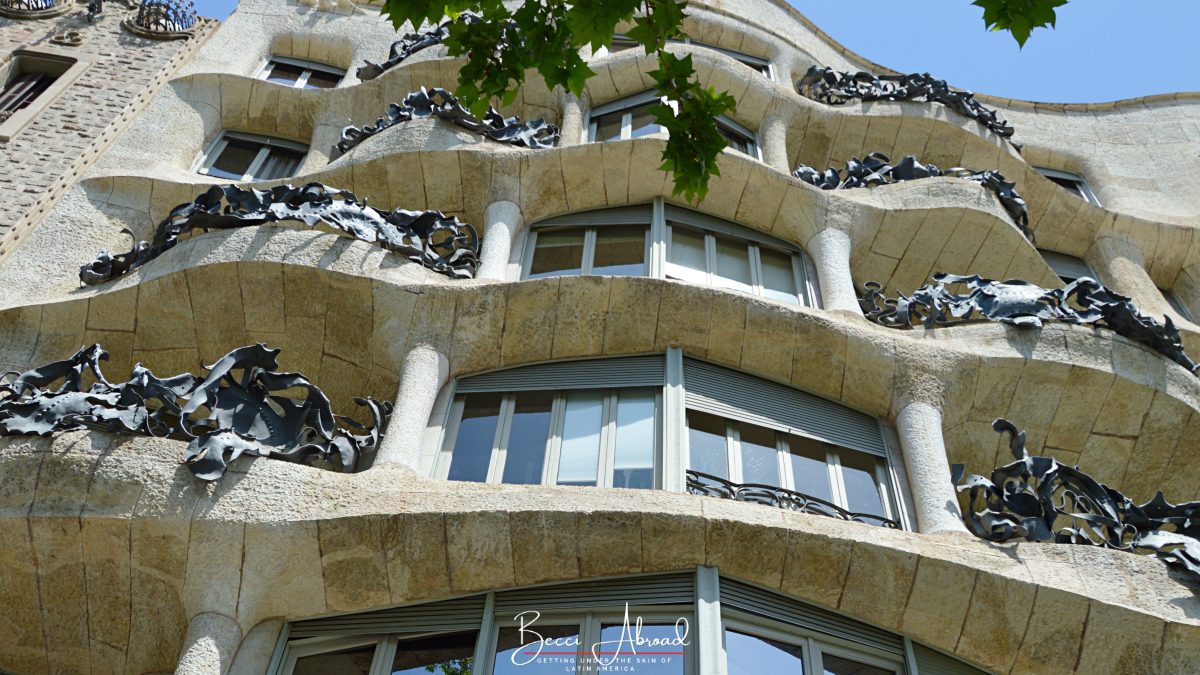
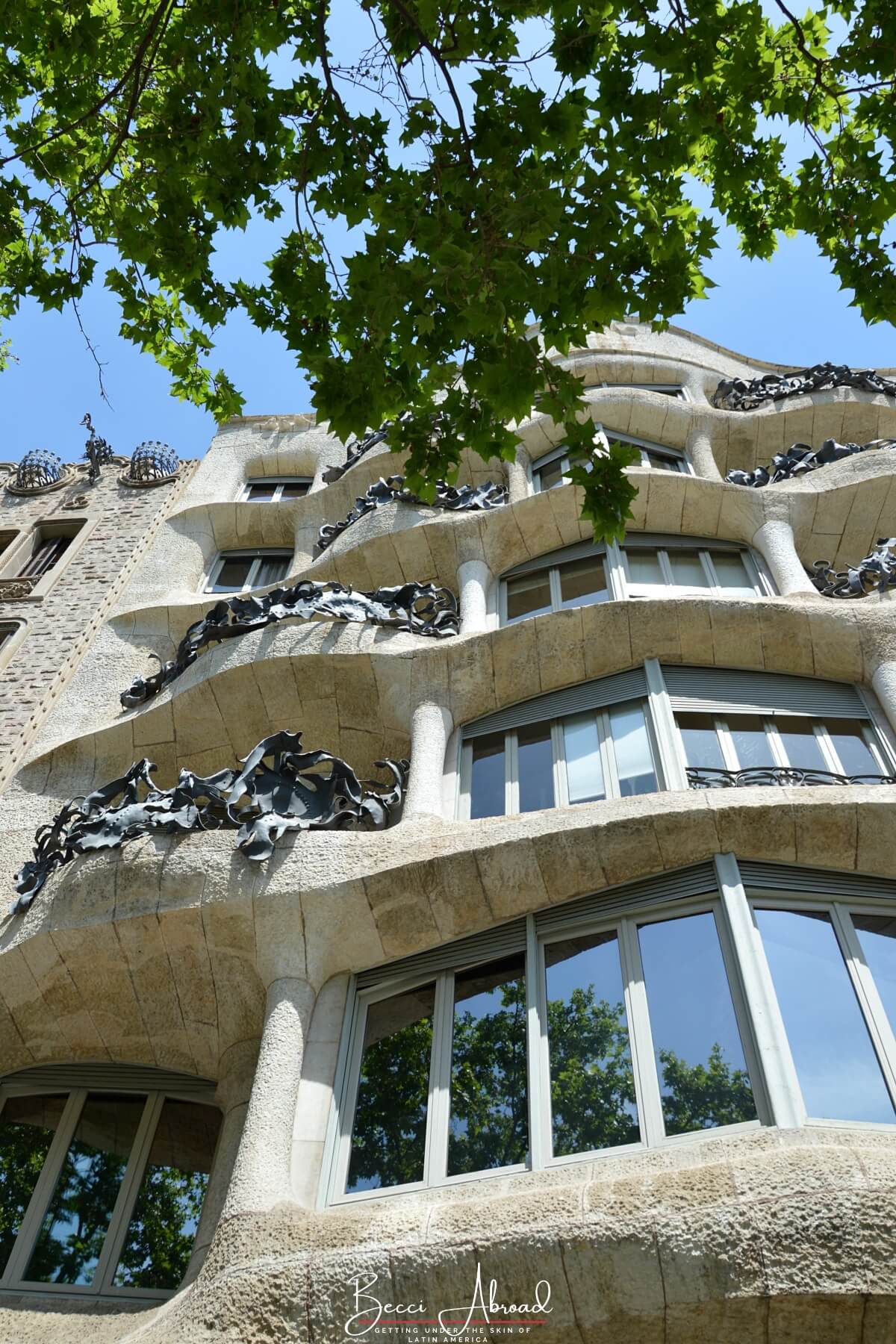
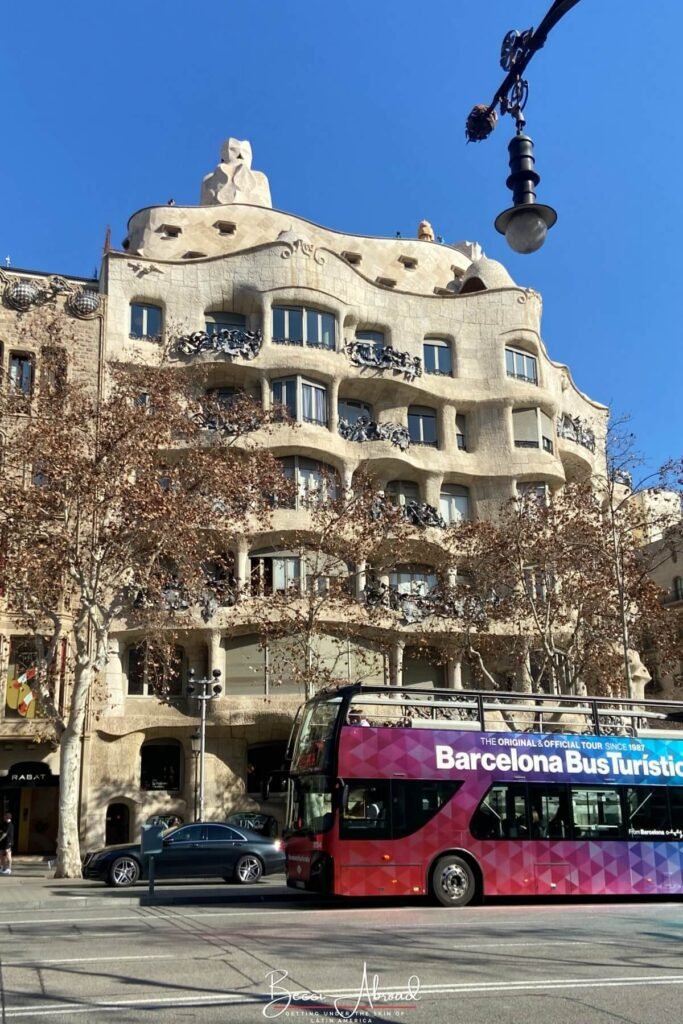
Tour Casa Milà (La Pedrera)
A few blocks up Passeig de Gràcia from Casa Batlló, you will find Casa Milà, better known as La Pedrera.
La Pedrera was Gaudí’s last private residence project, built between 1906 and 1910. The wavy stone façade and wrought-iron balconies became a UNESCO World Heritage Site in 1984, together with Park Güell and Palau Güell.
You can visit the inside of Casa Milà, including the rooftop terrace with its warrior-like chimneys and amazing views over Barcelona.
If you’re short on time or on an entrance-ticket budget? Barcelona’s tickets add up terrifyingly fast, so if you have to choose between the many popular tourist attractions in Barcelona, you can also just stop by Casa Milà from the outside.
The façade with its wavy stones is quite unique to admire from the street, and you can stop by the café on the ground floor for free and grab something to drink.
Personally, I have actually never made it inside Casa Milà (despite having been to Casa Batlló like three times!)
Admission: Tickets to Casa Milà start from 29 euros for adults with the video guide.
Opening hours:
- Summer (March to November)
- Daily: 9 am to 8:30 pm
- Night visits: 8:40 pm to 10:20 pm
- Winter (November to February)
- Daily: 9 am to 6:30 pm
- Night visits: 7 pm to 11 pm
Nearest metro: Diagonal (L3 and L5).
Location: Casa Milà, Passeig de Gràcia 92, Eixample.
Book your tickets to Casa Milà in Barcelona
Discover Gaudí’s First House, Casa Vicens
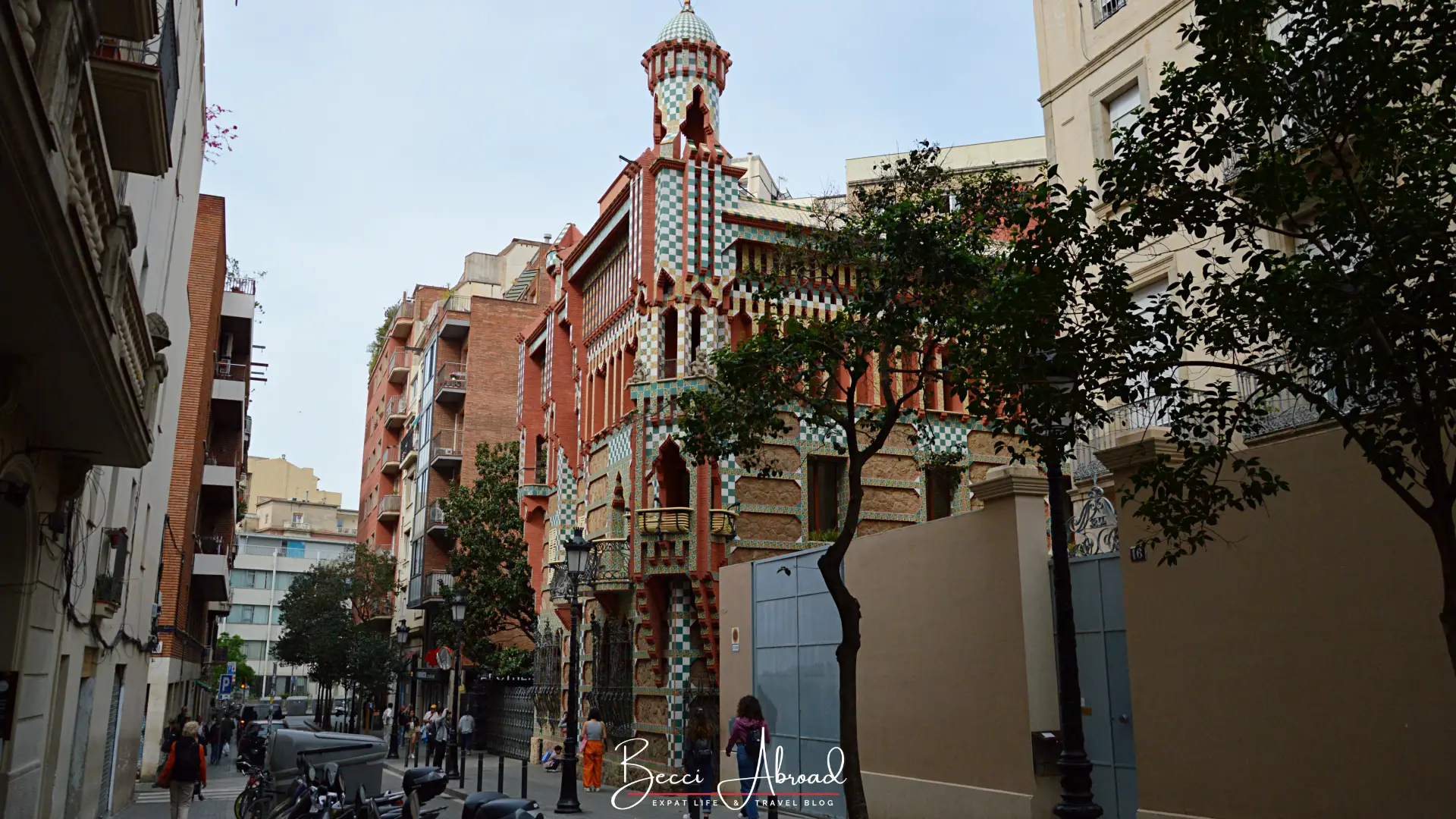
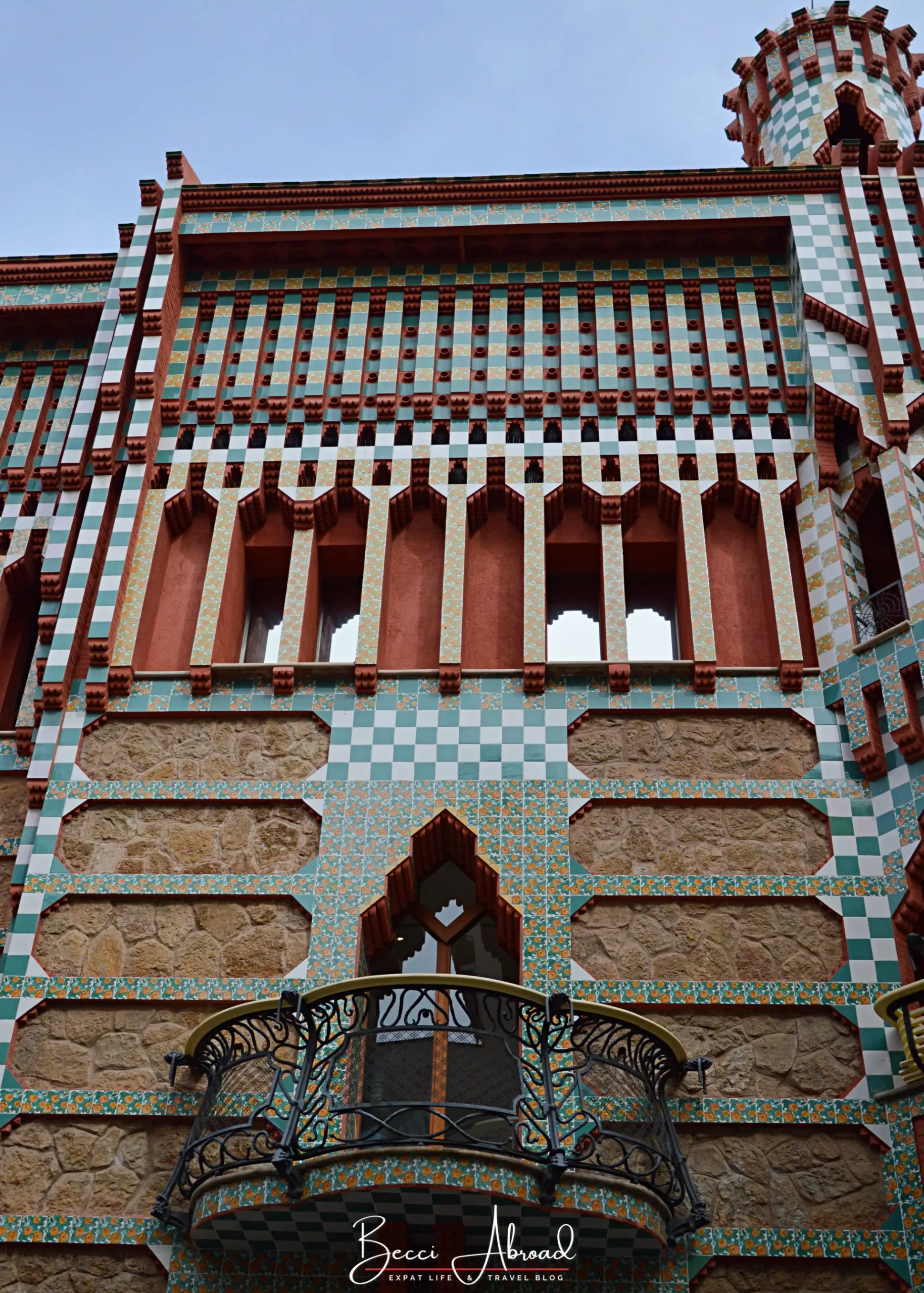
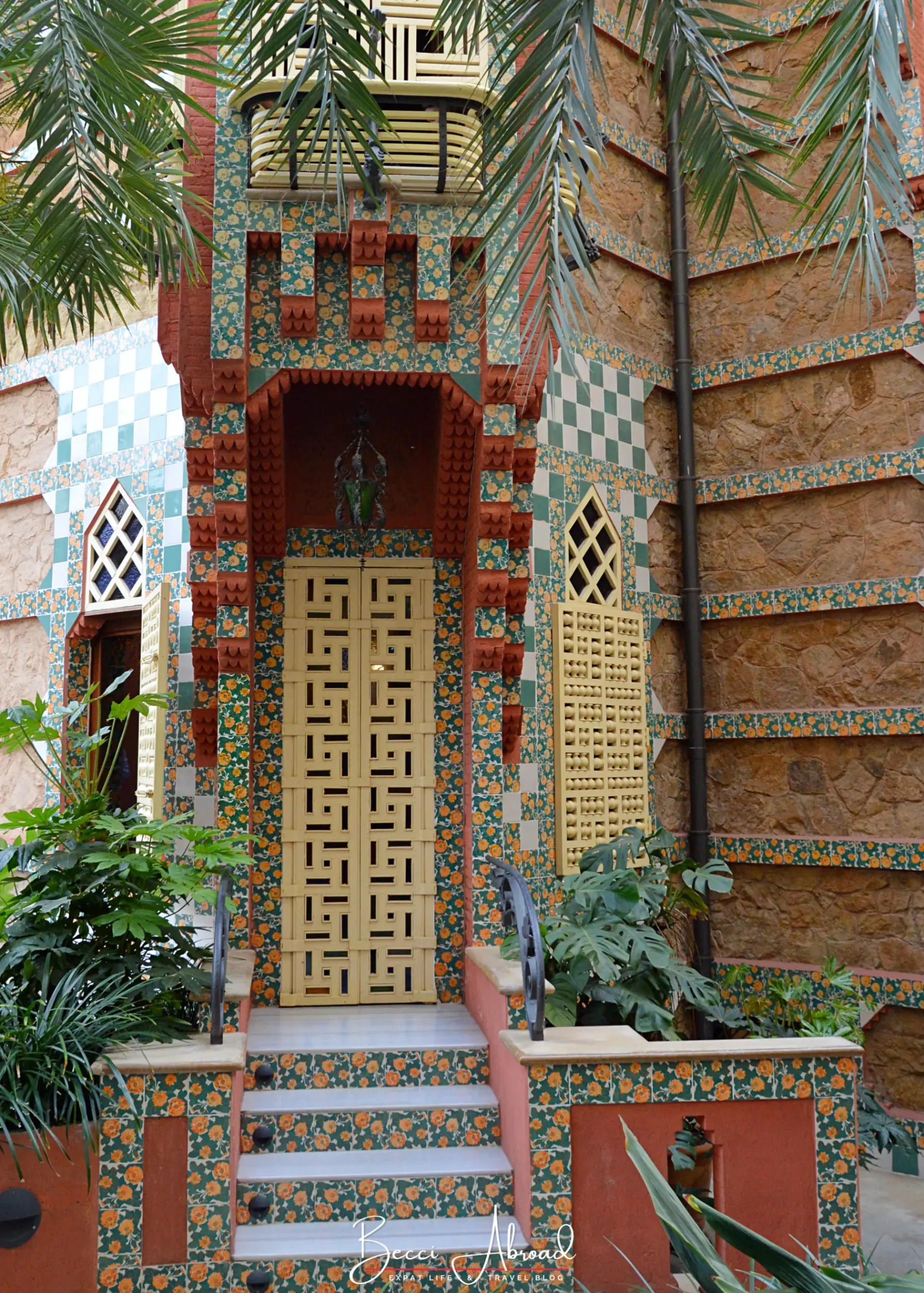
Casa Vicens in the Gràcia neighborhood was Gaudí’s first major project, the building that kicked off his career as a modernist architect.
Casa Vicens was built between 1883 and 1888 for the merchant Manuel Vicens i Montaner, and was declared a UNESCO World Heritage Site in 2005 together with Casa Batlló and the Church of Colònia Güell.
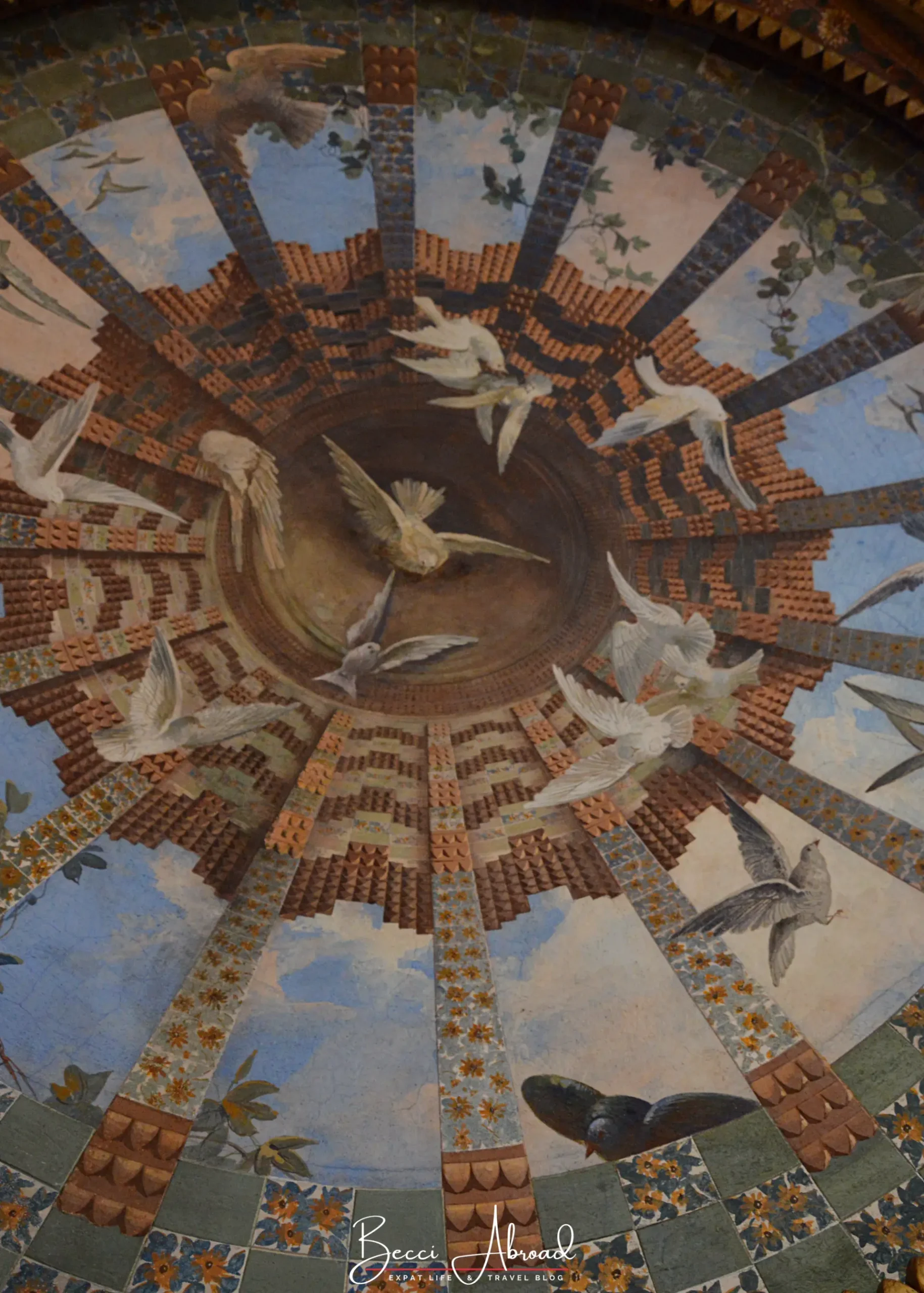
The façade of Casa Vicens is an eye-catching splash of multi-colored tiles with flower motifs and intricate ironwork, and inside each room seems to have its own personality.
At the time of its construction, the house stood freely in the middle of a large garden. The land was sold off over the years, so today only a small part of that garden remains in what is now busy Gràcia.
Casa Vicens is now a museum, and you can freely visit inside the building. Casa Vicens is generally less busy than its more popular brothers, Casa Batlló and Casa Milà. However, it is still a good idea to reserve tickets to Casa Vicens beforehand.
I visited Casa Vicens together with my mum and stepfather the first time they visited us when we had just moved to Barcelona.
While the style of Casa Vicens is notably different from that of, for example, Casa Batlló, you can still see some of the inspiration and characteristics that Gaudí later would develop in Casa Batlló and La Sagrada Família.
Admission: Tickets to Casa Vicens start from 22 euros for adults, including an audioguide.
Opening hours:
- Summer (March to October)
- Daily from 9 am to 8 pm
- Winter (November to February)
- Daily from 9 am to 6 pm.
Nearest metro: Fontana (L3)
Location: Casa Vicens, Carrer de les Carolines, 20-26, Gràcia
Book your tickets to Casa Vicens in Barcelona
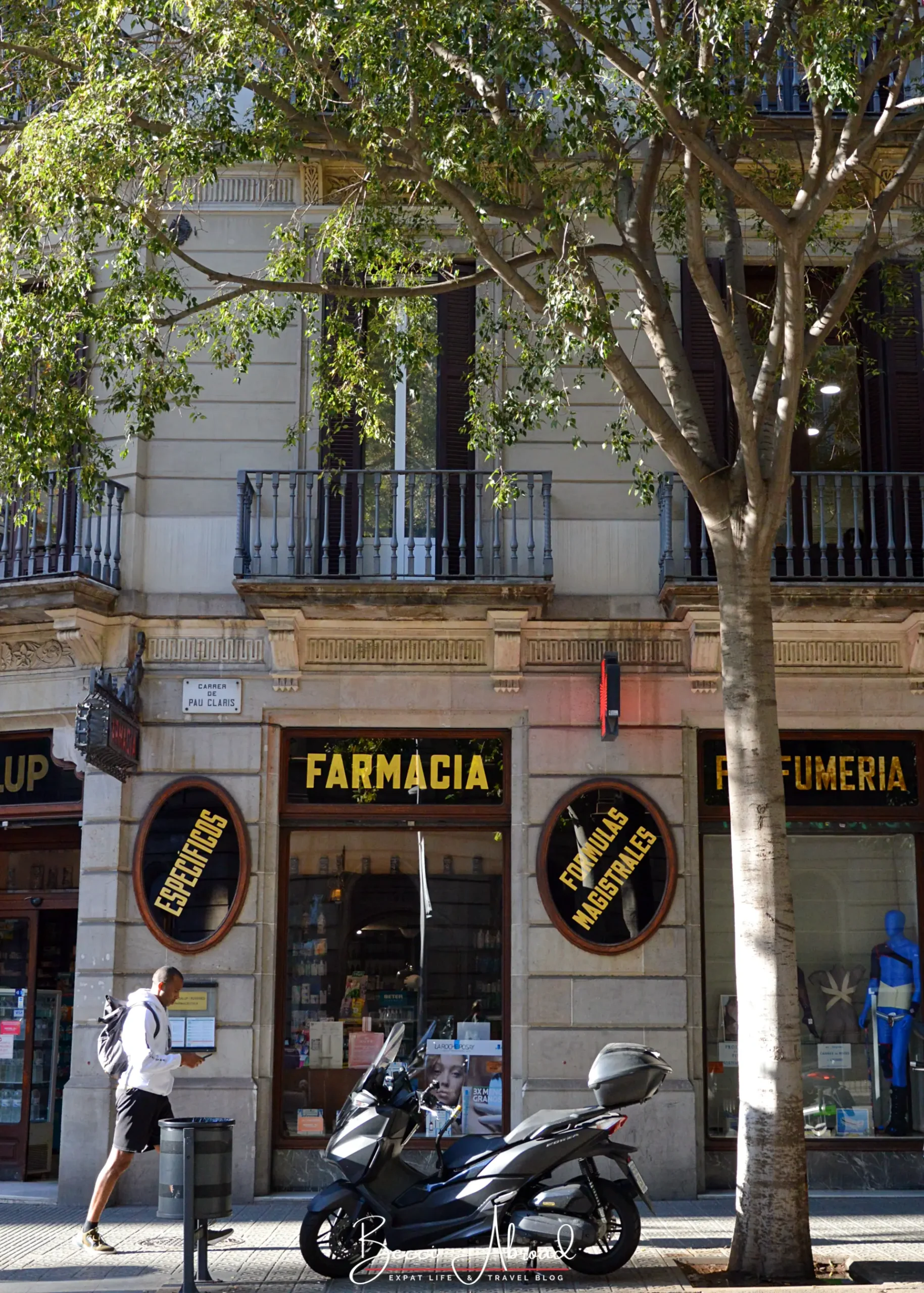
Admire the Beautiful Architecture in the Eixample District
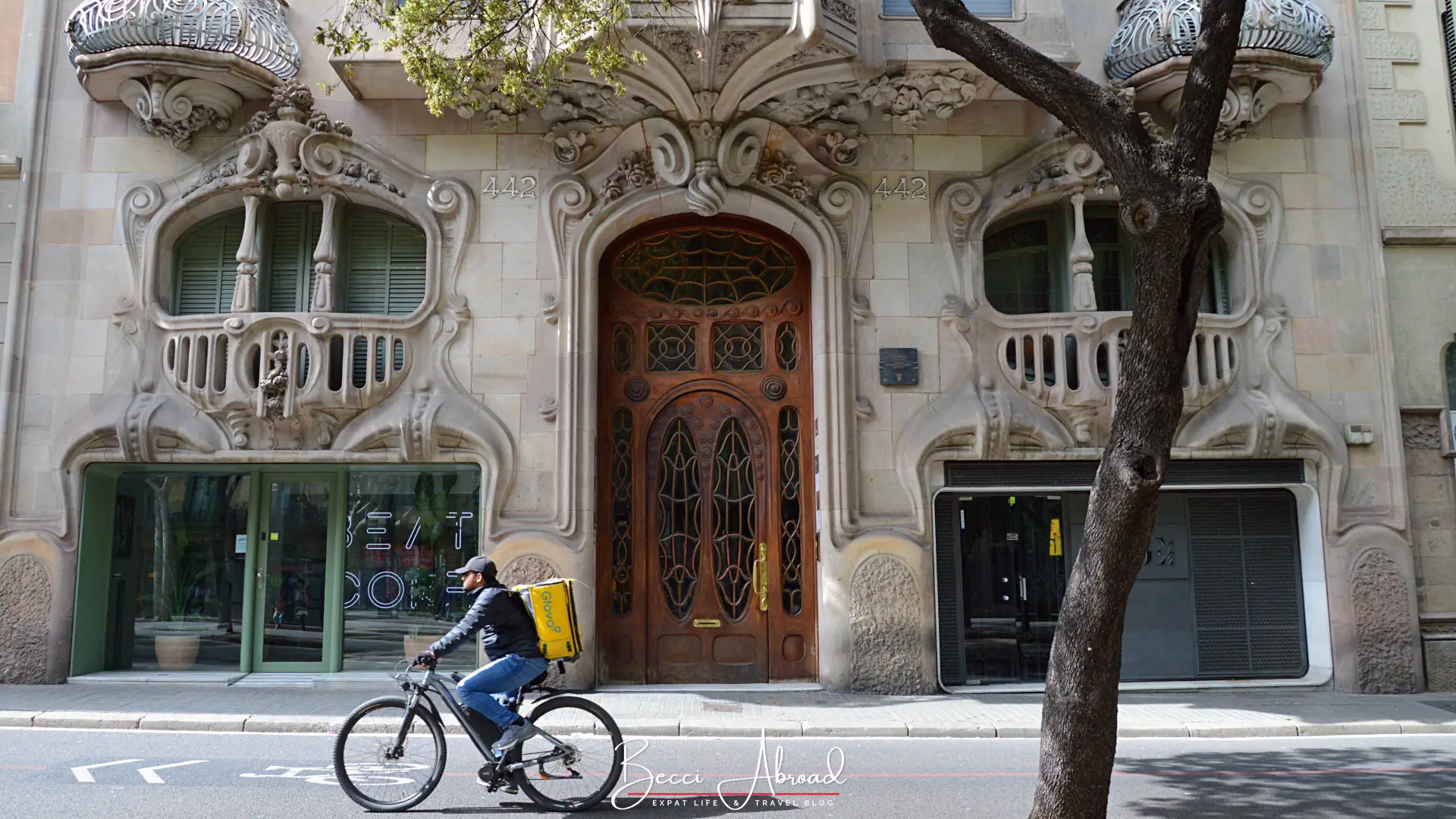
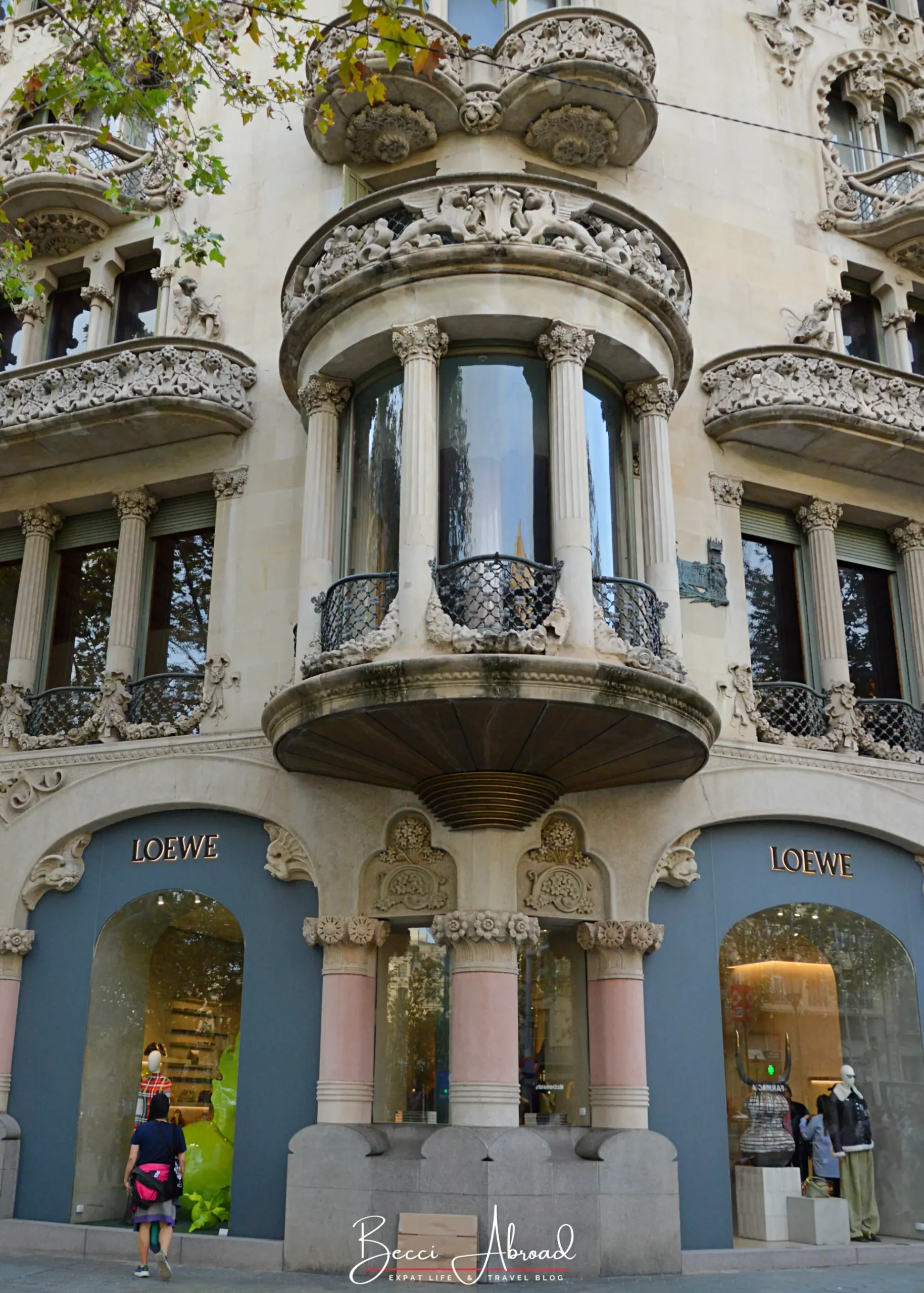
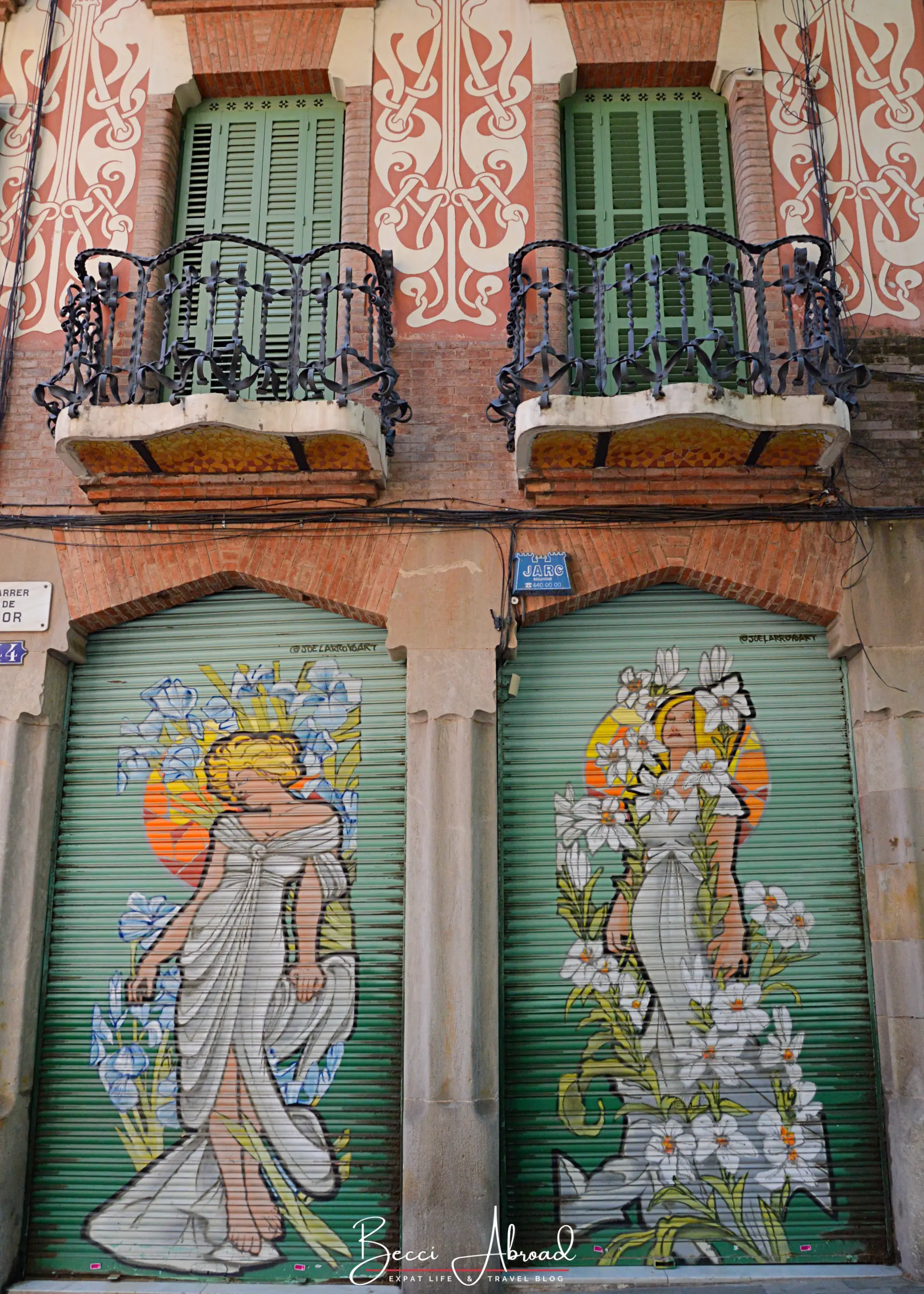
The Eixample is the elegant grid-planned district built in the nineteenth century, when Barcelona finally expanded beyond its medieval walls. Today it is an open-air museum of modernist architecture.
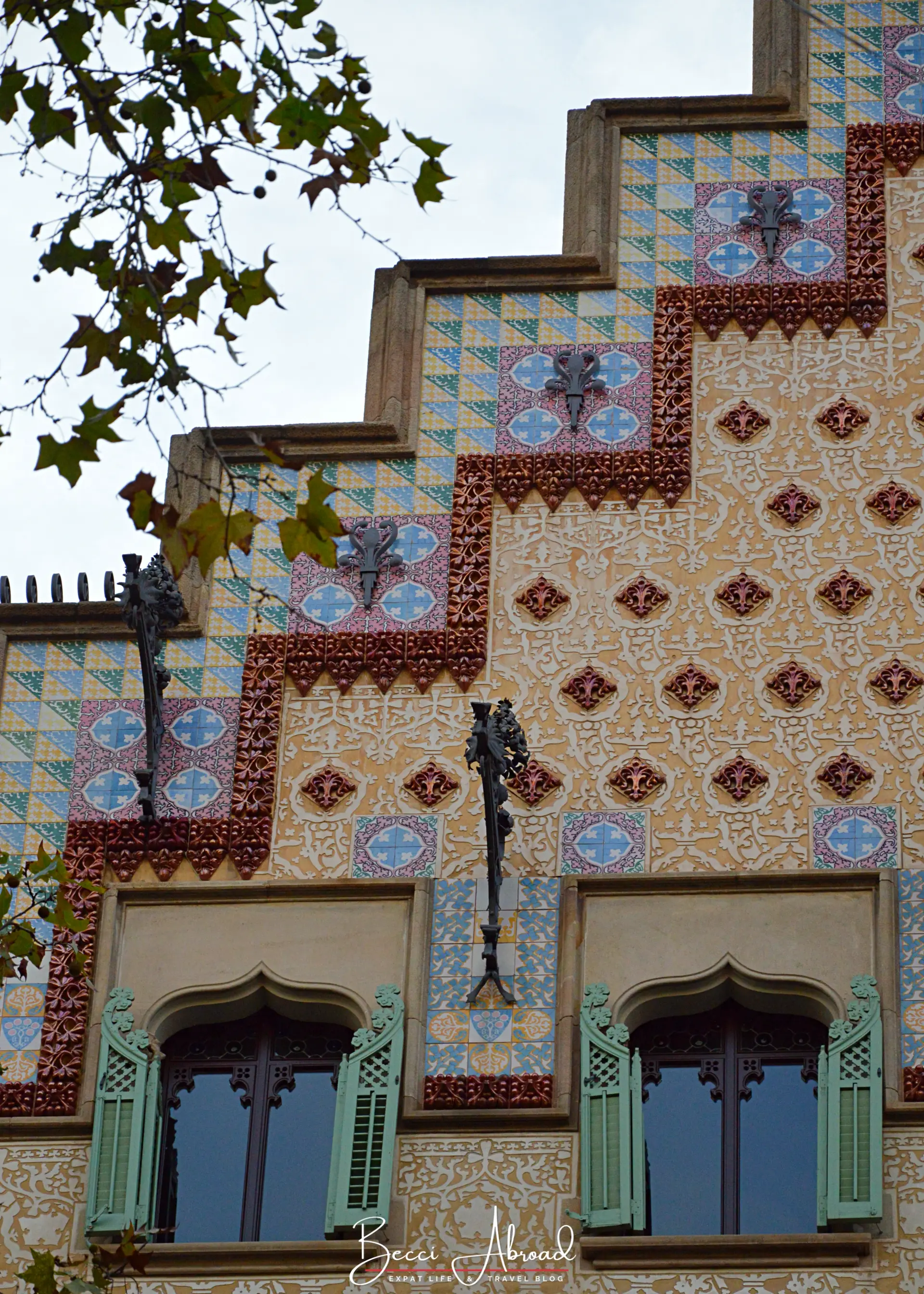
Casa Batlló and Casa Milà get all the fame, but strolling the Eixample’s wide avenues and small side streets, you will spot Casa Amatller right next door to Casa Batlló, plus Casa Lleó Morera (my favorite!), Casa Malagrida, and dozens of lesser-known gems.
The block holding Casa Batlló, Casa Amatller, and Casa Lleó Morera is nicknamed the Illa de la Discòrdia, the “Block of Discord”, because three rival architects built three wildly clashing houses side by side.
And look down while you walk! The hexagonal pavement tiles under your feet on Passeig de Gràcia were designed by Gaudí himself.
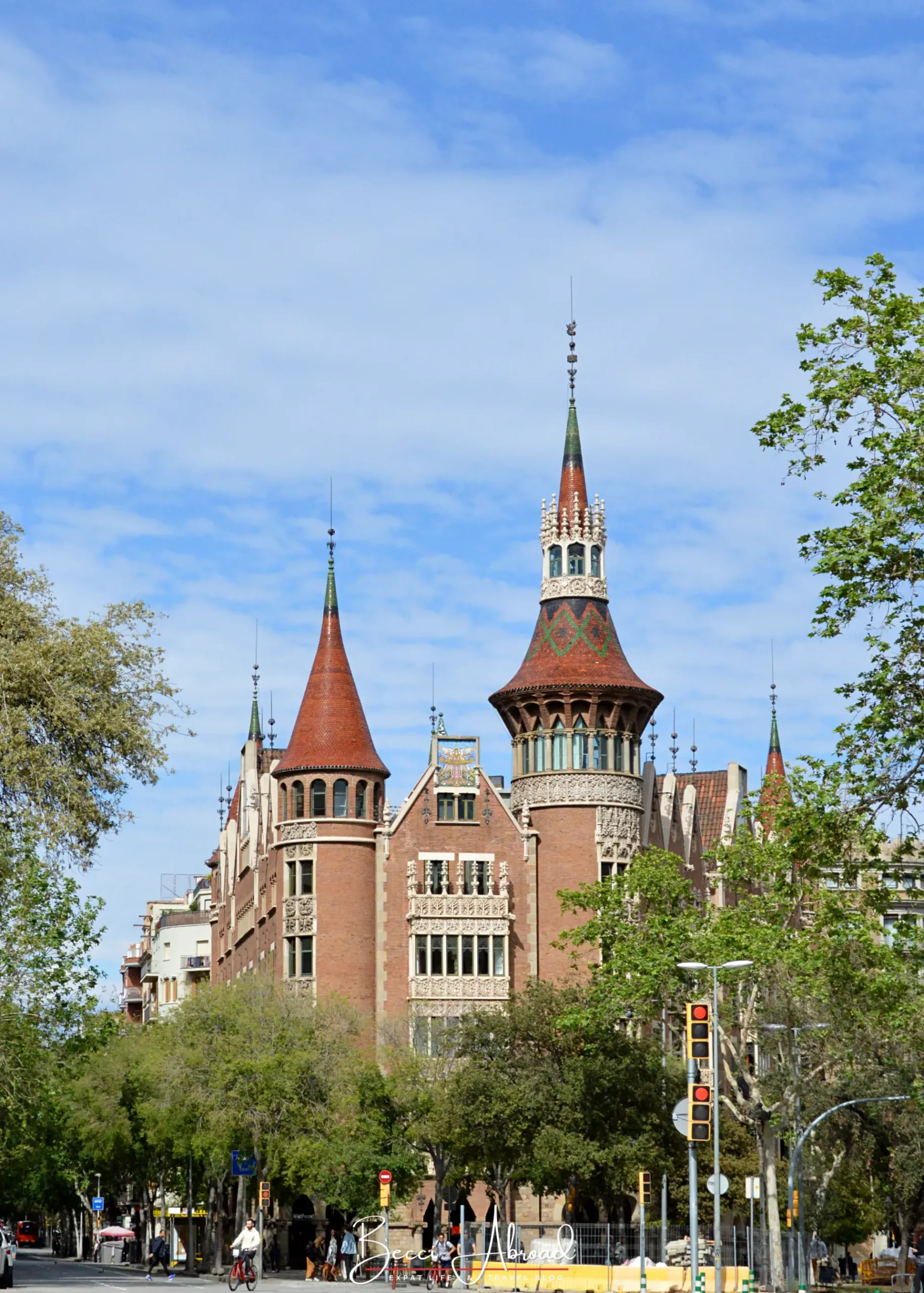
A stone’s throw from Passeig de Gràcia, you can find two of my favorite lesser-known buildings in Barcelona: Casa Comalat, a unique modernist building with a colorful mosaic facade, and Casa de les Punxes, a castle-looking modernist building on Avenida Diagonal.
Eixample is also one of the most popular places for locals to meet up for a cana (small glass of beer) after work or on weekends. Two popular streets for exploring beautiful modernist architecture and local tapas bars are Carrer d’Enrique Granados and Rambla de Catalunya (which is not the same as the infamous “La Rambla” street we’ll get to later).
I used to walk down Passeig de Gràcia on my way to work when I lived in Barcelona, and it’s like you always find something new to watch.
Historic Barcelona & the Old Town
Now let’s leave the modernist masterpieces behind and go back about two thousand years, into the oldest part of Barcelona.
Get Lost in the Gothic Quarter
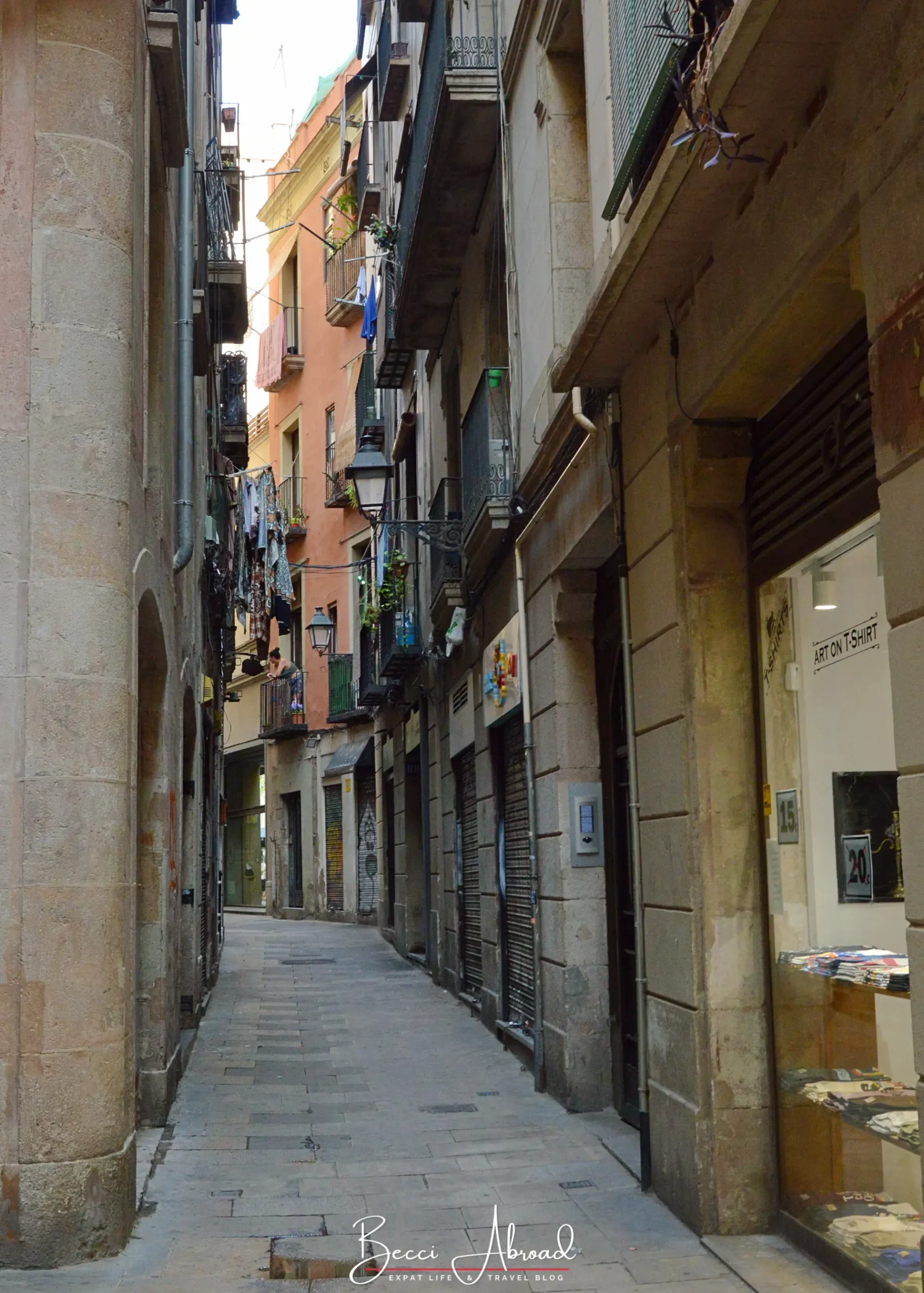
Wandering the narrow alleys of the Gothic Quarter, or Barri Gòtic in Catalan, is one of the most popular things to do in Barcelona!
The Gothic Quarter is the oldest neighborhood in the city, built directly on top of the original Roman settlement, and parts of the area date back over 2,000 years.
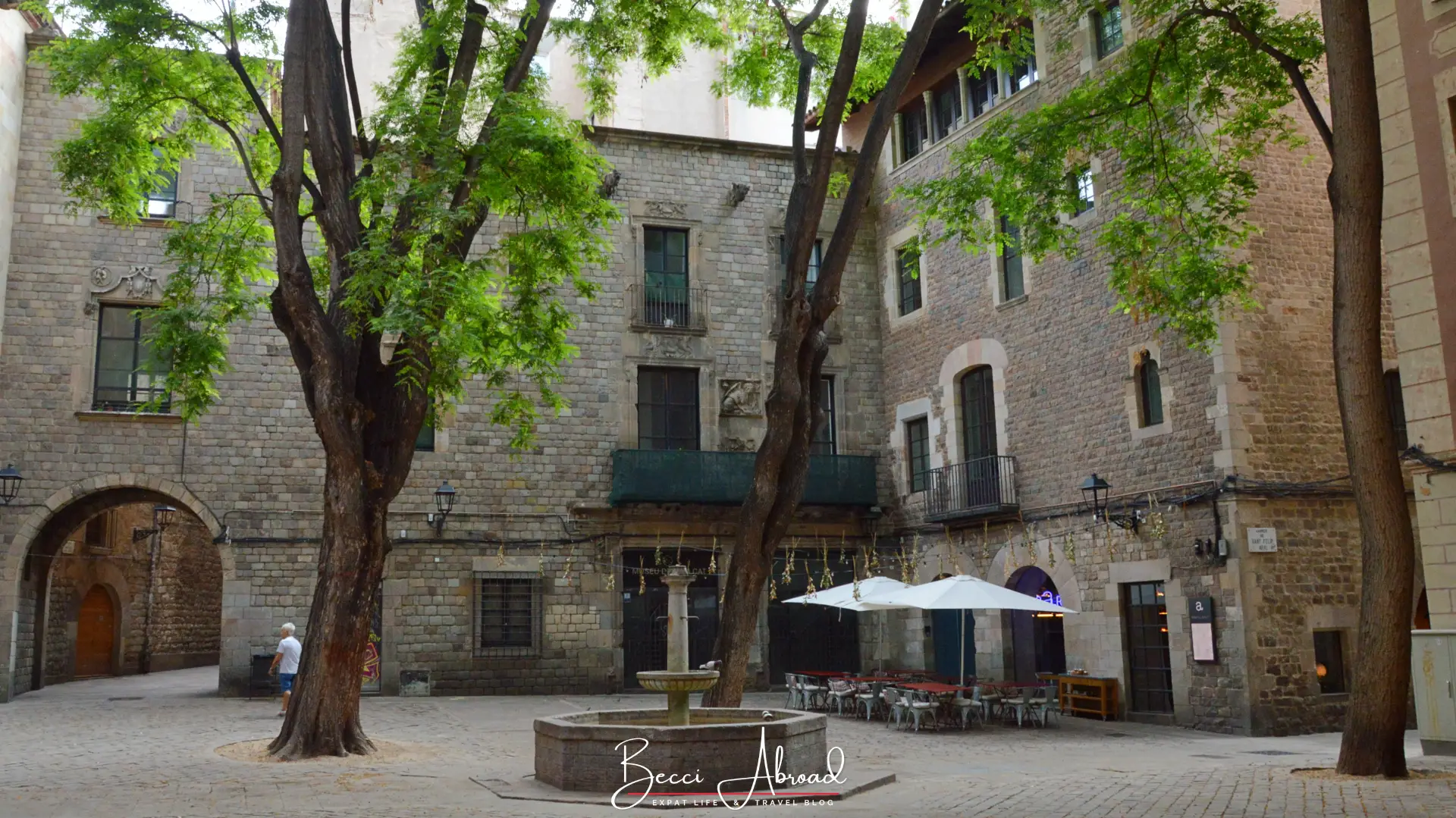
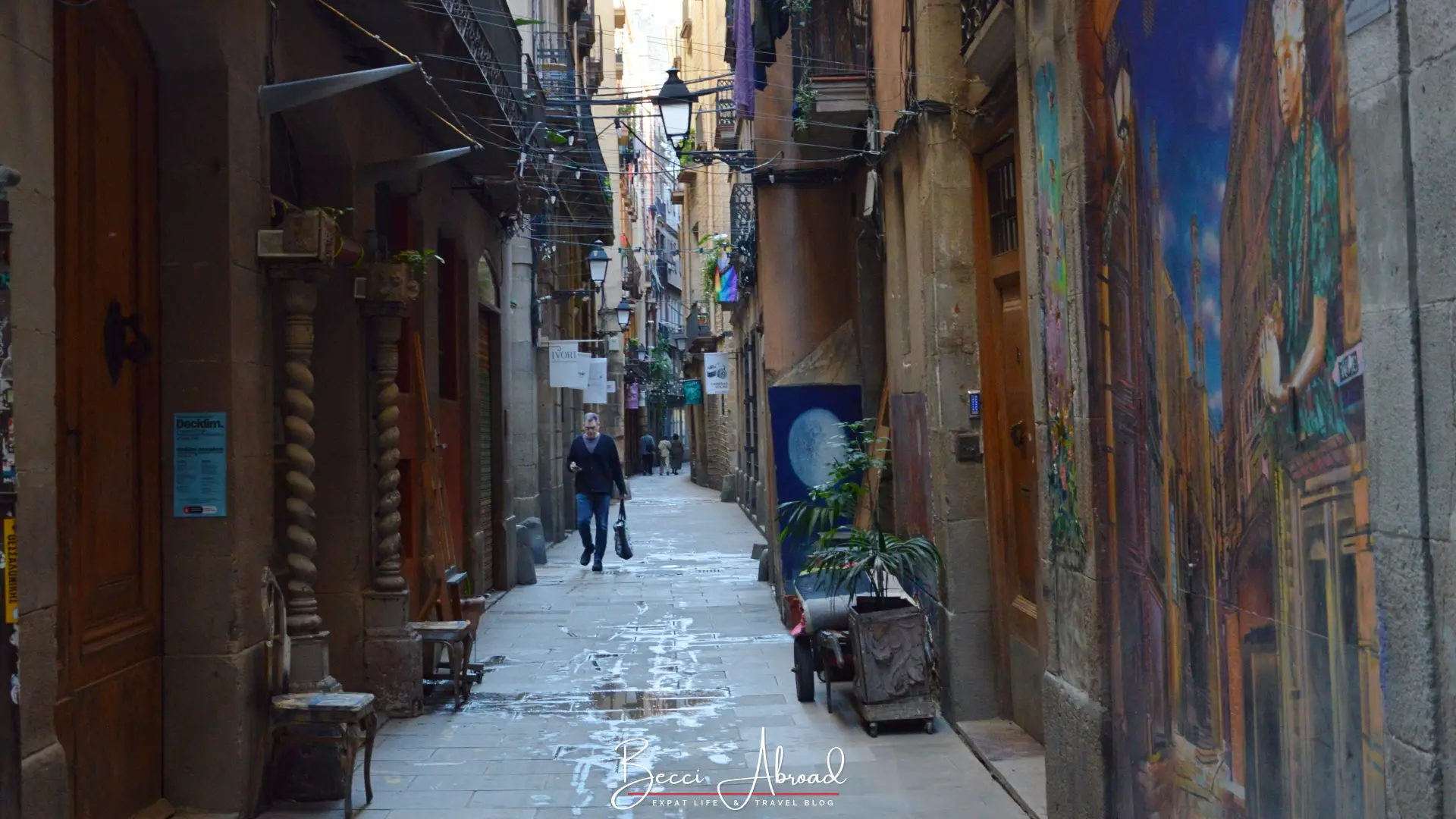
The Gothic Quarter feels like a maze of cobblestone streets, medieval buildings, hidden courtyards, and small artisan shops that seem frozen in time.
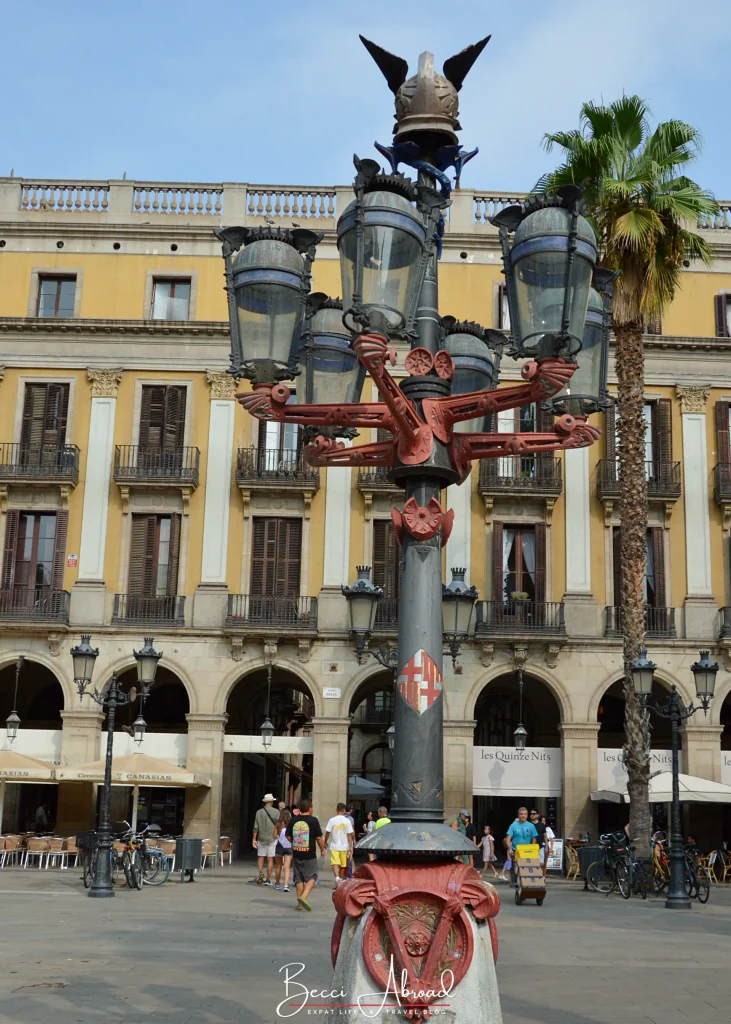
In the Gothic Quarter, just off La Rambla, you’ll also find Plaça Reial, a palm-lined square with Gaudí-designed lampposts. Plaça Reial is a perfect spot for people-watching, but I would definitely not recommend eating there as it is very touristy!
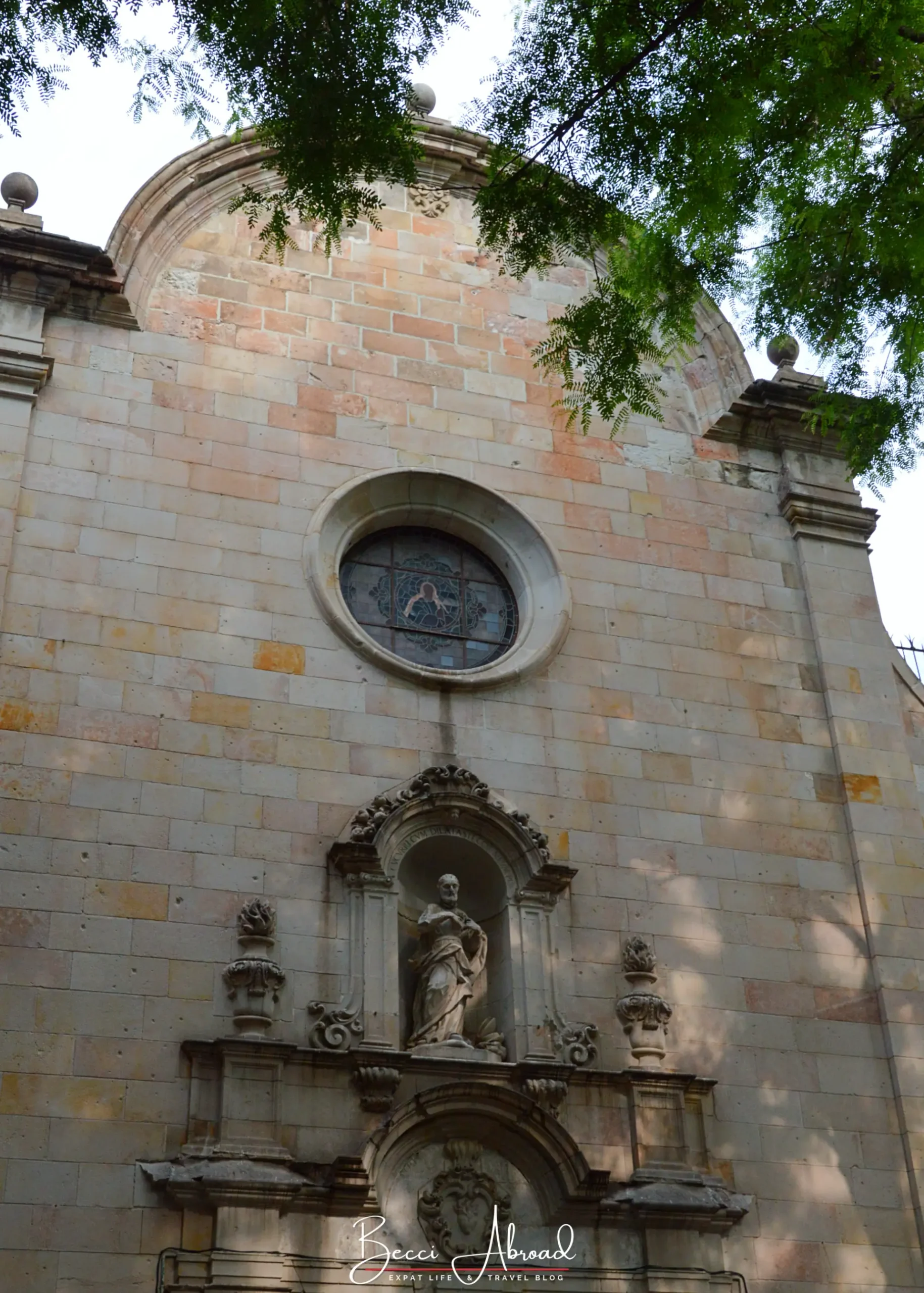
The Gothic Quarter offers many historical buildings and squares, including the Basilica of Santa Maria del Pi, a thirteenth-century Gothic church, Plaça Sant Jaume, the political heart of the city since the fourteenth century, and home to Casa de la Ciutat, Barcelona’s town hall.
At Barcelona’s Historical Museum, Museu d’Història de Barcelona (MUHBA), you can learn about the city’s historic development and walk through the excavated remains of the Roman city underneath the modern city of Barcelona.
There are so many different things to do and see in the Gothic Quarter, but I have to be honest; the Gothic Quarter always leaves me with mixed feelings.
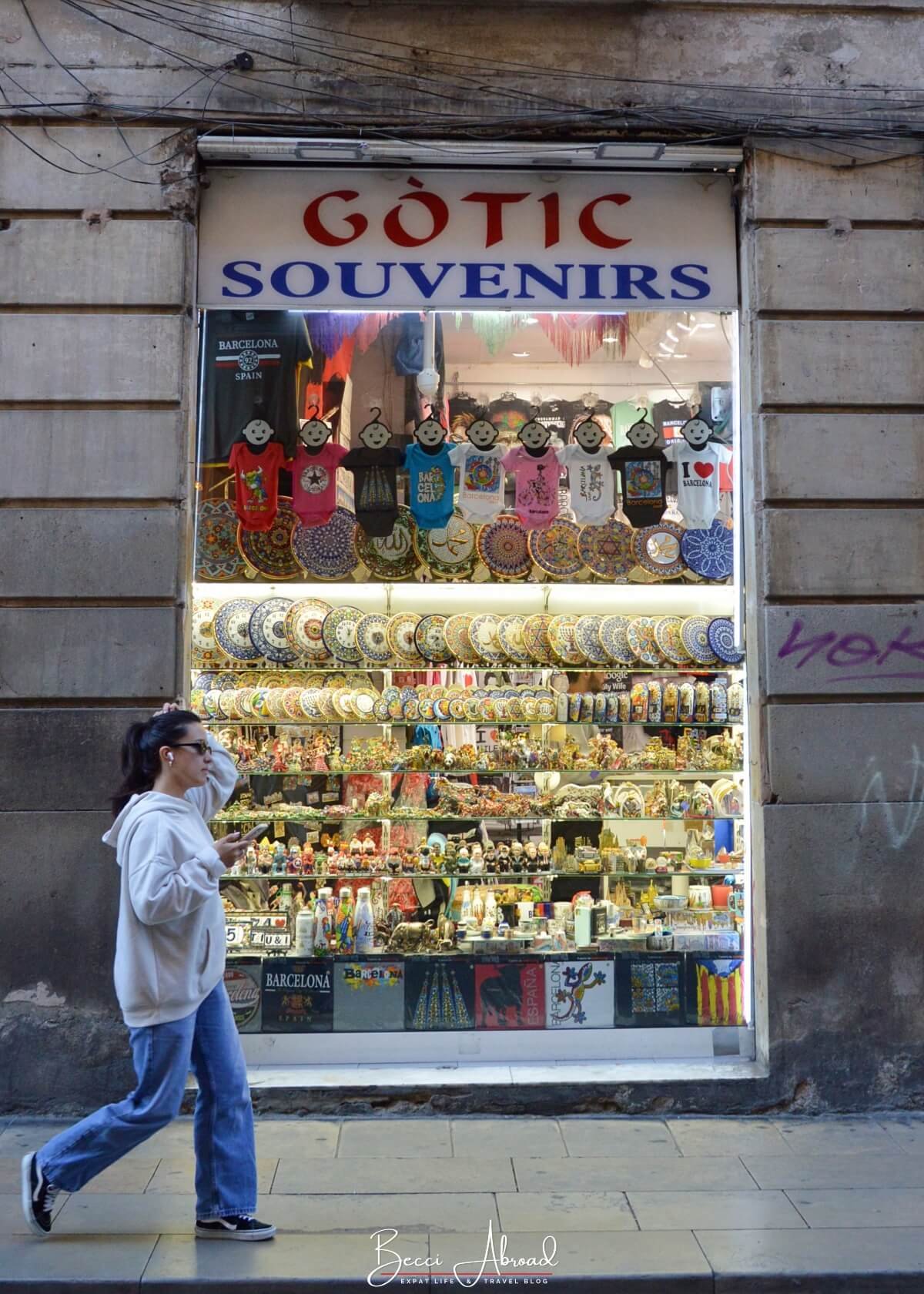
The neighborhood is one of the most beautiful and atmospheric parts of Barcelona, but the Gothic Quarter is also one of the most touristy and crowded areas of the city. The narrow streets and main squares can feel uncomfortably packed with tour groups and souvenir shops.
So, my clear recommendation is to visit the Gothic Quarter early in the morning before the crowds arrive, and it is not a neighborhood that I would recommend staying in for your trip to Barcelona.
Nearest metro: Jaume I (L4) or Liceu (L3).
Location: The Gothic Quarter is located between La Rambla and Via Laietana.
Book a walking tour of the Gothic Quarter
Visit Barcelona’s Cathedral
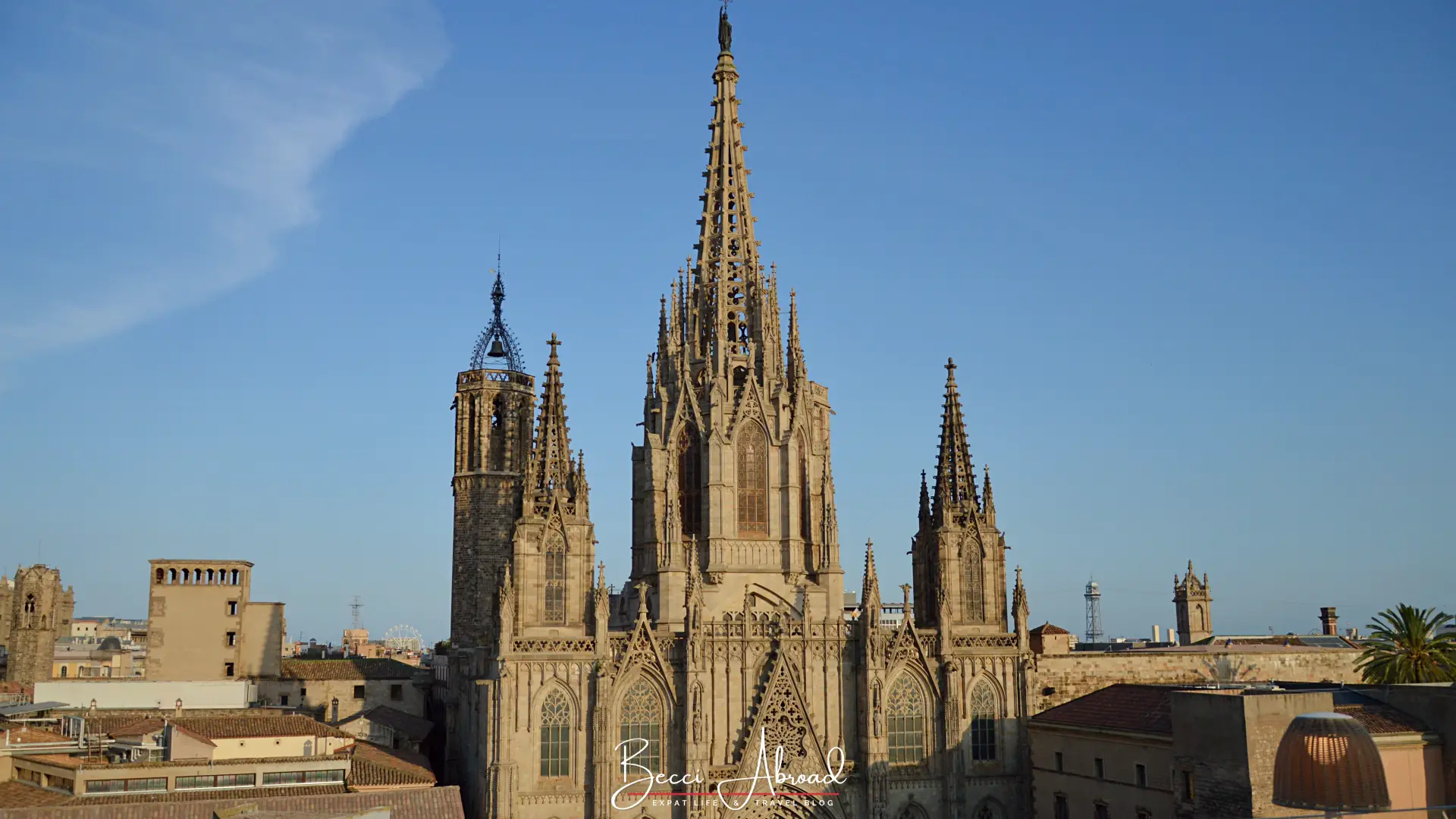
The main attraction in the Gothic Quarter is the Barcelona Cathedral, properly called the Catedral de la Santa Creu i Santa Eulàlia.
The cathedral in Barcelona looks like a beautiful medieval church. And yes, the bulk of it is medieval, but the famous spiky facade you photograph from Plaça Nova was actually not finished until 1913!
Construction of the Gothic cathedral began on 1 May 1298, and the main body and cloister were largely finished by 1448.
But the west facade stayed plain and unfinished for over 400 years, until a banker named Manuel Girona i Agrafel paid to have it completed in 1882–1913, following the fifteenth-century design that had simply never been built.
So, it is funny to think that the most “medieval-looking” part of the Cathedral is younger than parts of Sagrada Família!
You can visit inside the cathedral and even climb to the top of its roofs for a beautiful view over Barcelona’s old town.
Admission: Tickets to Barcelona’s Cathedral start at 16 euros for adults.
Opening hours:
- Monday to Friday: from 9:30 am to 6:30 pm
- Saturdays: from 9:30 am to 5:15 pm
- Sundays and public holidays: from 2 pm to 5 pm
Nearest metro: Jaume I (L4).
Location: Barcelona Cathedral, Plaça Nova, Gothic Quarter.
Book your visit to the Barcelona Cathedral
Snap a Photo at the Kissing Lips Mural
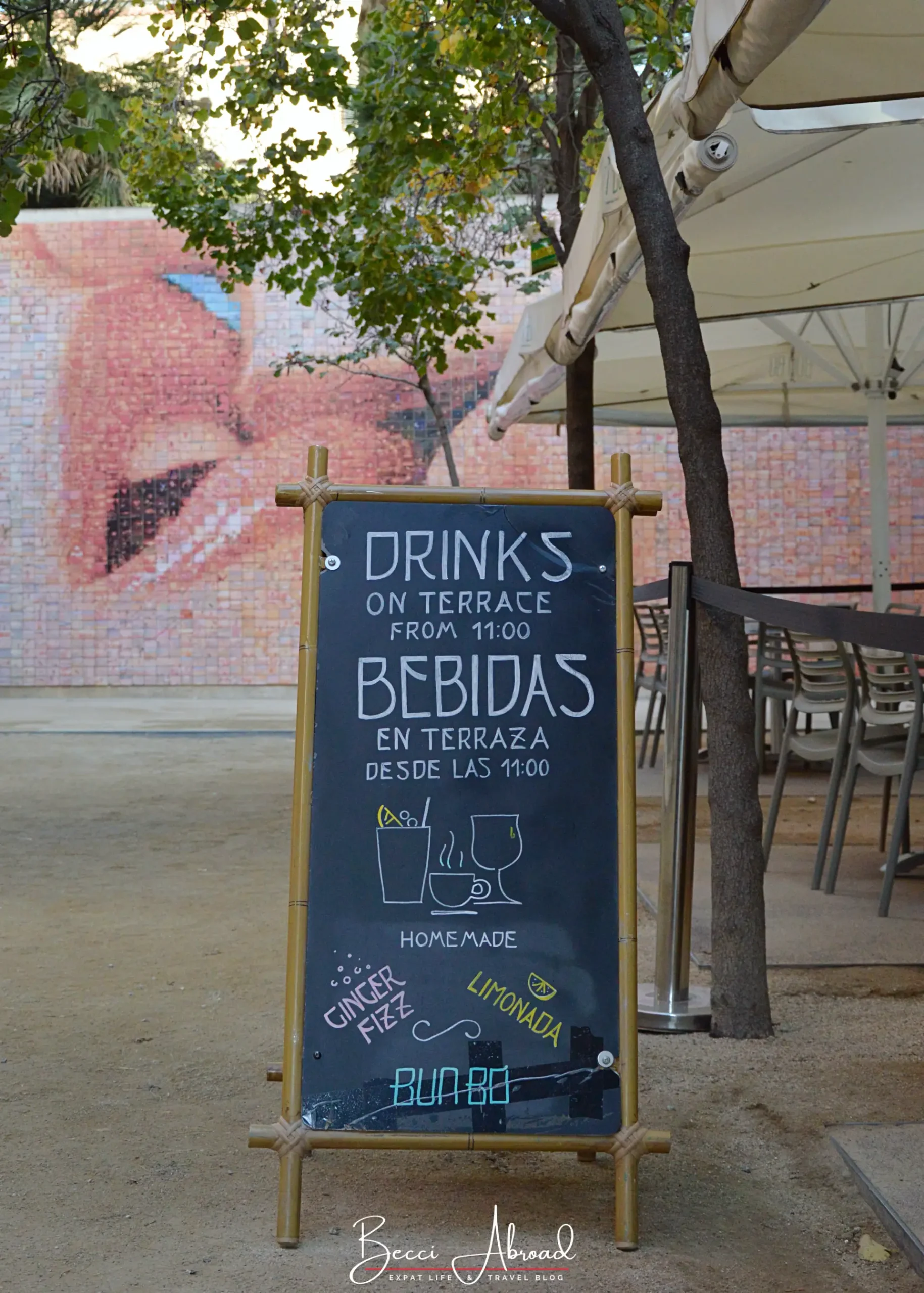
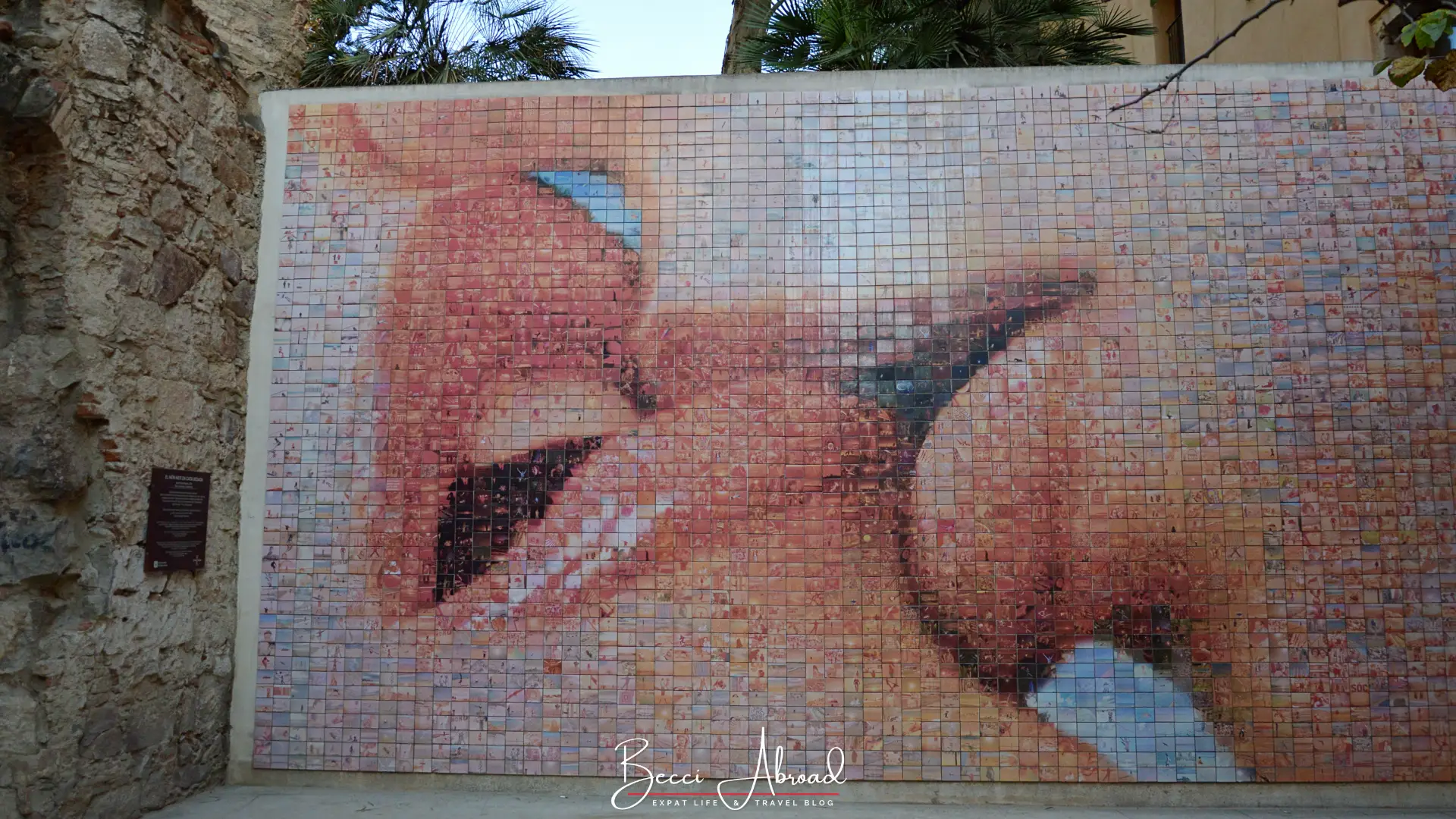
Tucked away on a small square, Plaça d’Isidre Nonell, in front of the Cathedral, you’ll find one of Barcelona’s most well-known (and most photographed) street art murals: the Kissing Lips Mural.
The Kissing Lips Mural is a bit of a different street art mural since it is made of a mosaic of photographs.
From a distance, it looks like one huge, romantic photograph of two people kissing, painted straight onto the side of the building.
Get closer, though, and the illusion falls apart in the best possible way. The whole image is actually a photomosaic, made up of around 4,000 tiny individual photographs from Barcelona residents, who submitted their own personal photos for the project.
The mural is called El Món Neix en Cada Besada in Catalan, which translates to “The World Begins With Every Kiss“, and was created in 2014 by the artist Joan Fontcuberta.
Fontcuberta created the mural together with the ceramicist Antoni Cumella, who printed the photographs onto individual ceramic tiles.
The mural was unveiled to mark the 300th anniversary of the Siege of Barcelona in 1714, the event Catalonia still commemorates every year on Catalonia’s National Day on September 11th, called La Diada.
Nearest metro: Jaume I (L4) or Liceu (L3).
Location: Kissing Lips Mural, Plaça d’Isidre Nonell, Gothic Quarter.
Take photos of Pont del Bisbe
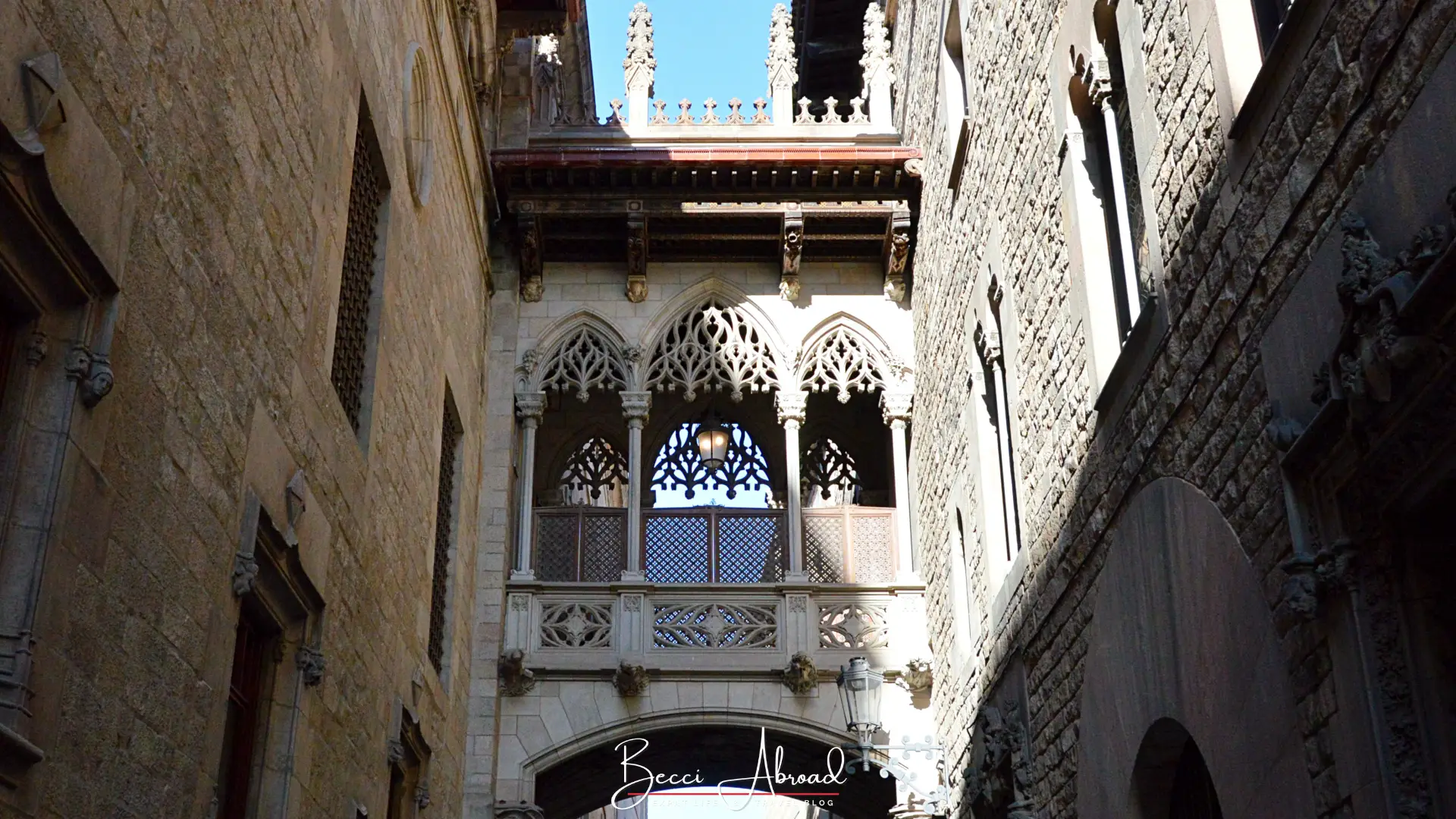
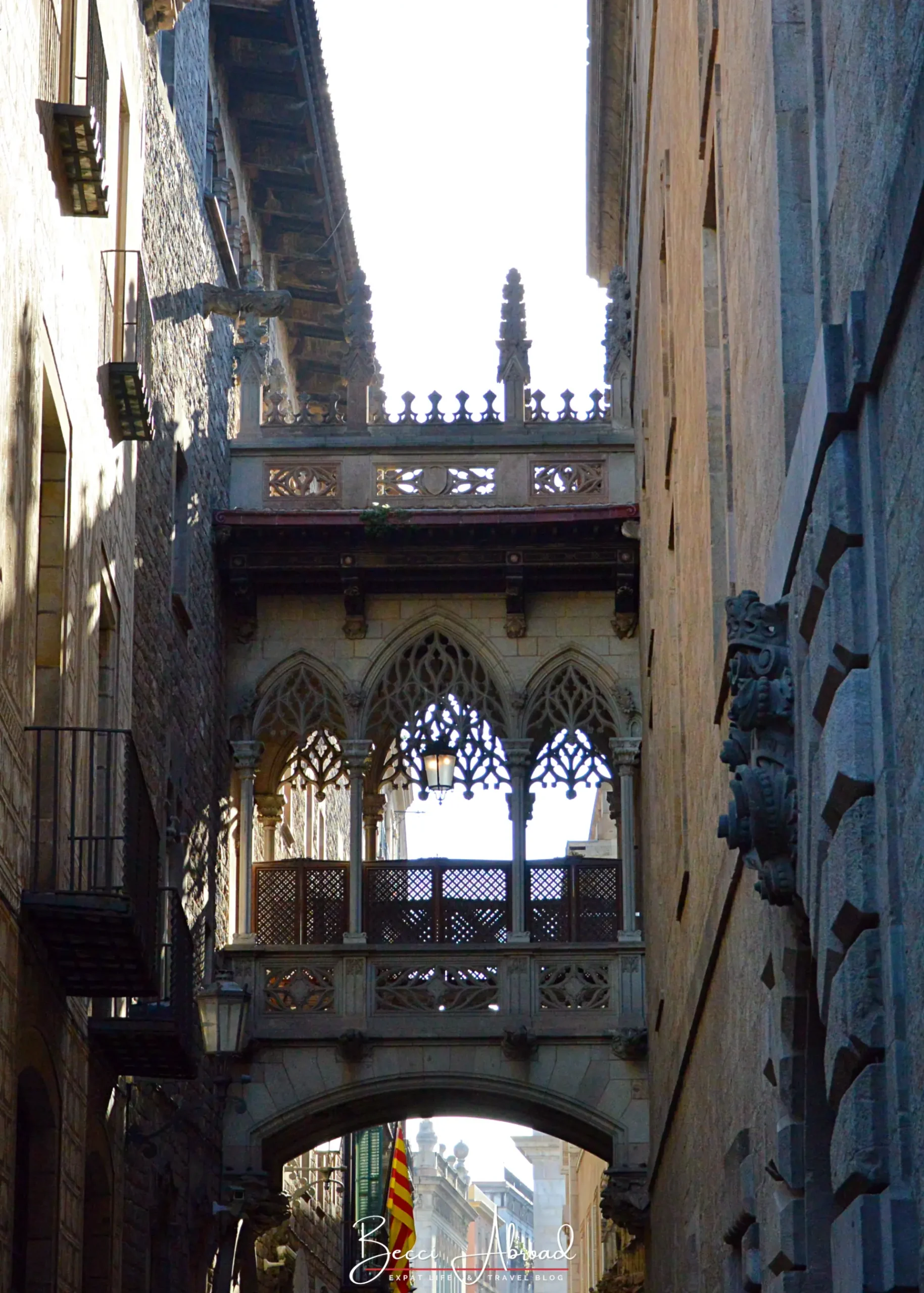
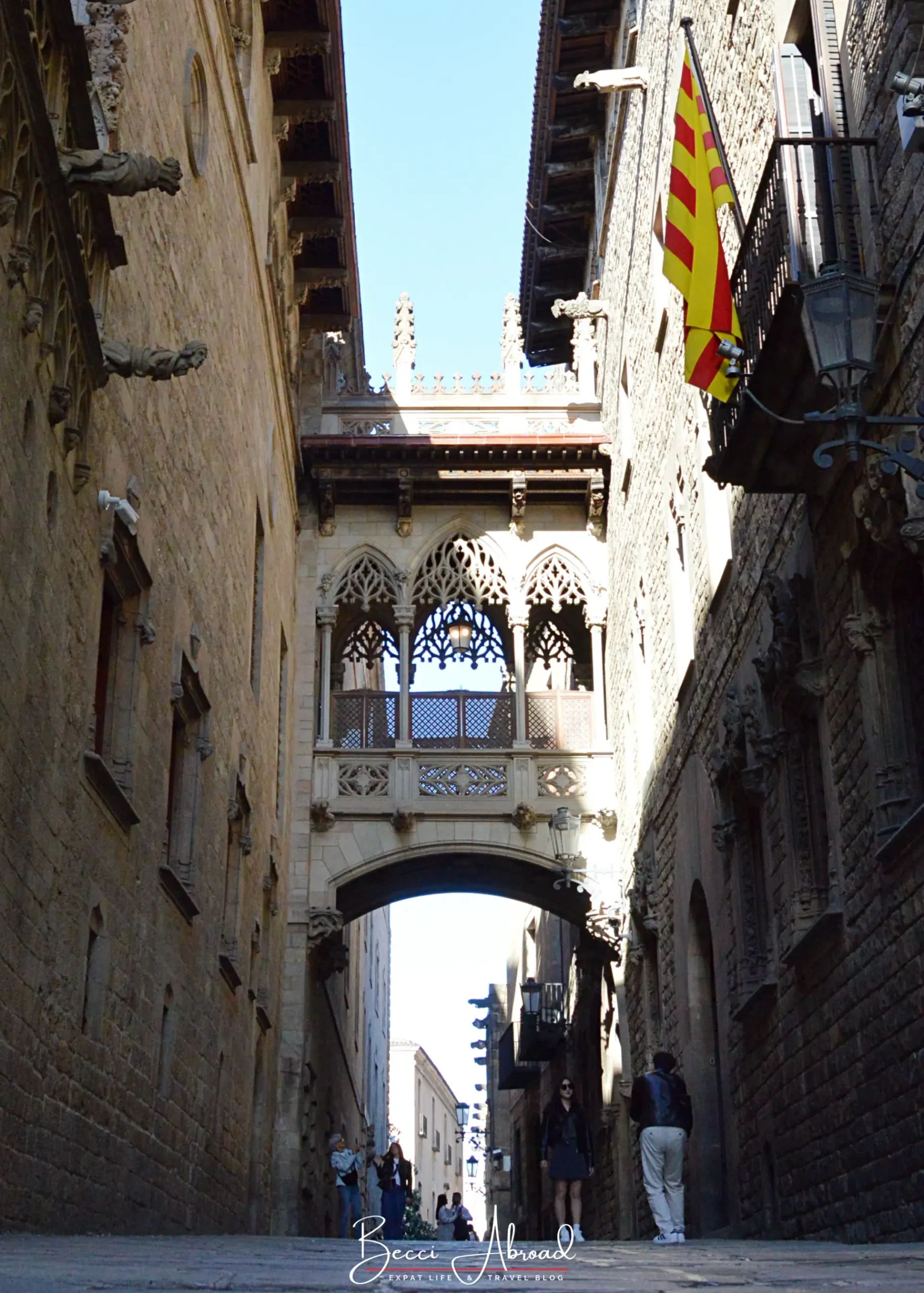
The most photographed spot in the Gothic Quarter is the Pont del Bisbe, or the Bishop’s Bridge in English.
Pont del Bisbe is an elegant neo-Gothic bridge arching over Carrer del Bisbe right by the Cathedral.
Let me say it straight away: the Pont del Bisbe is not medieval at all. The bridge was built in 1928 as part of the city’s restoration project for the 1929 International Exposition.
Pont del Bisbe was built by the architect Joan Rubió i Bellver. In 1927, Rubió i Bellver presented a plan to remodel the entire Gothic Quarter ahead of the International Exposition. His idea was not only to restore the neighborhood, but to demolish every building around the Cathedral that was not Gothic, and then rebuild it all in neo-Gothic style so that the whole quarter would architecturally match.
However, the plan was rejected, and the only part of it that was carried out was Pont del Bisbe!
If you look closely at the underside of the arch, you will find a skull with a dagger driven through it.
Most people read the skull as Joan Rubió i Bellver’s revenge on the city officials who rejected his grand plan for the Gothic Quarter. The urban legend about the skull with a dagger goes that either it is a curse aimed at the critics who killed his plan, or a gravestone for the plan itself.
The Pont del Bisbe connects the Palau de la Generalitat, which houses the Government of Catalonia, with the historic Casa dels Canonges, or translated as the Canon House.
I strongly recommend visiting Pont del Bisbe as early in the morning as you possibly can!
Visiting early in the morning, does not only guarantees that you can get a photo of the iconic building without too many people around, but the soft morning light on the stone and the cobbles gives everything a magical touch!
Nearest metro: Jaume I (L4).
Location: Ponte del Bisbe, Carrer del Bisbe, Barri Gòtic.
Get Lost in the Streets of El Born
Right next to the Gothic Quarter, you’ll find El Born, a historic neighborhood that is often overlooked compared to its more famous neighbor.
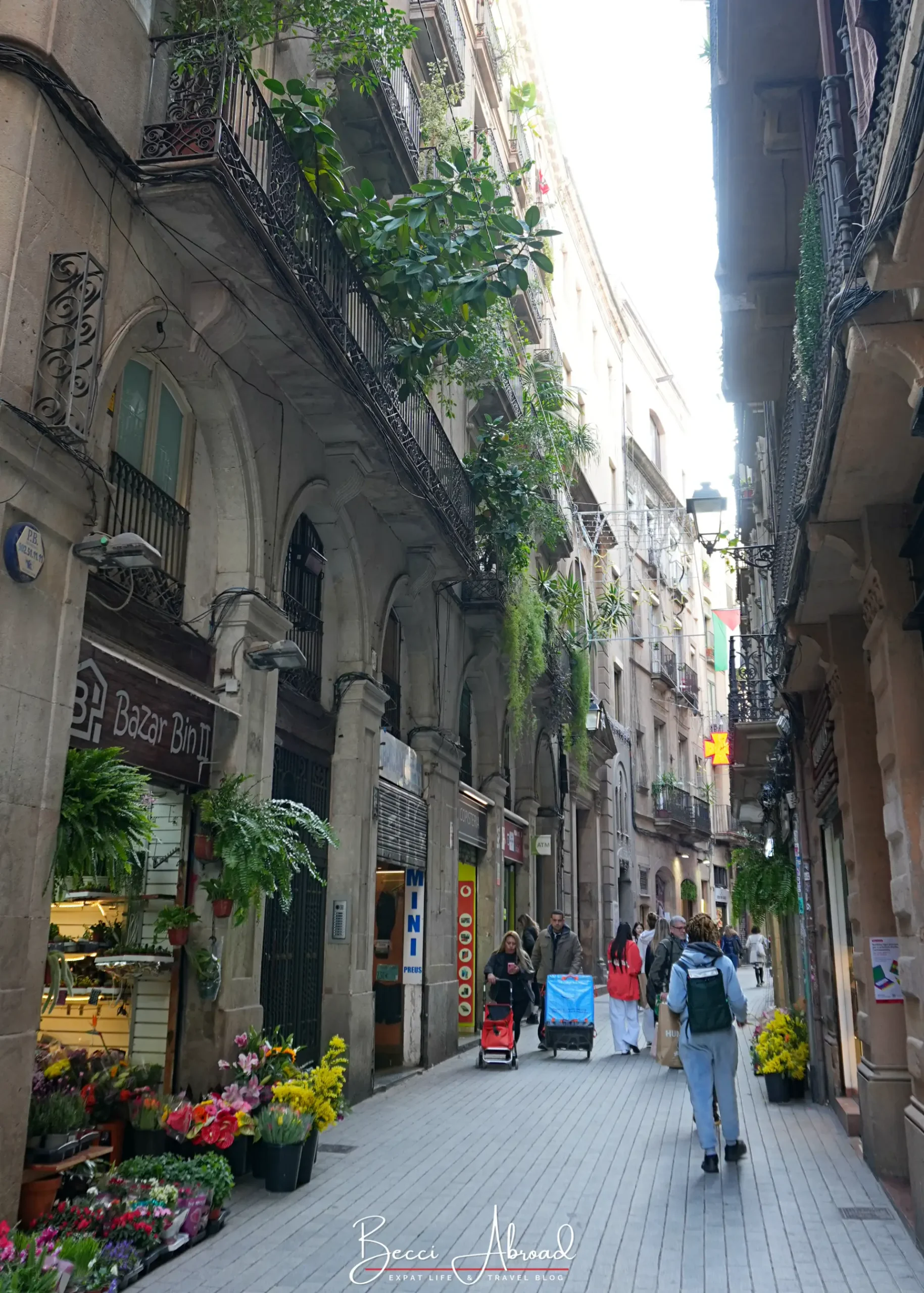
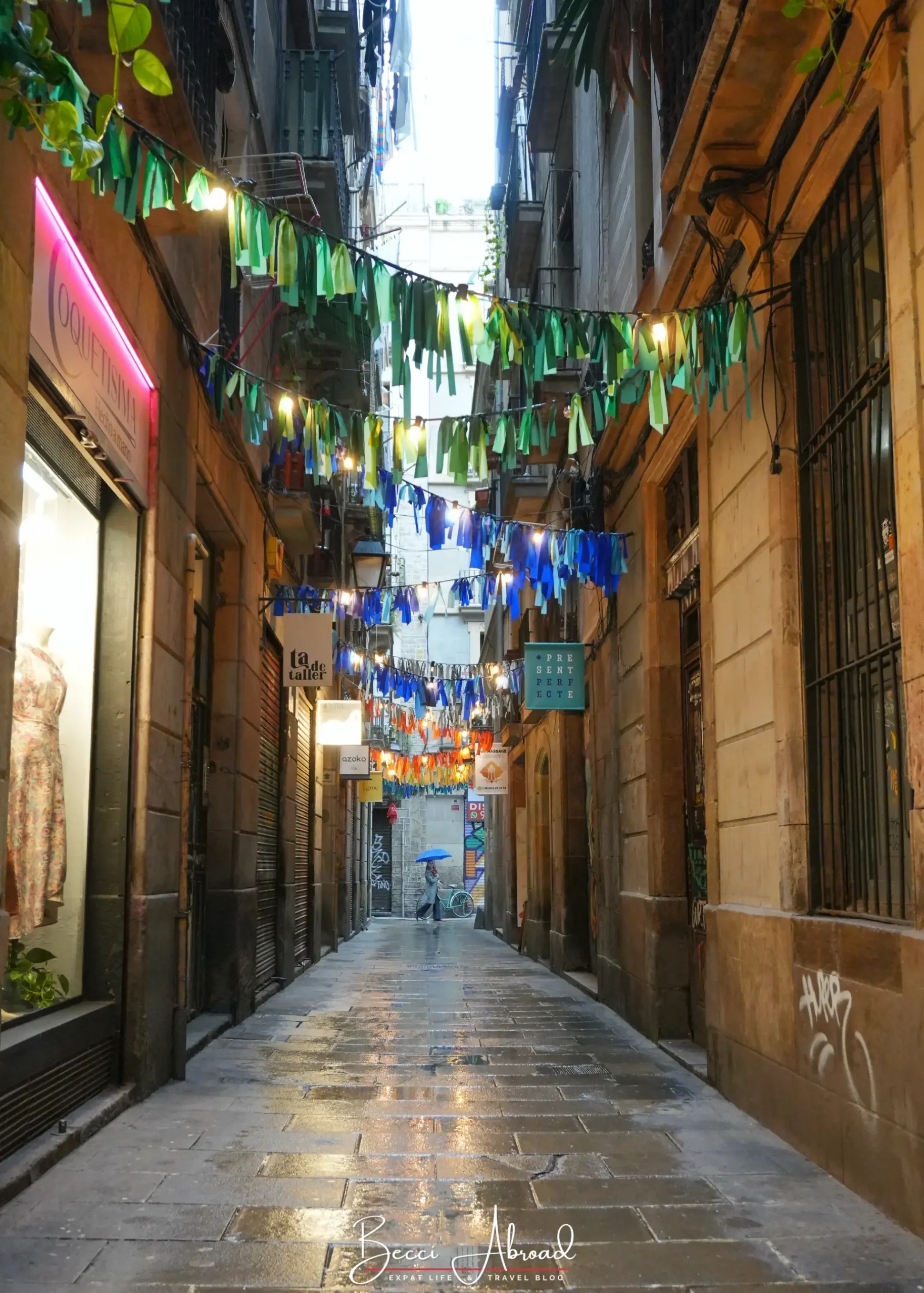
El Born offers similar medieval charm with a more local, creative energy, and its narrow streets are lined with small boutiques, wine bars, and tapas spots.
One of my favorite souvenir shops in Barcelona, Mercilona, is located in El Born, and is a perfect stop for locally crafted souvenirs to bring with you home!
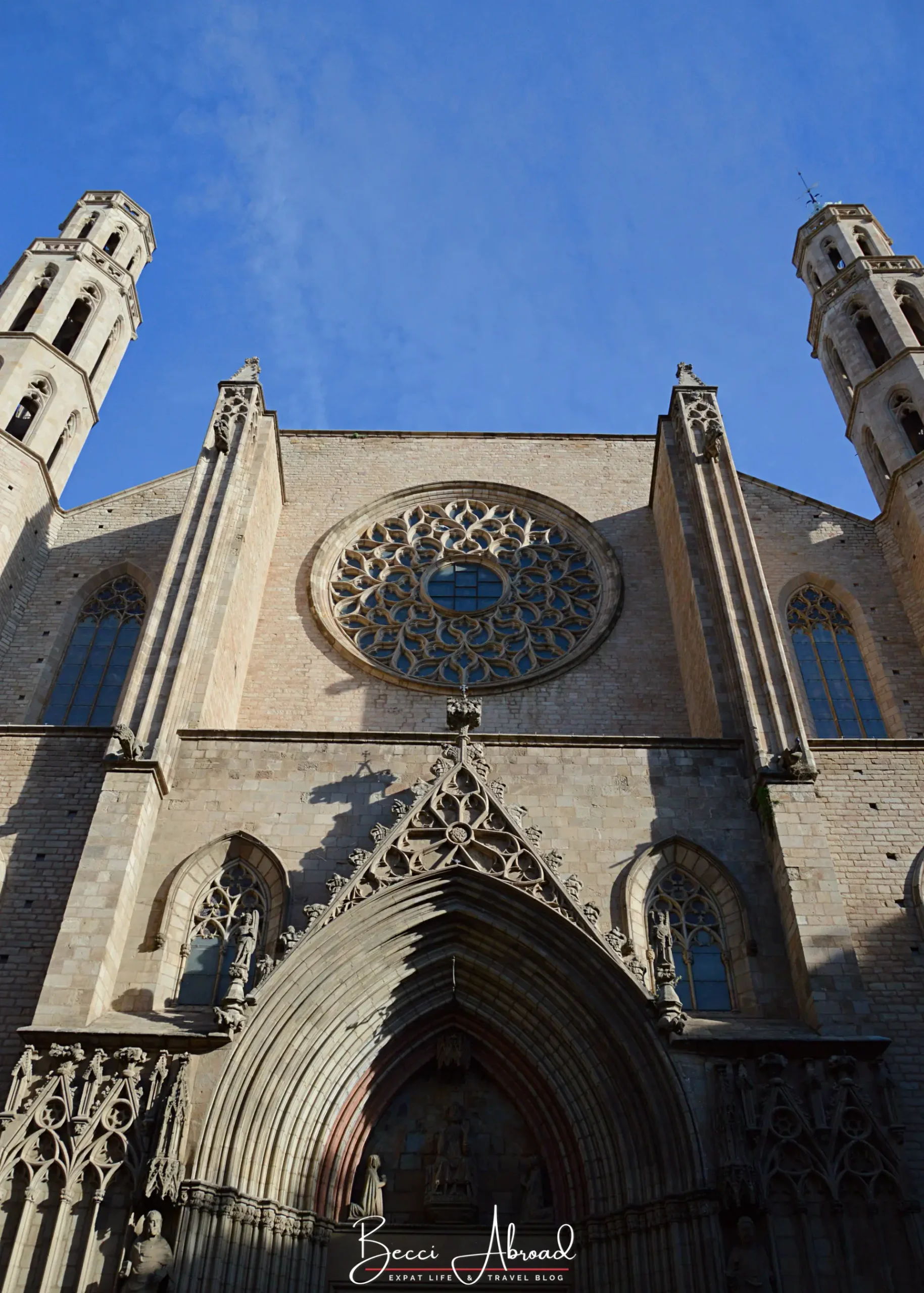
One of the most popular things to do in El Born is to visit the church, Basilica Santa Maria del Mar, or translated as “Church of Our Lady of the Sea”. The church dates back to the thirteenth century and is a masterpiece of Catalan Gothic.
The Church of Our Lady of the Sea offers access to its roof, from where you have a beautiful view over El Born and the Gothic Quarter. I visited the church and its roof on a beautiful, clear winter day in Barcelona, and I had the church’s roof completely to myself!
From the church, there is a wide pedestrian street, called Passeig del Born, which is a great place to stop for tapas and a drink after exploring!
Nearest metro: Jaume I (L4) or Barceloneta (L4).
Location: El Born, Ciutat Vella.
Book a walking tour of El Born
Check Out the Collection at the Picasso Museum
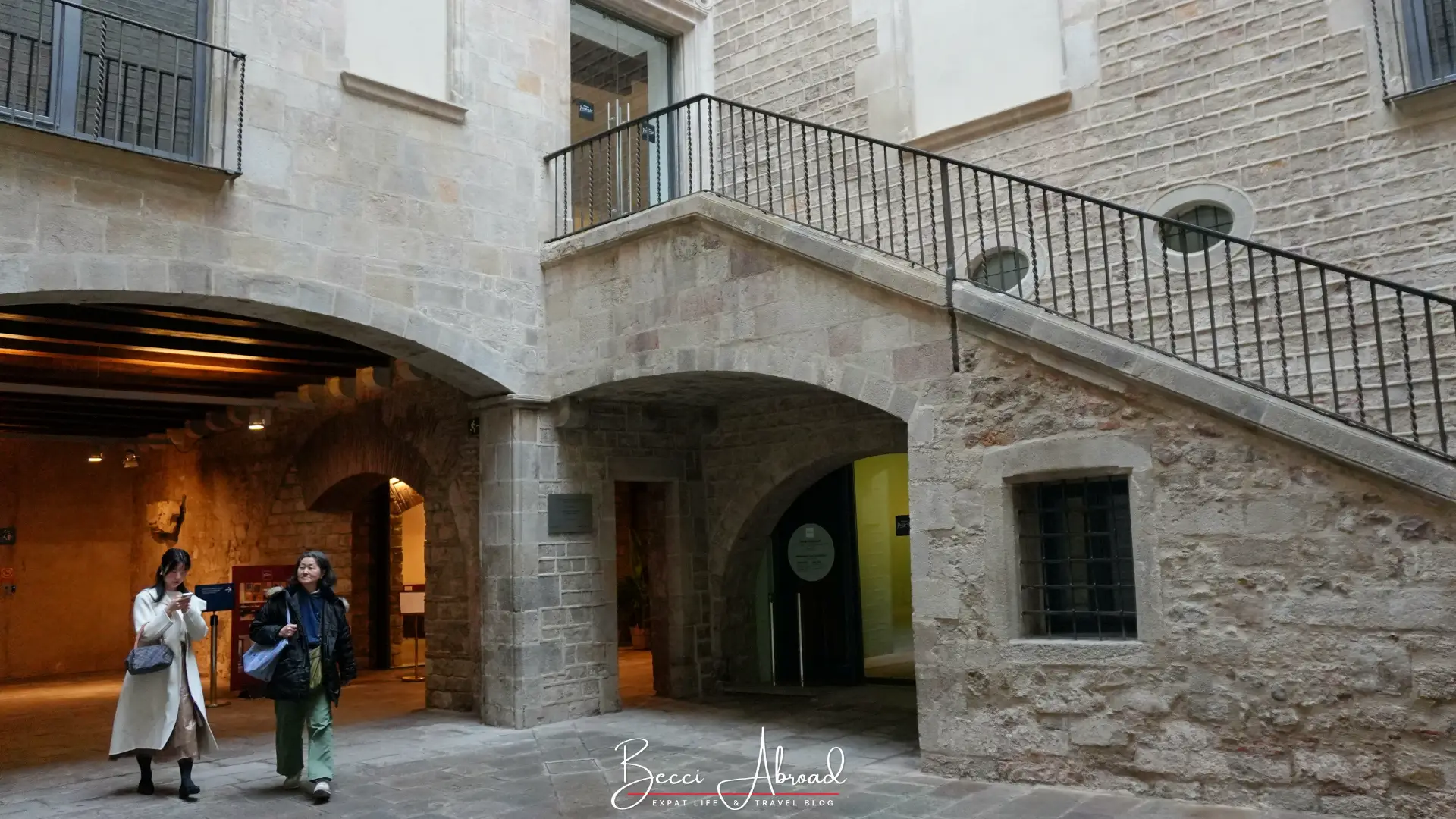
A short walk from the Church of Our Lady of the Sea, you’ll find the Picasso Museum, which is one of the best things to do in Barcelona for art lovers.
The Picasso Museum in Barcelona houses one of the world’s most extensive collections of Picasso’s work, including paintings, sculptures, ceramics and sketches spanning from his early years to his later periods.
The museum is located in five connected medieval mansions in the heart of El Born, which make a pretty unique backdrop for exploring the famous painter’s work.
Here is the money-saving tip for Barcelona that most guides bury: the Picasso Museum offers a lot of free admissions!
The museum is free on Thursday afternoons in winter, and on Thursday, Friday, and Saturday evenings in summer! On top of that, the museum offers free admission the first Sunday of every month.
You should definitely reserve your free ticket ahead of time!
The free slots are released only four days ahead and sell out within hours. So, if you want to take advantage of this offer, you need a bit of planning and good will. Check the museum’s website for the details and to reserve the free ticket!
However, it can get very crowded at the Picasso Museum when they offer the free visits, so if you dislike crowds, you might want to get a paid ticket instead.
Admission: 14 euros online for adults, 15 euros at the ticket office.
Opening hours:
- Summer (April to September)
- Tuesdays, Wednesdays, and Sundays: from 9 am to 8 pm
- Thursdays, Fridays, and Saturdays: from 9 pm to 9 pm
- Winter (October to March)
- From Tuesday to Sunday: 10 am to 7 pm
Note: The Picasso Museum is closed on Mondays.
Nearest metro: Jaume I (L4).
Location: Picasso Museum, Carrer Montcada 15-23, El Born.
Book a guided tour of the Picasso Museum in Barcelona
Walk Under the Arc de Triomf
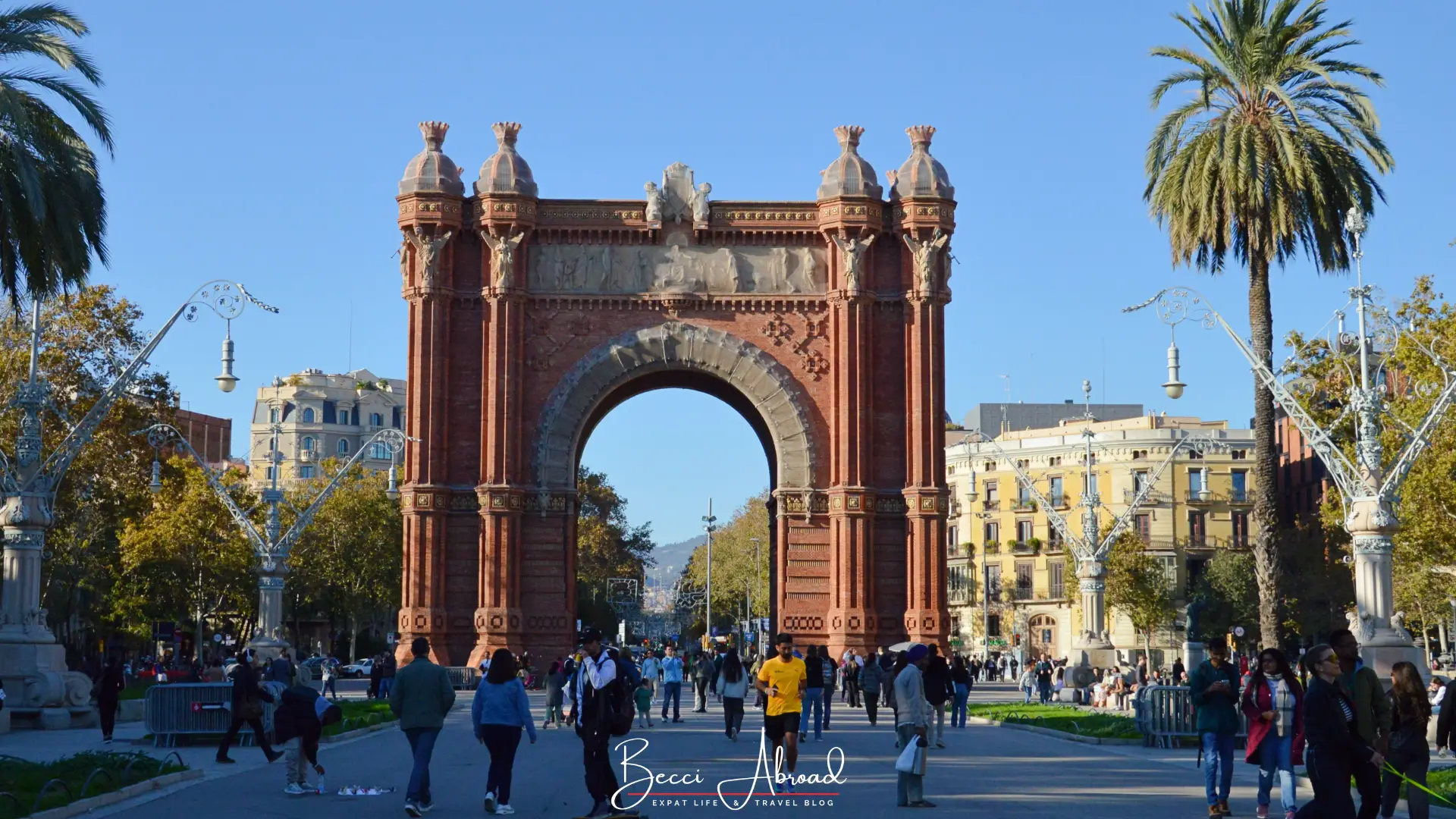
The Arc de Triomf is a massive red-brick monument in the El Born neighborhood, and it has become one of those iconic must-sees in Barcelona.
The Arc de Triomf was designed by Catalan architect Josep Vilaseca i Casanovas as the main entrance to the 1888 Barcelona World Fair.
The Arc de Triomf stands 30 meters (98 ft) tall, and opens onto the palm-lined promenade Passeig de Lluís Companys, which leads straight down to Ciutadella Park.
The promenade is a favorite stage for street performers, but you should also be cautious about pickpockets in this area.
In the late afternoon, the light on the brickwork of the Arc de Triomf is just so beautiful!
The Arc de Triomf is a bit underwhelming as a destination in itself, but it is a lovely five-minute walk on your way to the Ciutadella park.
Nearest metro: Arc de Triomf (L1).
Location: Arc de Triomf, Passeig de Lluís Companys, Sant Pere.
Go on a Picnic in Parc de la Ciutadella
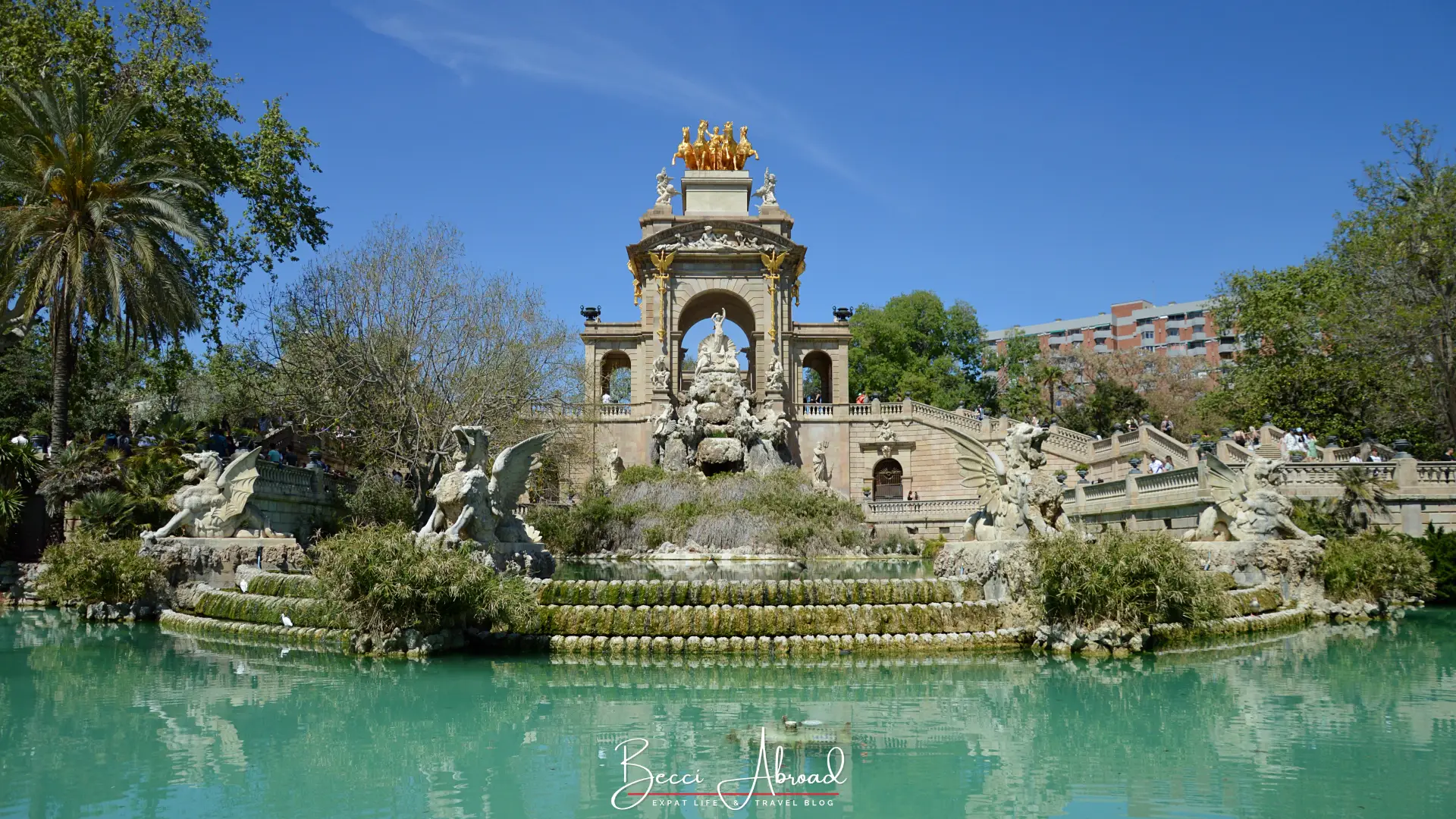
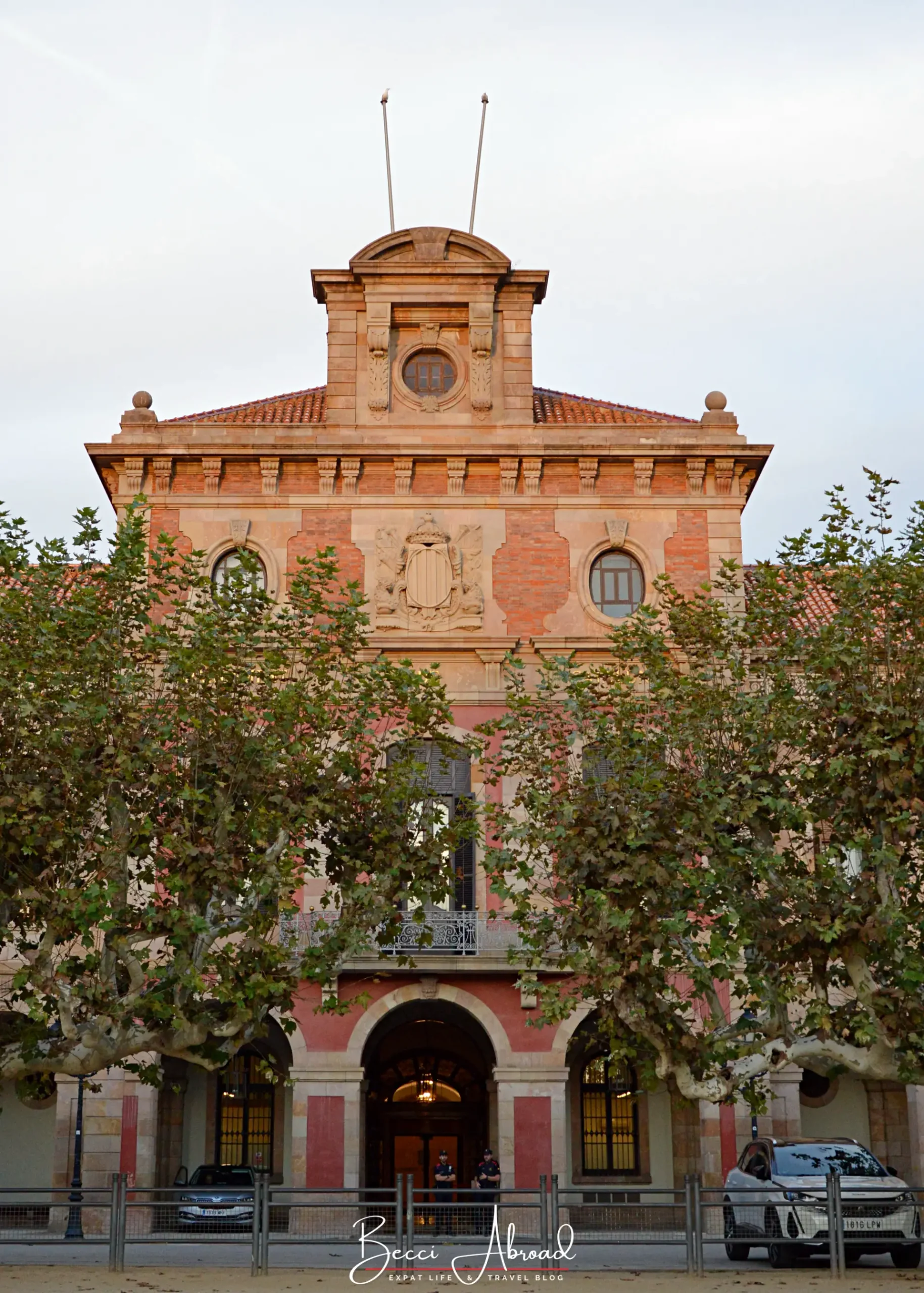
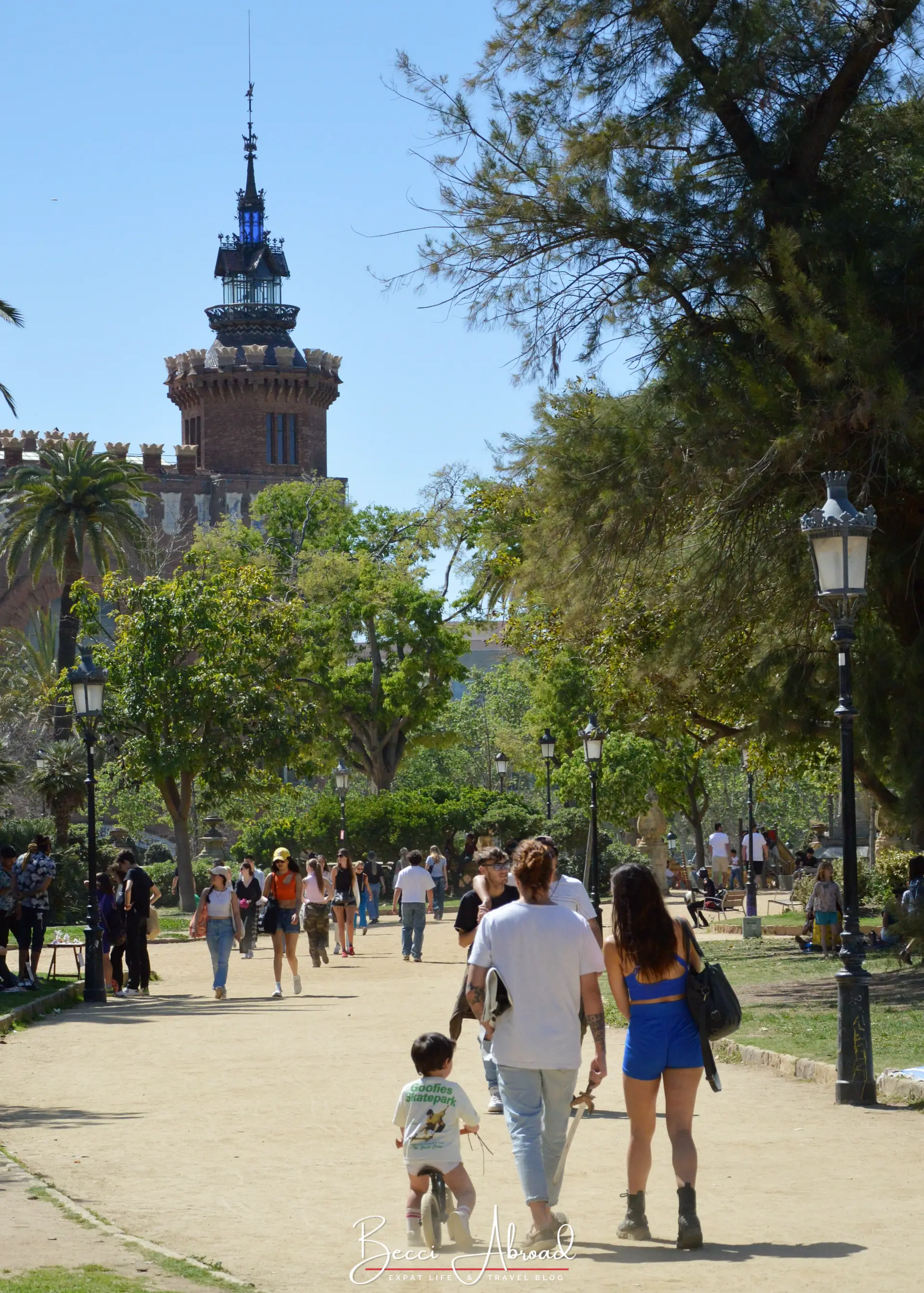
Parc de la Ciutadella, or translated as the Ciutadella Park, is one of the largest and most beloved green spaces in Barcelona
The popular park sits right on the edge of El Born, and on weekends, especially in summer, this is where locals come to picnic on the grass, play music, and row boats on the little lake.
Inside the park, you will find historic buildings, museums, the Barcelona Zoo, and the Parliament of Catalonia.
The real showstopper is the Cascada Monumental, a grand fountain and waterfall designed by Josep Fontserè and crowned with golden sculptures.
The Cascada Monumental fountain is also a popular photo-stop in Barcelona!
From the main entrance of the Ciutadella Park, you have a straight view up to the Arc de Triomf, so the two really are one walk rather than two.
The Ciutadella Park also hosts one of my absolute favorite hidden gems in Barcelona (which by now is probably not so hidden anymore): the Ciutadella Park’s Greenhouses.
The best way to experience the Ciutadella Park is to grab a sandwich and a coffee from one of the many cafes in El Born and go for a picnic in the park.
Nearest metro: Arc de Triomf (L1) or Barceloneta (L4).
Location: Ciutadella Park, Passeig de Picasso 21, Ciutat Vella.
Get your photo taken at Ciutadella Park
Markets, Food and Local Culture
We have covered the buildings, so now let’s talk about the part of Barcelona you eat and drink your way through.
Grab a Snack at Mercat de la Boqueria
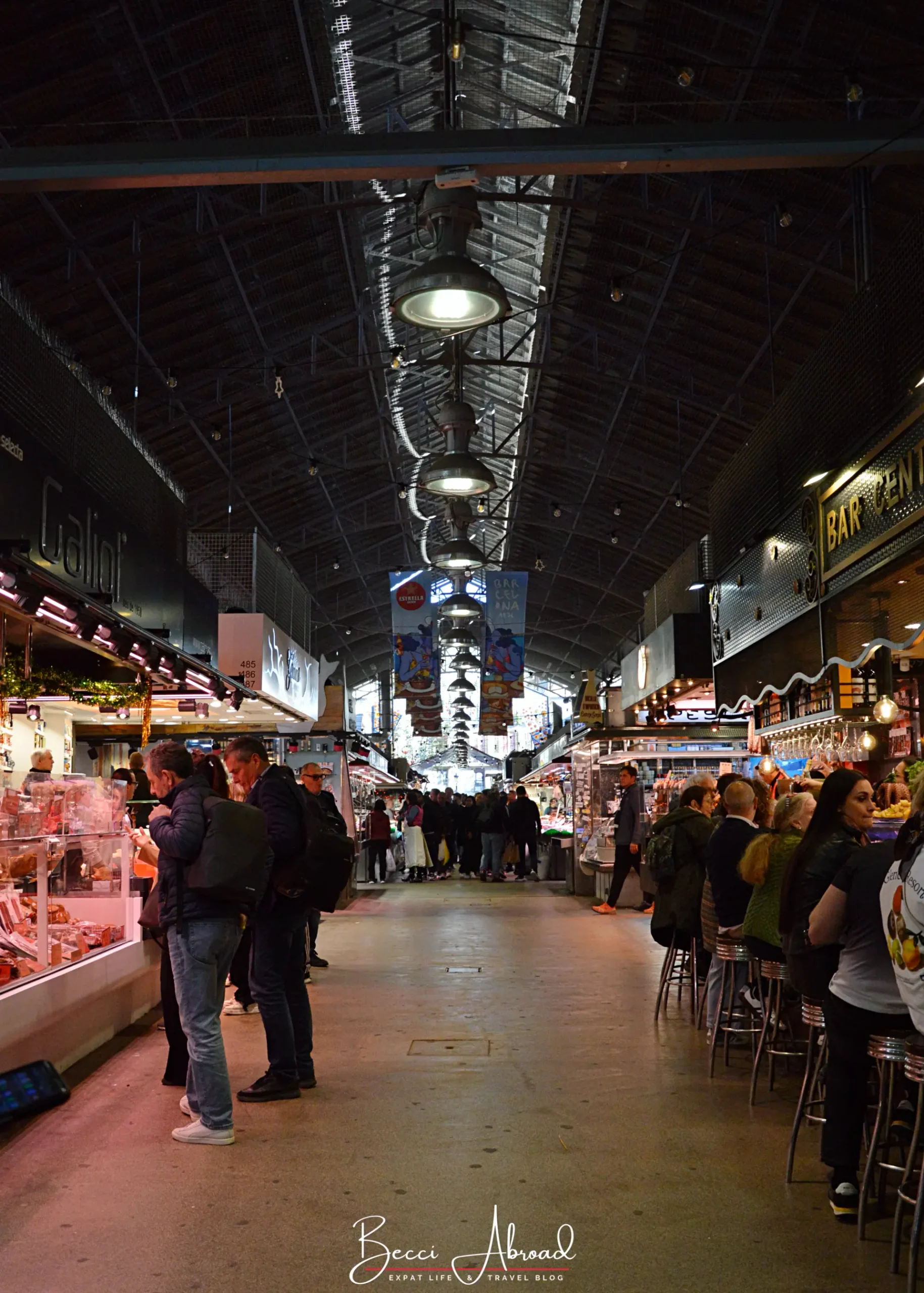
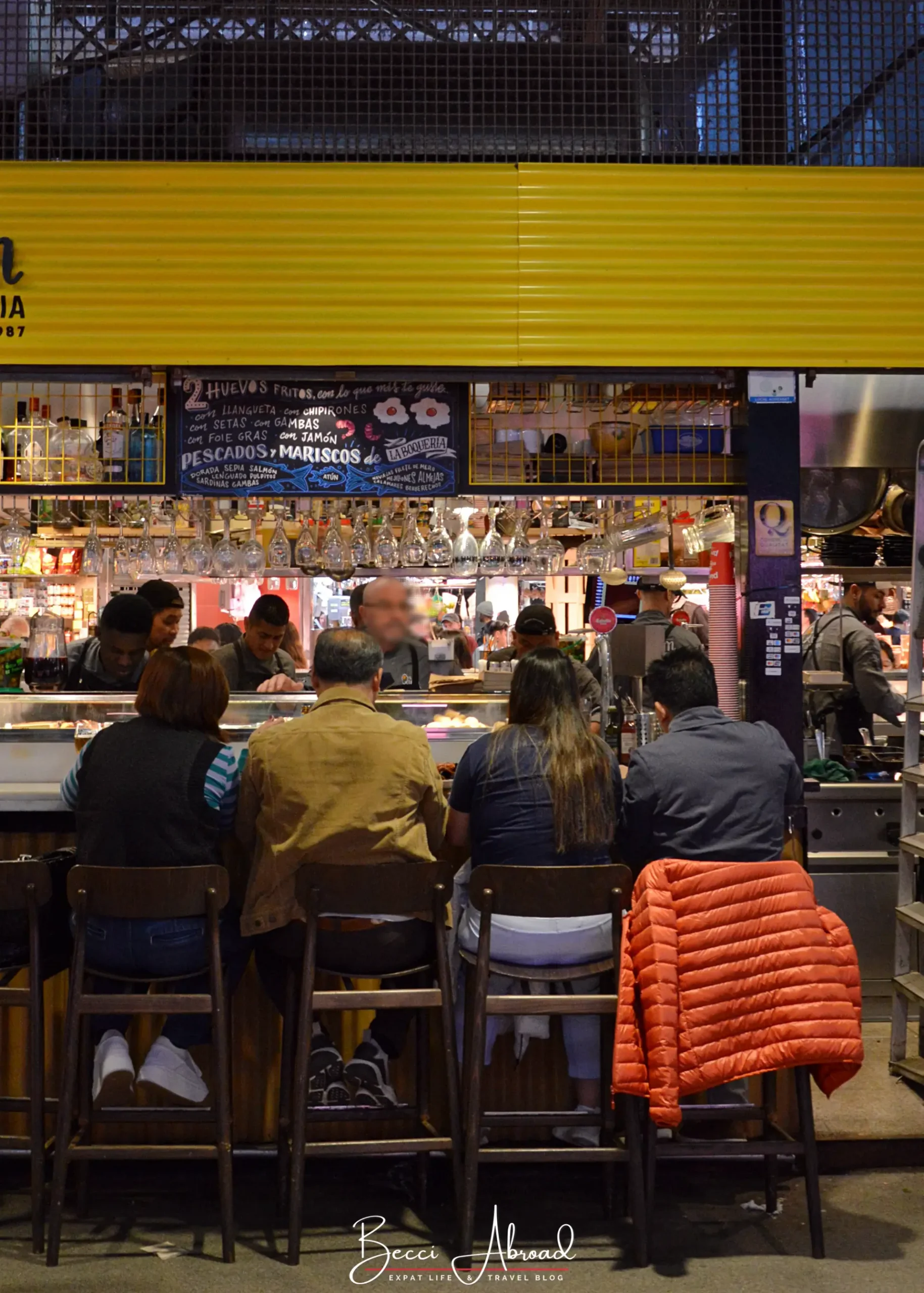
The Boqueria Market is one of the most popular things to do in Barcelona, and by now, also quite a touristy place, if I have to be honest with you.
The Boqueria Market, or properly called Mercat de Sant Josep de la Boqueria in Catalan, is kind of a classic must-see in Barcelona, so drop by and grab a snack before heading out again.
The Boqueria Market is located just off La Rambla in the very center of Barcelona, and it has roots going back all the way to around 1217, where the first mention of the market is said to have been discovered.
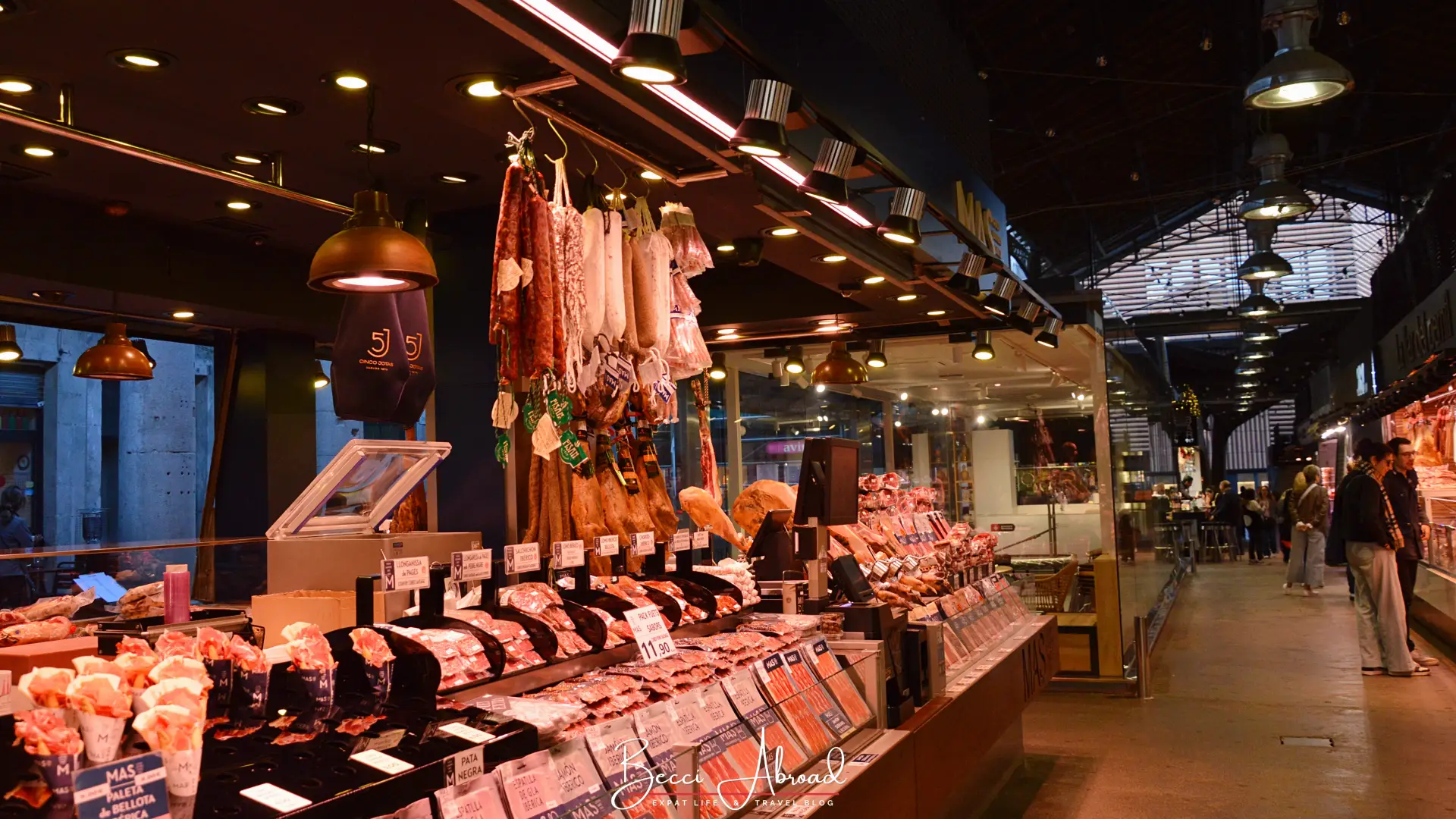
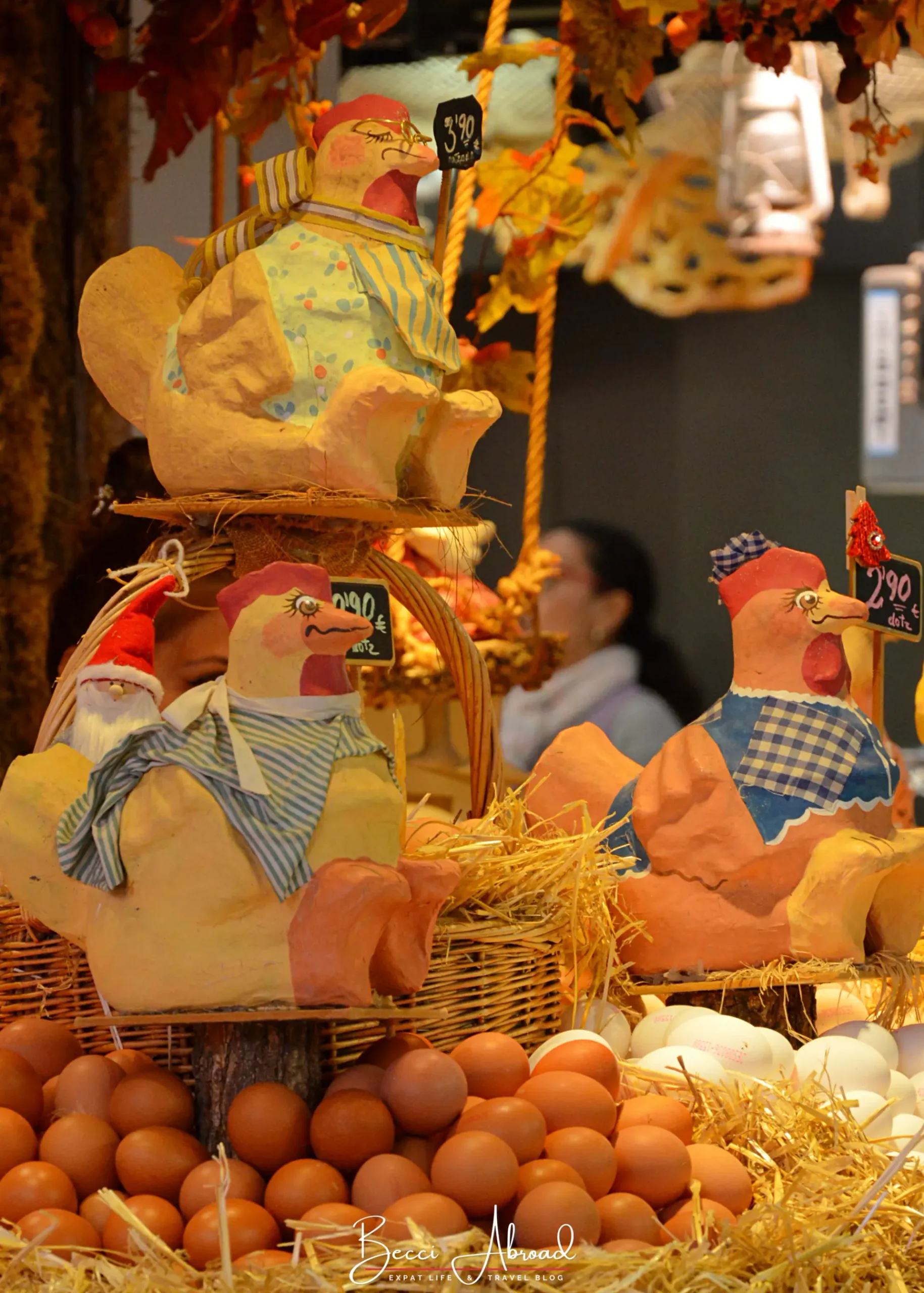
Nearly every neighborhood in Barcelona has its own food market, but La Boqueria is the most famous of them all. Like any neighborhood market in Barcelona, the Boqueria Market is packed with fresh fruit, seafood, jamón, and local delicacies.
Jamón is Spanish cured ham, and the good stuff hanging from the ceiling is jamón ibérico, made from acorn-fed black Iberian pigs.
For a more local angle, join a paella cooking class that takes you shopping for ingredients at the market before you cook.
Opening hours:
- Monday through Saturday: from 8 am to 8:30 pm.
- Closed Sundays.
Nearest metro: Liceu (L3).
Location: Boqueria Market, La Rambla 91, Ciutat Vella.
Explore more of the Boqueria Market in Barcelona
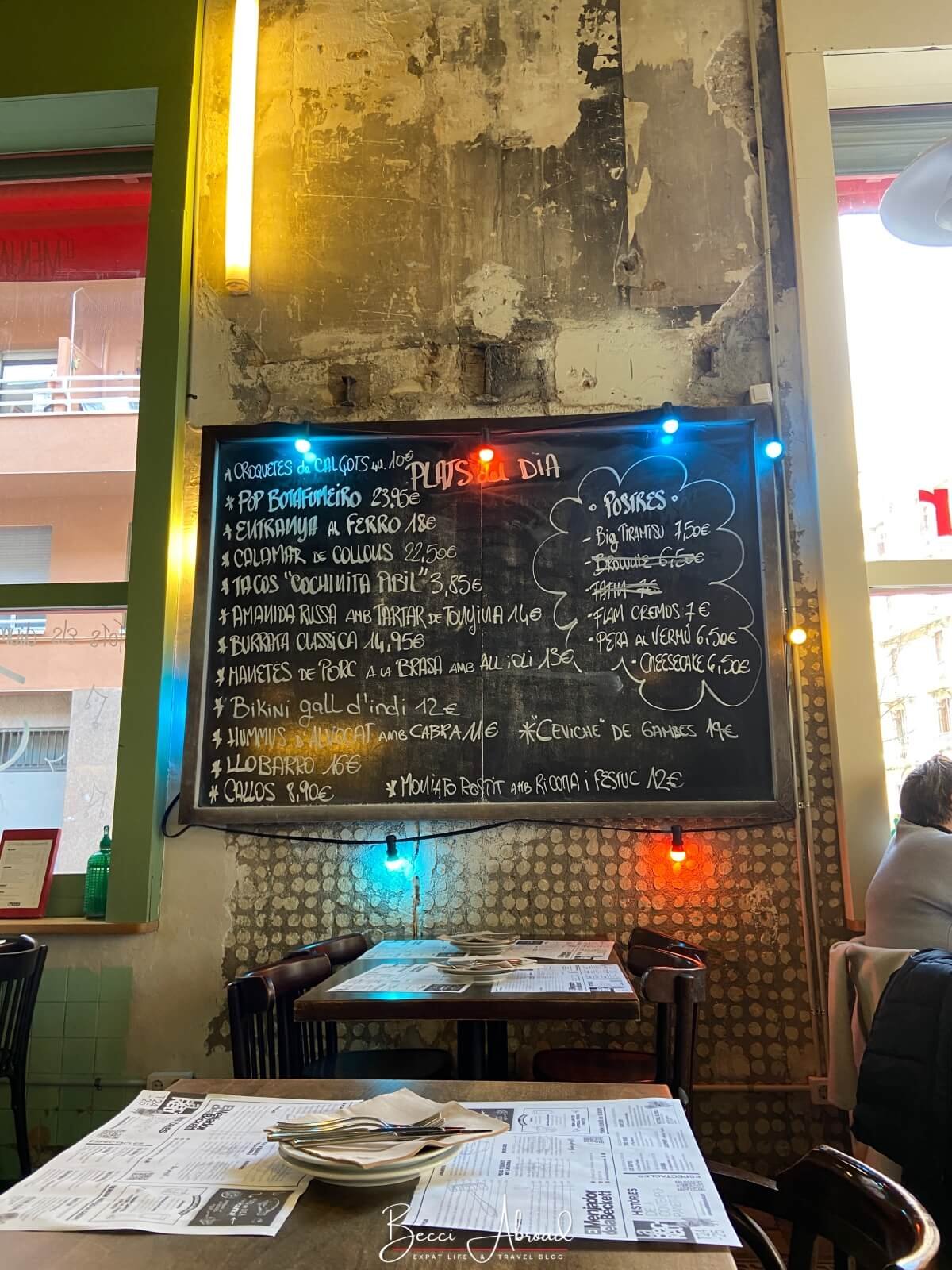
Taste Traditional Catalan Cuisine
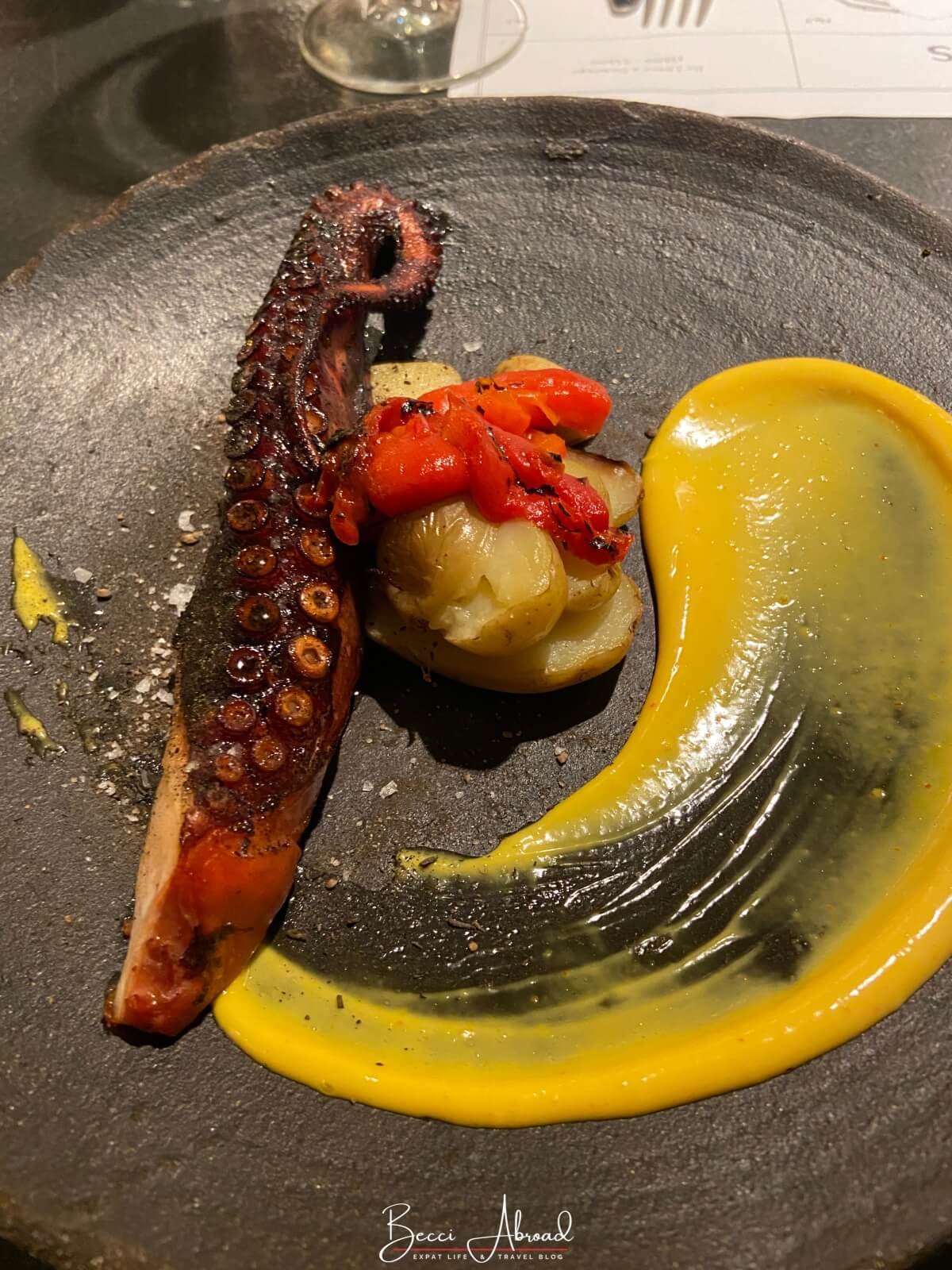
Catalonia has its own food culture, which is both similar to and different from traditional Spanish food. In Barcelona, you’ll find many cool restaurants to taste both Catalan and international food.
In Barcelona and Catalonia, you’ll find pa amb tomàquet, which in Spanish is pan con tomate, and it simply translates to “bread with tomato”. It is a simple dish consisting of bread rubbed with ripe tomato, olive oil, and salt. You can find pa amb tomàquet both on the breakfast menu and as an option on the tapas menu in the evening.
Another classic tapa is patatas bravas, which are fried potato chunks with a spicy sauce, and every bar in the city claims theirs are the best!
For something sweet, crema catalana is Catalonia’s answer to the French crème brûlée. Crema catalana is a custard dessert with a caramelized sugar crust, traditionally flavored with citrus and cinnamon rather than vanilla.
And if you visit in winter or early spring, do not miss calçots. These are long grilled spring onions that you dip in romesco, a Catalan sauce of roasted red peppers, tomatoes, garlic, and almonds. You eat them with your hands wearing a bib, and it gets real messy!
Drink Local Cava and Vermut
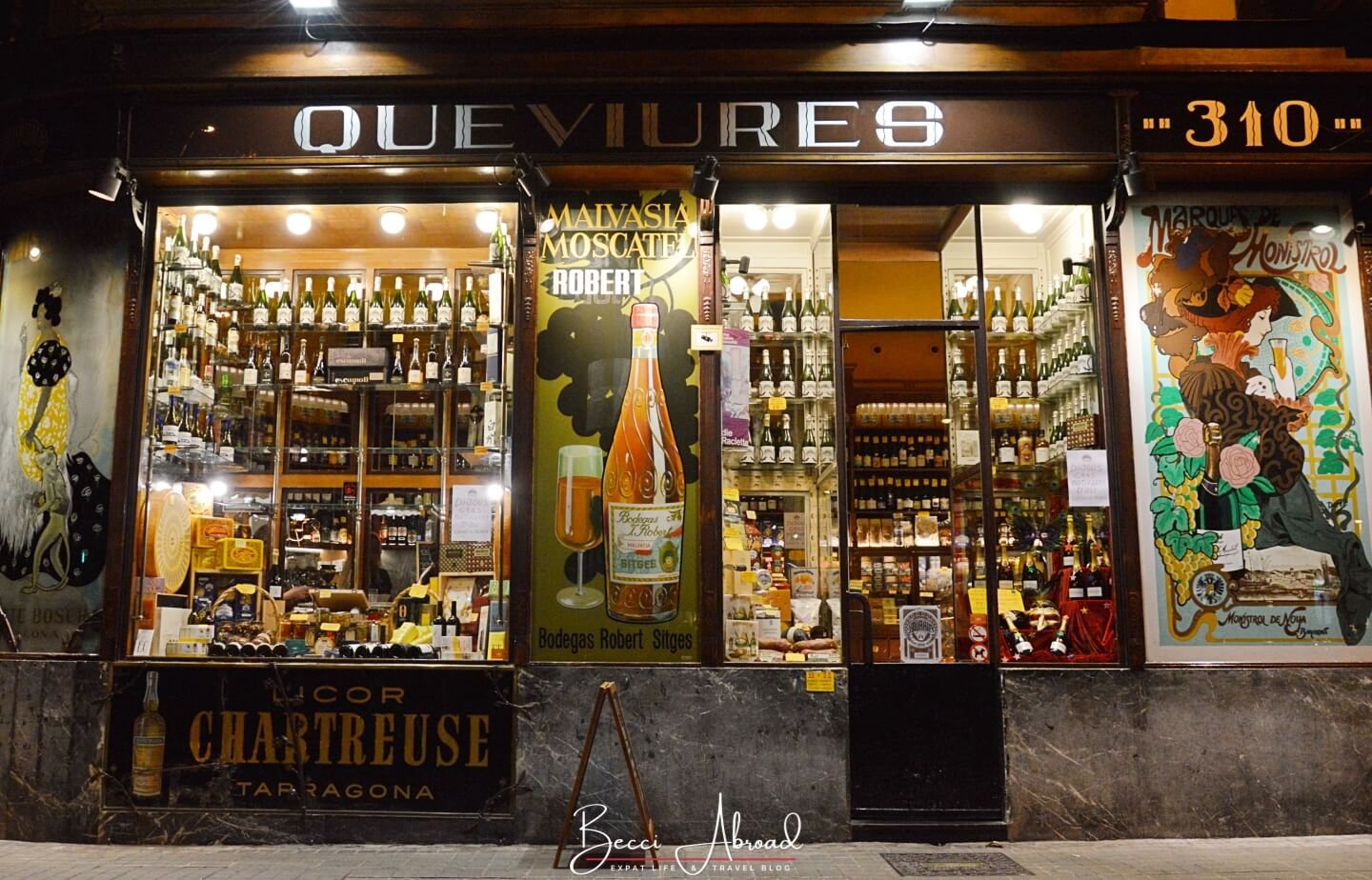
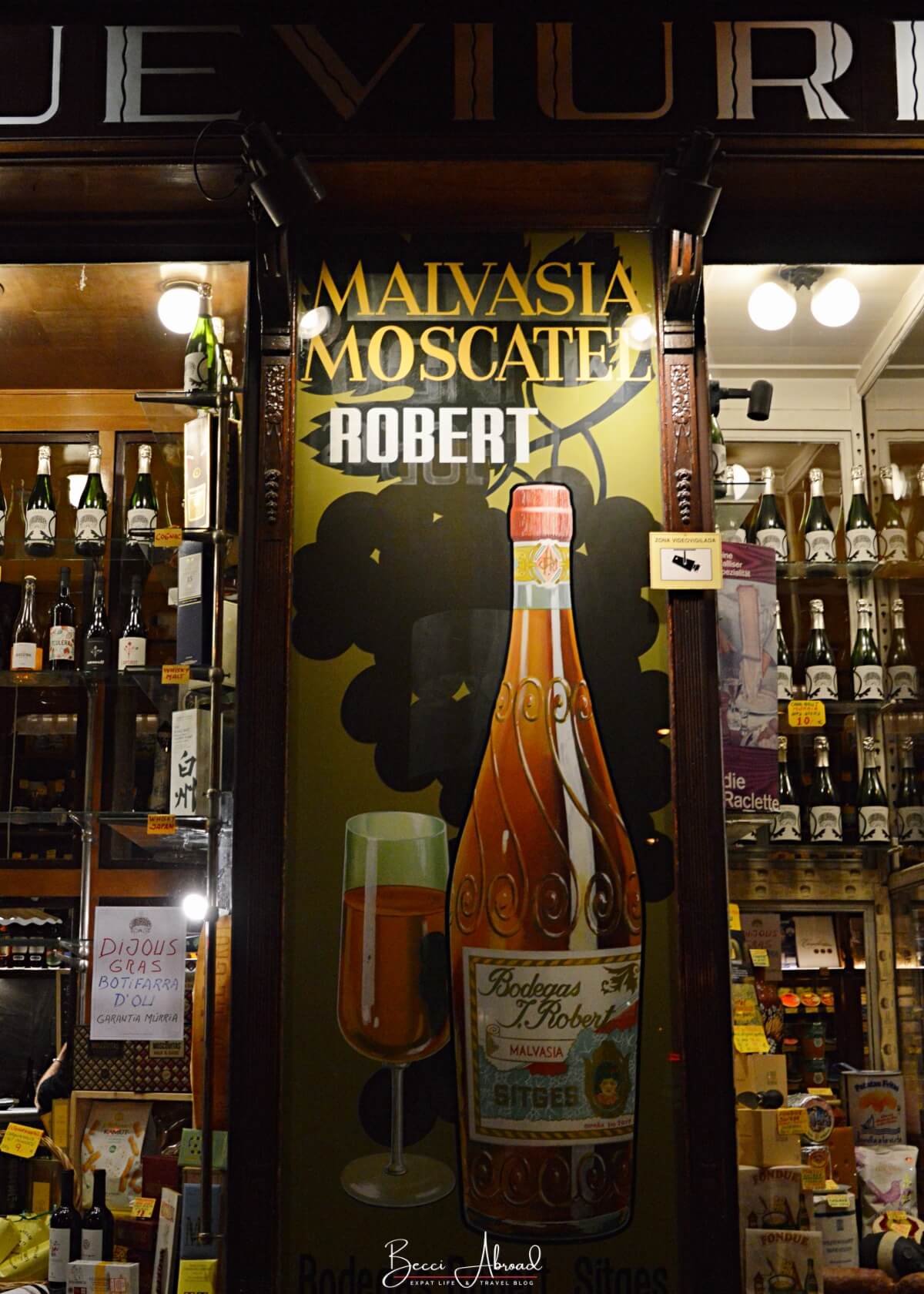
Cava is a sparkling wine produced mostly in the Penedès region just outside Barcelona. Cava is basically Catalonia’s answer to champagne – but for a lot more reasonable price!
So, if you enjoy sparkling wine, I can only recommend ordering some Catalan cava when visiting Barcelona!
I developed a really big habit of drinking cava with friends when I lived in Barcelona!
One of my favorite places for tasting cava is either at a rooftop bar overlooking the city or at Can Paixano, a local bar in the Barceloneta neighborhood that only serves homemade sandwiches and cava.
Another local habit I completely inherited while living in Barcelona (and I still maintain here in Madrid) is drinking vermouth!
La hora del vermut is a local tradition of having a glass of vermouth served with olives, normally served pre-lunch and in the early evening as an after-work drink.
Most local tapas bar or restaurants with respect for themselves has vermouth in Barcelona, and I strongly recommend giving it a try!
Watch Locals Build Human Towers
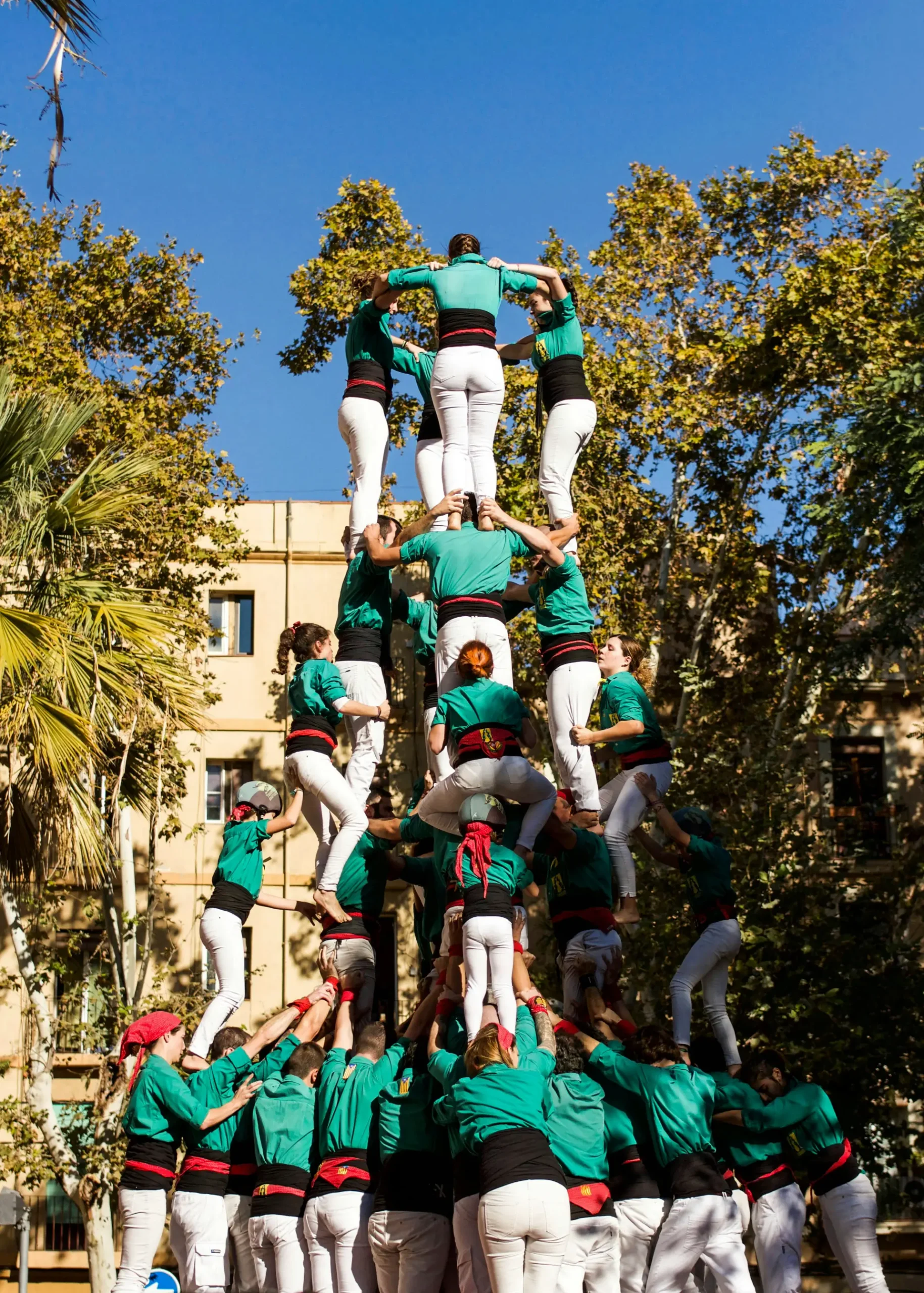
Castells, or human towers, are one of Catalonia’s most spectacular traditions, and it is even recognized by UNESCO as Intangible Cultural Heritage.
Teams of castellers climb on each other’s shoulders to build towers up to nine or ten levels high, and the person who scrambles up to the top is always a small child wearing a helmet.
The human towers are one of the least expected things to experience in Barcelona for first-timers, and quite a nerve-wracking activity to watch!
A large crowd of people usually forms around the team of castellers to watch this impressive performance, and the crowd goes completely silent as the tower goes up!
You can catch castells at neighborhood festivals, also called festes majors, which are happening throughout the year. Especially during La Mercè Festival, which is Barcelona’s biggest festival happening in late September, you will be able to see castells.
I have experienced castells quite a few times first-hand, but actually never got to take a photo of them. One time my mum and I stumbled onto a large group of people in the Gothic Quarter and realized that they had stopped to watch a team of castellers form their human tower.
Tour the FC Barcelona Camp Nou Stadium (for Football Fans)
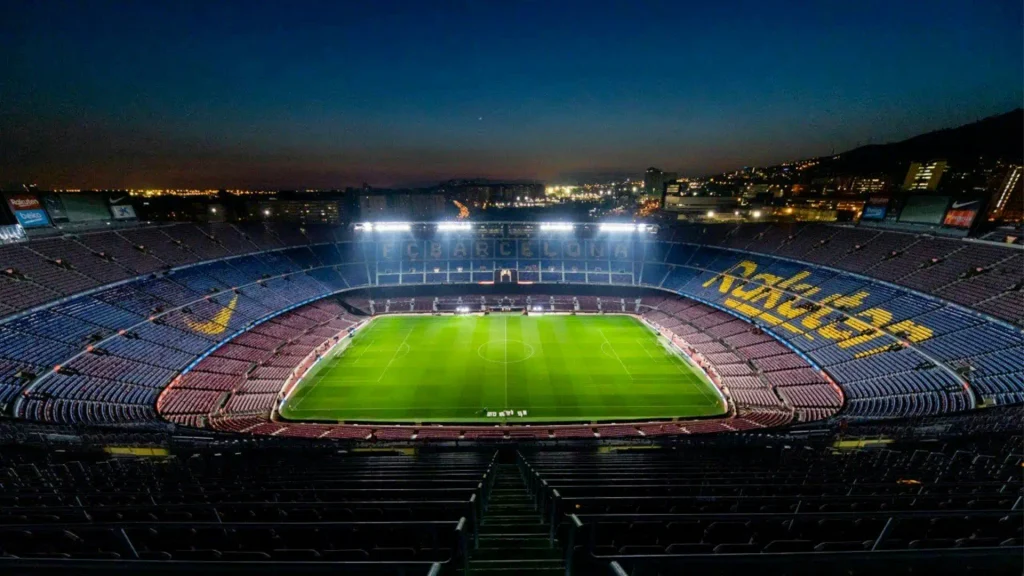
Spotify Camp Nou is the legendary home of FC Barcelona and one of the largest stadiums in Europe, with a capacity of over 99,000.
The stadium has been under a huge renovation for years, but match days are returning in August 2026, even though the building is not fully finished yet.
That means the classic pitchside stadium tour hasn’t returned. Instead, the FC Barcelona Museum and an immersive tour are running, with interactive exhibits, an audio guide, a 360-degree show, and a viewpoint over the construction site.
So if you are a serious fan, the visit is still worth it. If you were picturing walking out of the tunnel onto the pitch, that is not on offer right now.
And if your dates line up, going to an actual match is by far the better experience anyway!
Admission: Tickets to the Barca Museum start at 28 euros for adults.
Opening hours:
- Winter (February to March)
- Monday to Sunday: from 10 am to 7 pm
- Summer (March to October)
- Monday to Sunday: from 9:30 am to 7 pm
- Autumn (October to December)
- Monday to Sunday: 10 am to 6 pm
Nearest metro: Collblanc (L5 and L9) or Palau Reial (L3).
Location: Camp Nou Stadium, Carrer d’Arístides Maillol 12, Les Corts.
Explore the Local Feeling in the Gràcia Neighborhood
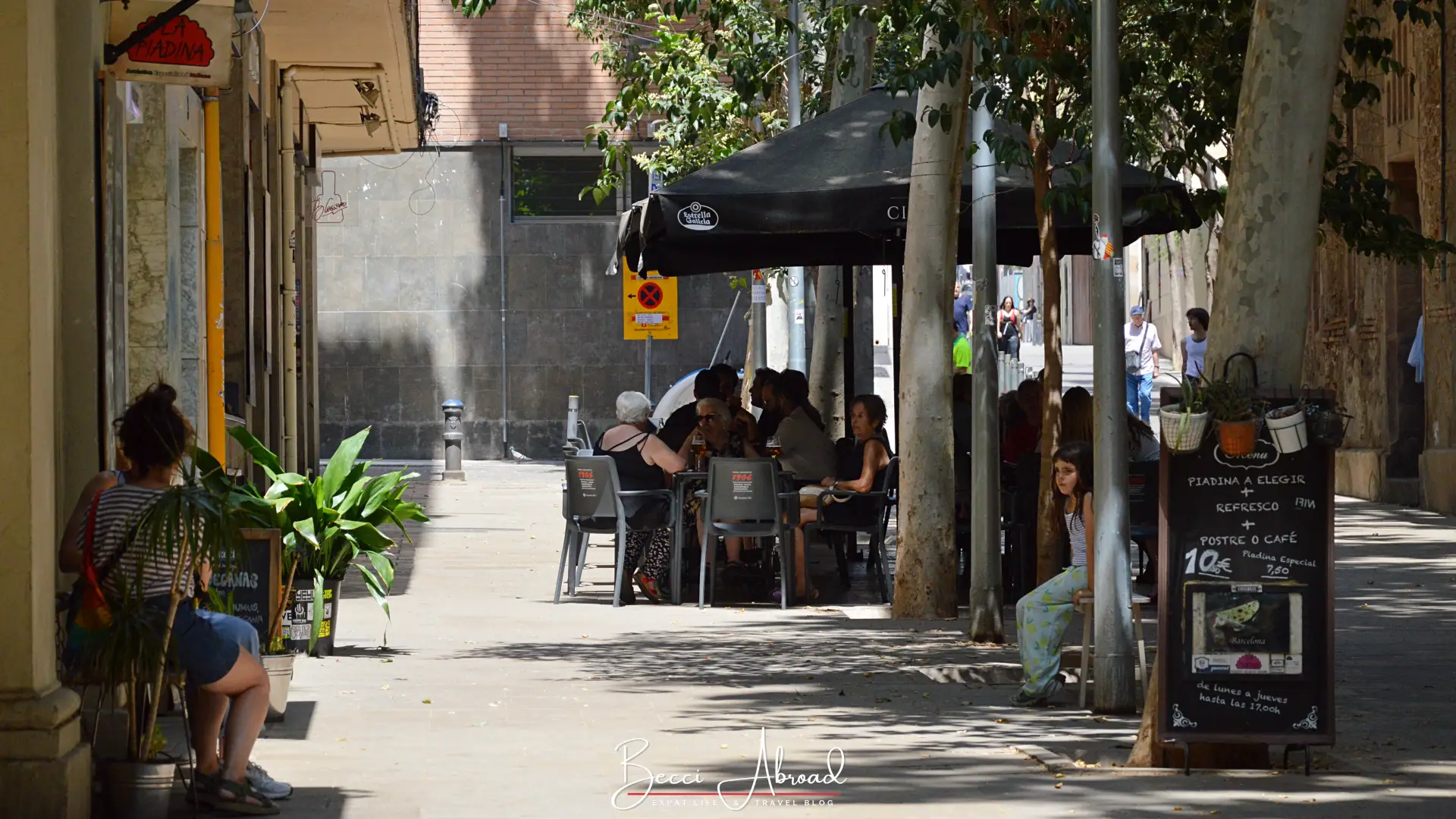
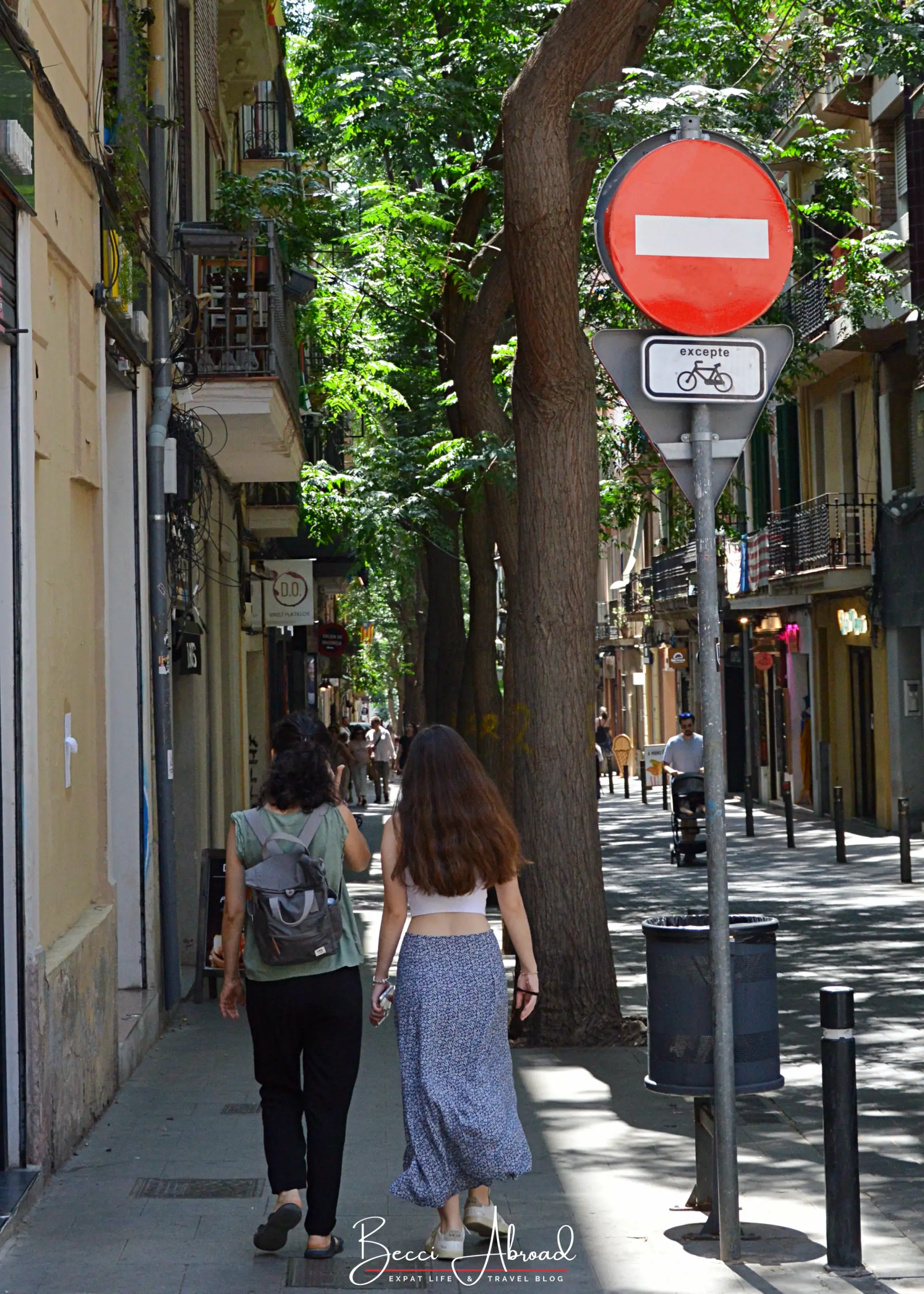
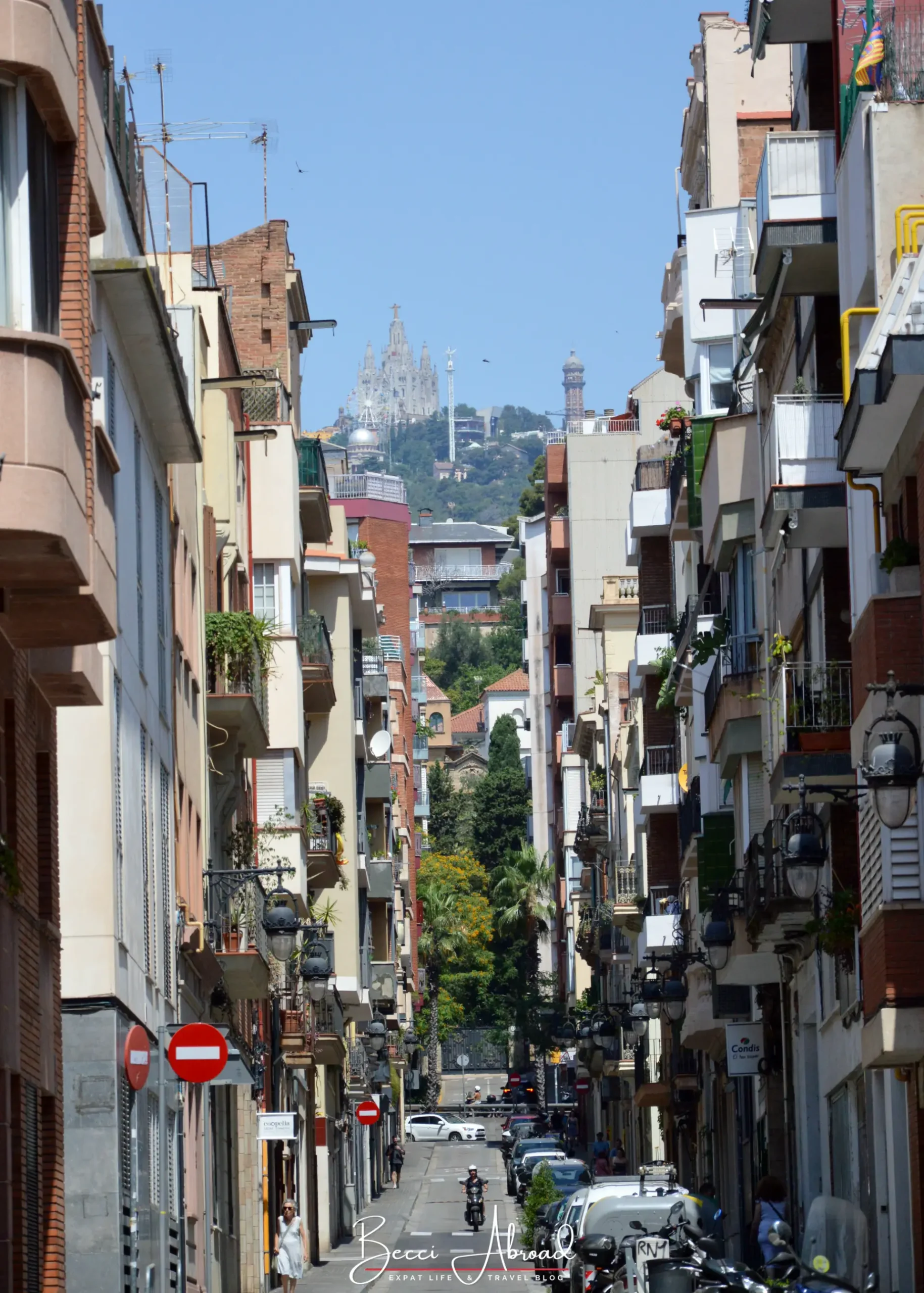
The Gràcia neighborhood in Barcelona was once an independent village, and honestly it still feels like one.
The atmosphere in Gràcia is laid-back, with a grid of narrow streets and lively plazas where locals linger over vermouth, and kids play football until late in the evening.
Plaça del Sol and Plaça de la Vila de Gràcia are the classic spots to grab a terrace seat and people-watch.
Gràcia is the perfect place to go for lunch or some tapas after visiting Park Güell, and get a feeling of what local life in Barcelona looks like away from the main tourist attractions.
If you are visiting Barcelona in mid-August, you should definitely not skip a visit to Gràcia. During August, the neighborhood celebrates the Festa Major de Gràcia, which transforms the streets into wildly decorated themed installations, all built by the neighbors themselves.
Location: Gràcia
Nearest metro: Fontana (L3), Joanic (L4) or Diagonal (L3 and L5).
Famous Streets, Squares and the Beach
Now let’s look at the Barcelona addresses everyone has heard of, including the one I will happily tell you to walk through once and then leave.
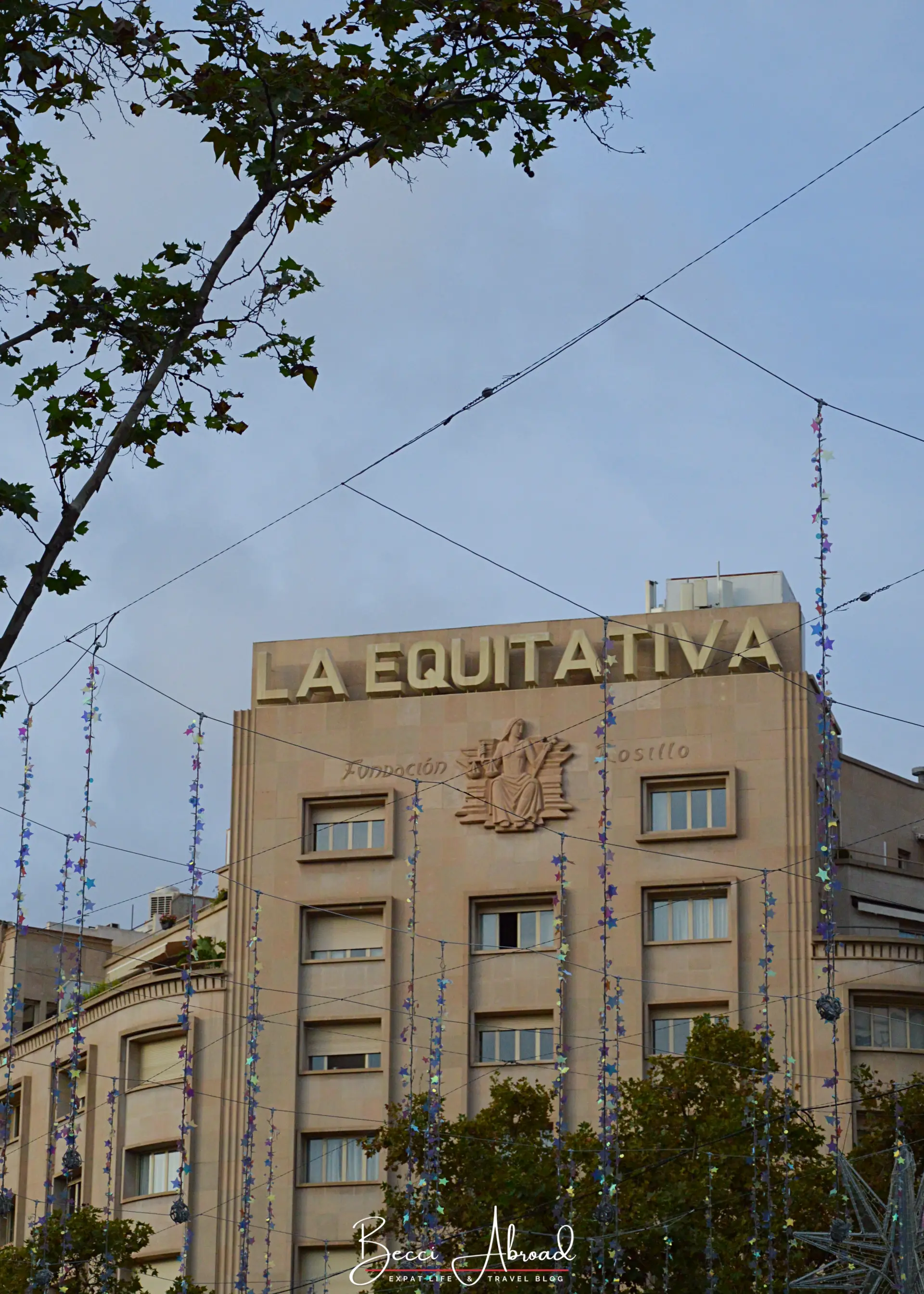
Stroll Along Passeig de Gràcia
Passeig de Gràcia is Barcelona’s most elegant avenue, running from Plaça de Catalunya up to Avinguda Diagonal.
Passeig de Gràcia is one of Barcelona’s most popular shopping streets, and along the beautiful avenue you’ll find everything from high-end designer shops to H&M and Uniqlo.
Even if you are not shopping, the architecture makes Passeig de Gràcia worth the walk on its own!
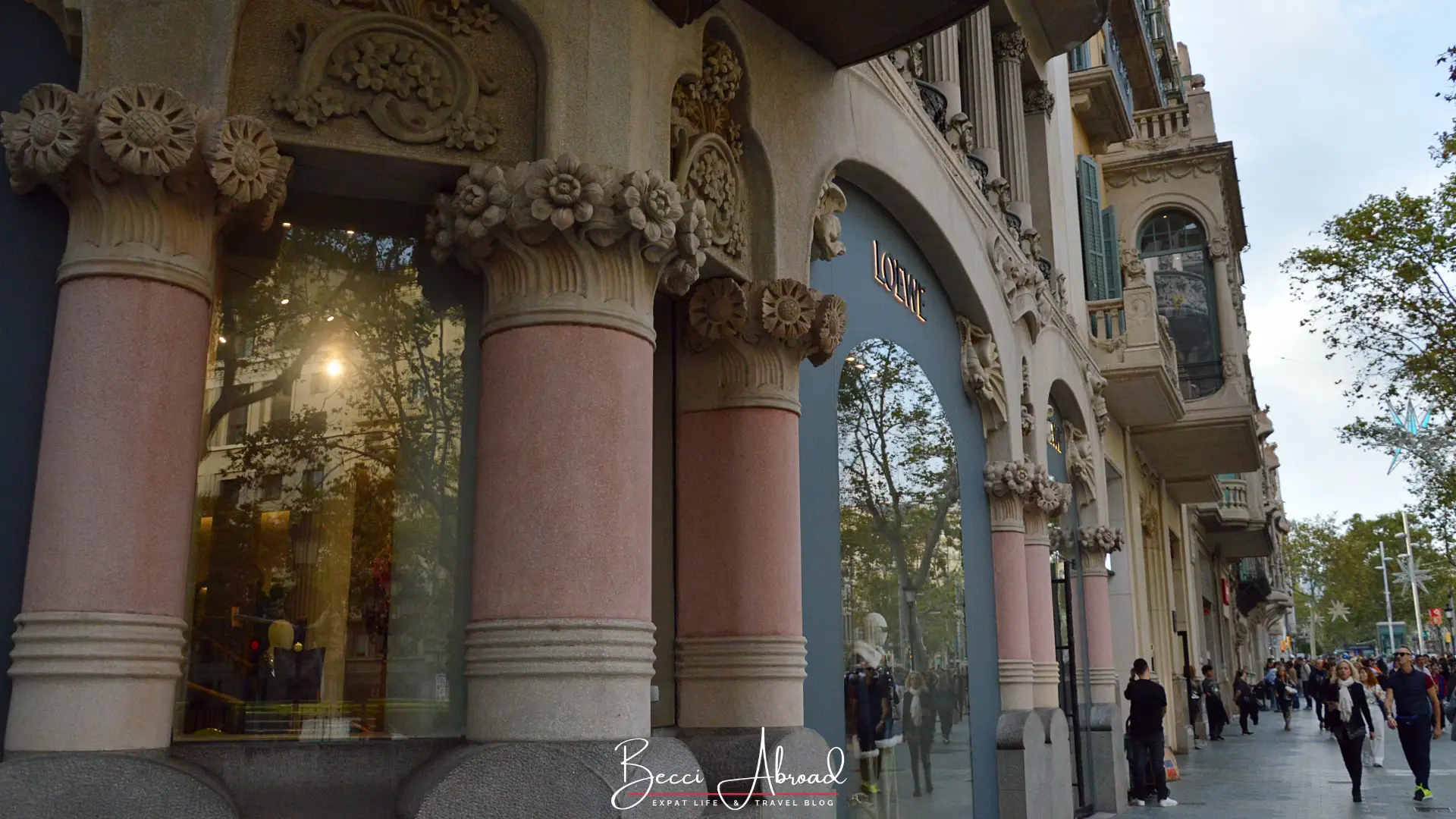
Passeig de Gràcia is home to many of Barcelona’s most beautiful and unique modernist buildings, including the famous Gaudí buildings Casa Batlló and Casa Milà, as well as lesser-known modernist beauties.
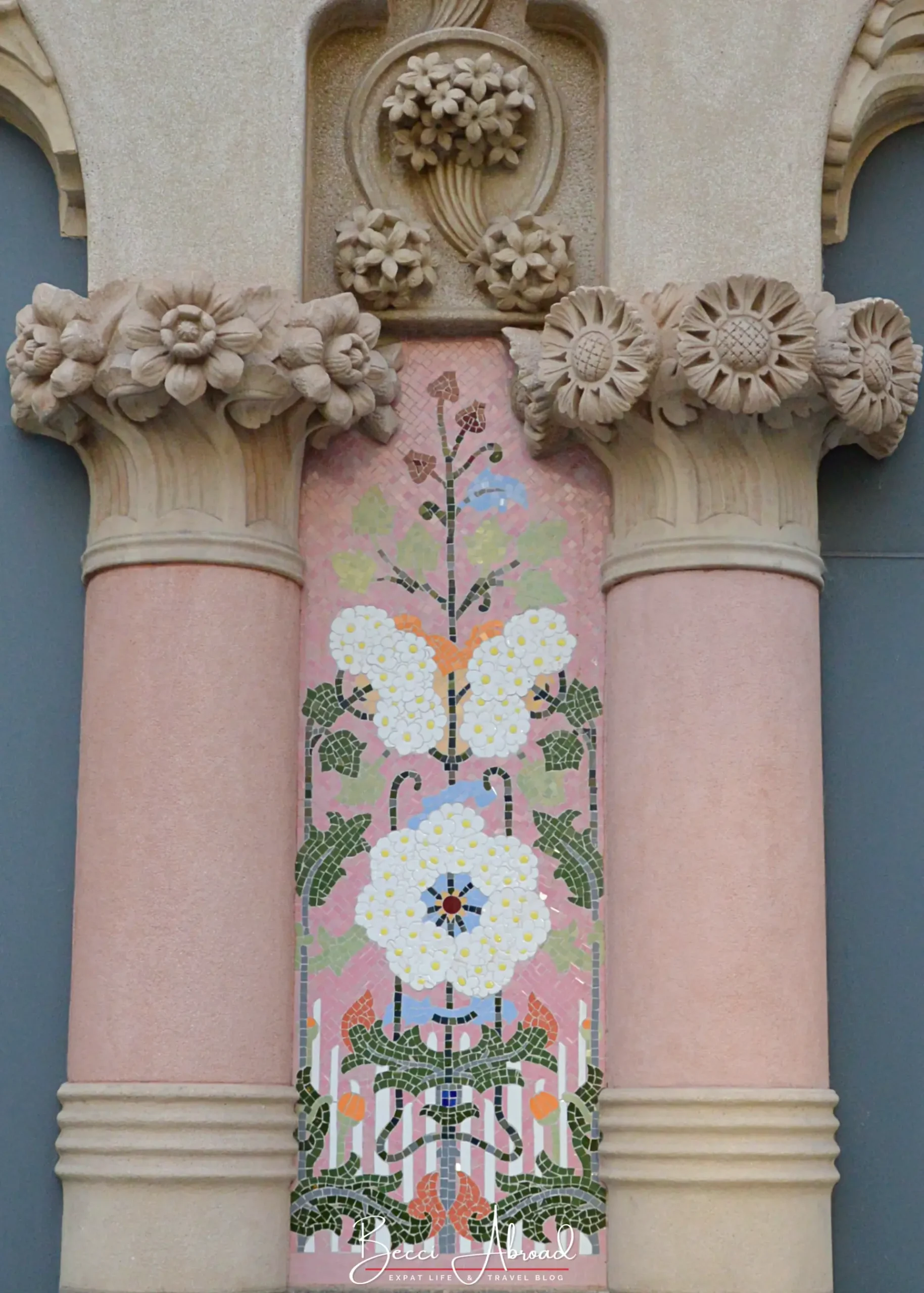
My own personal favorite on Passeig de Gràcia is Casa Lleó Morera with its beautiful pink mosaics. I also recommend stopping by Passatge de la Concepció, which is a beautiful little alley connecting Passeig de Gràcia and Rambla de Catalunya.
Nearest metro: Passeig de Gràcia (L2, L3 and L4) or Diagonal (L3 and L5).
Location: Passeig de Gràcia, between Plaça de Catalunya and Avinguda Diagonal.
Stop by Plaça de Catalunya
Plaça de Catalunya is a giant square in the center of Barcelona that connects the old town with the Eixample.
The massive square is less of an attraction and more of an orientation point or natural starting point for exploring Barcelona.
Plaça de Catalunya buzzes with people at every hour of the day. Most metro lines and the airport bus stop here, making it a place you most certainly will visit no matter if you plan for it or not.
Plaça de Catalunya is also the beginning of Barcelona’s most famous (or should I say infamous) street: La Rambla.
Personally, I don’t particularly enjoy the constant buzz of people everywhere at Plaça de Catalunya, but when I went on a walking tour about the Spanish Civil War in Barcelona, I learned to appreciate the historical importance of the square.
Nearest metro: Catalunya (L1 and L3).
Location: Plaça de Catalunya, Ciutat Vella.
Walk Down La Rambla (Once)
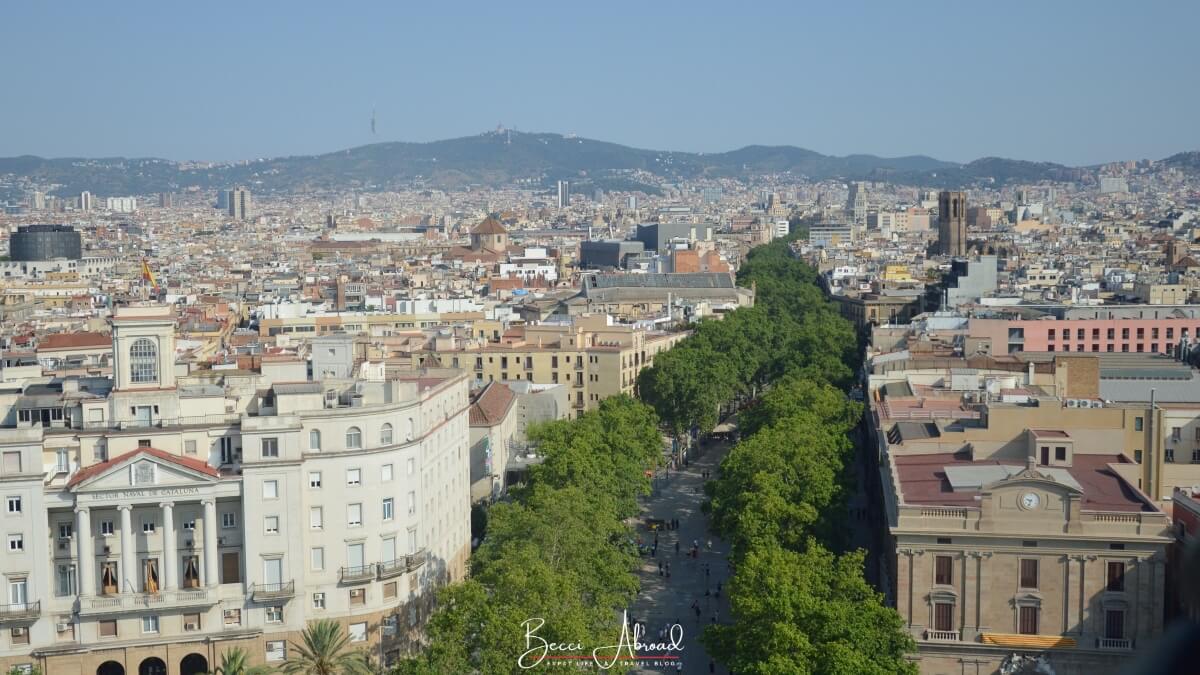
La Rambla is the most famous street in Barcelona, running from Plaça de Catalunya down to the Columbus Monument and the sea, with the Gothic Quarter on one side and El Raval on the other.
Let me be completely honest with you; La Rambla is one of my least favorite places in Barcelona.
La Rambla is crowded, the restaurants are overpriced tourist traps, and you need to watch your bag closely, because this is one of the most popular areas for pickpockets in Barcelona.
So, my recommendation is to walk it once for the experience, take in the flower stalls, the street performers, and the viewpoint at the Columbus Monument, and then go spend your time elsewhere in Barcelona.
And definitely do not eat on La Rambla! There are so many stories online about tourists being scammed by the restaurants on La Rambla.
Nearest metro: Catalunya (L1 and L3), Liceu (L3) or Drassanes (L3).
Location: La Rambla, from Plaça de Catalunya to Port Vell.
Go for a Swim at La Barceloneta Beach
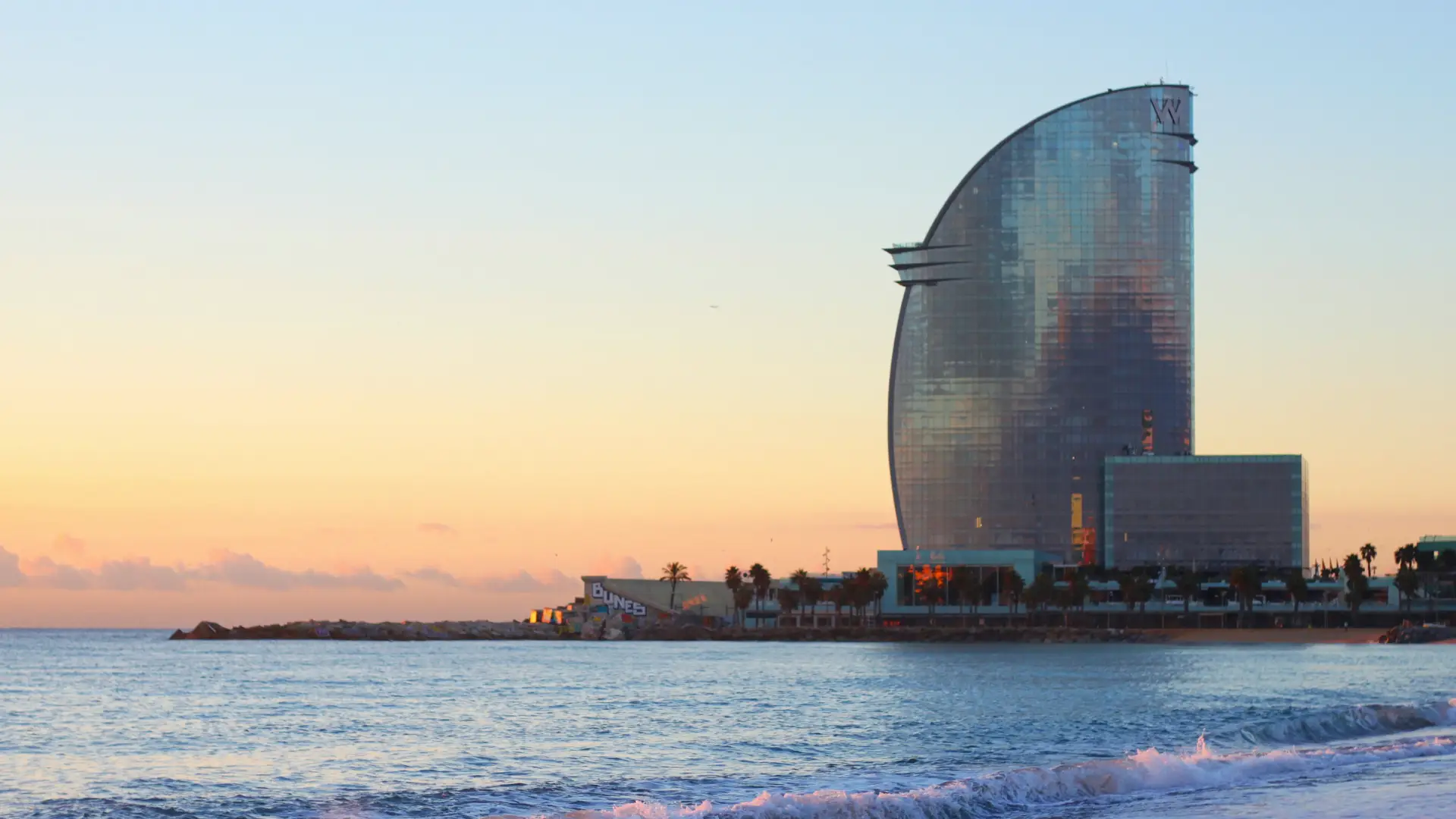
Barceloneta Beach is the city’s most famous beach, located just a short walk from Barcelona’s old town.
Going for a swim or relaxing at Barceloneta Beach is one of the most popular things to do in Barcelona – especially during the hot and humid summers in Barcelona!
The beach’s proximity to the city is exactly what makes it wildly popular with locals and tourists.
You can sunbathe, swim, play beach volleyball, walk the promenade, or share a glass of wine at a chiringuito, which is what a beach bar is called in Spain.
If you are like me and prefer beaches with fewer crowds and cleaner water, then I would recommend heading to the beaches north of Barceloneta Beach.
In the Poblenou neighborhood, you’ll find the beaches Bogatell, Mar Bella, and Nova Icària, which are just as nice (or nicer) than Barceloneta, and those are the beaches locals actually use!
Nearest metro: Barceloneta (L4) or Ciutadella | Vila Olímpica (L4).
Location: Barceloneta, Ciutat Vella.
Stop by Plaça d’Espanya for a Photo of the MNAC
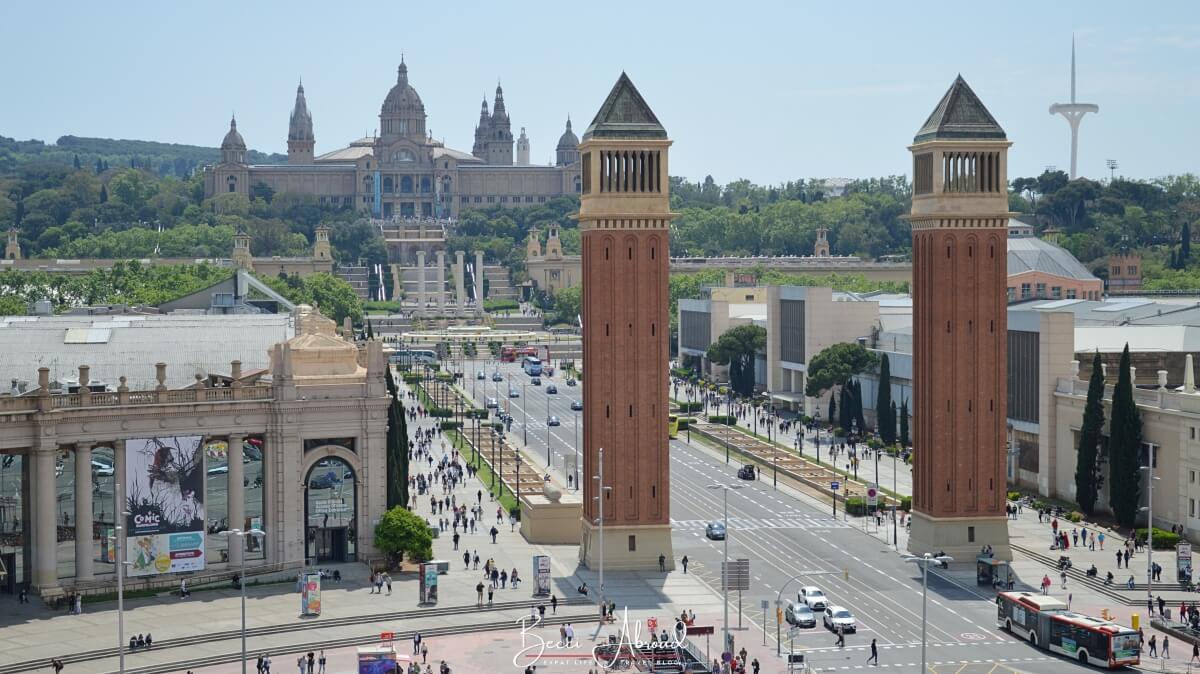
Plaça d’Espanya, meaning the Spanish Square, is one of Barcelona’s biggest squares, and a key point in the southern part of the city.
The most outstanding building by Plaça d’Espanya is the national museum for Catalan art, Museu Nacional d’Art de Catalunya, or simply MNAC.
The building that houses the MNAC is also called Palau Nacional, and it looks like it is centuries old, but actually it is barely a hundred years old.
The Palau Nacional was built for the 1929 International Exposition, the same event that gave Barcelona the Magic Fountain and Poble Espanyol.
The building was only supposed to have been the stage of the International Exposition, but then nobody tore it down.
In October 1931, the city started moving art collections in from the old Ciutadella museum, and the Museu d’Art de Catalunya officially opened inside it on 11 November 1934, with about 1,869 works. So the building that was supposed to be temporary became a permanent home for Catalan art
The collection in MNAC is massive, and you can easily spend an afternoon visiting the different exhibitions and learn about Catalan art.
If you’re short on time for your Barcelona itinerary, I would skip visiting inside MNAC, and instead just drop by Plaça d’Espanya for a quick photo stop.
Right at Plaça d’Espanya, you’ll find the Las Arenas shopping center. The building used to be the local bullring in Barcelona, but now it has been converted into a shopping mall.
On the top of the Las Arenas mall, there is a rooftop viewpoint with one of the best views over Plaça d’Espanya.
You can visit the viewpoint free of charge if you go through the Las Arenas mall, or you can pay to take the elevator up to the top from street level.
Plaça d’Espanya is also a natural gateway. From here you can walk up the Montjuïc Hill or take the train out to Montserrat.
Nearest metro: Espanya (L1 and L3).
Location: Plaça d’Espanya, Sants-Montjuïc.
Watch the Light Show at the Magic Fountain
At Plaça d’Espanya, you’ll find one of the most popular tourist attractions in Barcelona: the Magic Fountain.
The Magic Fountain, also called Font Màgica de Montjuïc, offers a free light-and-water show that takes place every Thursday, Friday, and Saturday evening!
For several years, the Magic Fountain was suspended because of drought in Catalonia, but the Magic Fountain is now working again.
The performances of the Magic Fountain takes places Wednesdays through Sundays from 9:30 pm to 10:30 pm during the summer months (June to September)
You kan get more information about the lightshow and which music plays on the different days at Barcelona’s city council’s website for the Magic Fountain.
Nearest metro: Espanya (L1 and L3).
Location: Magic Fountain, Plaça de Carles Buïgas, 1, Sants-Montjuïc.
The Best Views in Barcelona
Barcelona is built between hills and the sea, which means the city offers some amazing viewpoints!
Visiting the city’s viewpoints is one of my absolute favorite things to do in Barcelona, but here are some of the most popular viewpoints you should know about!
Catch the Sunset from Bunkers del Carmel
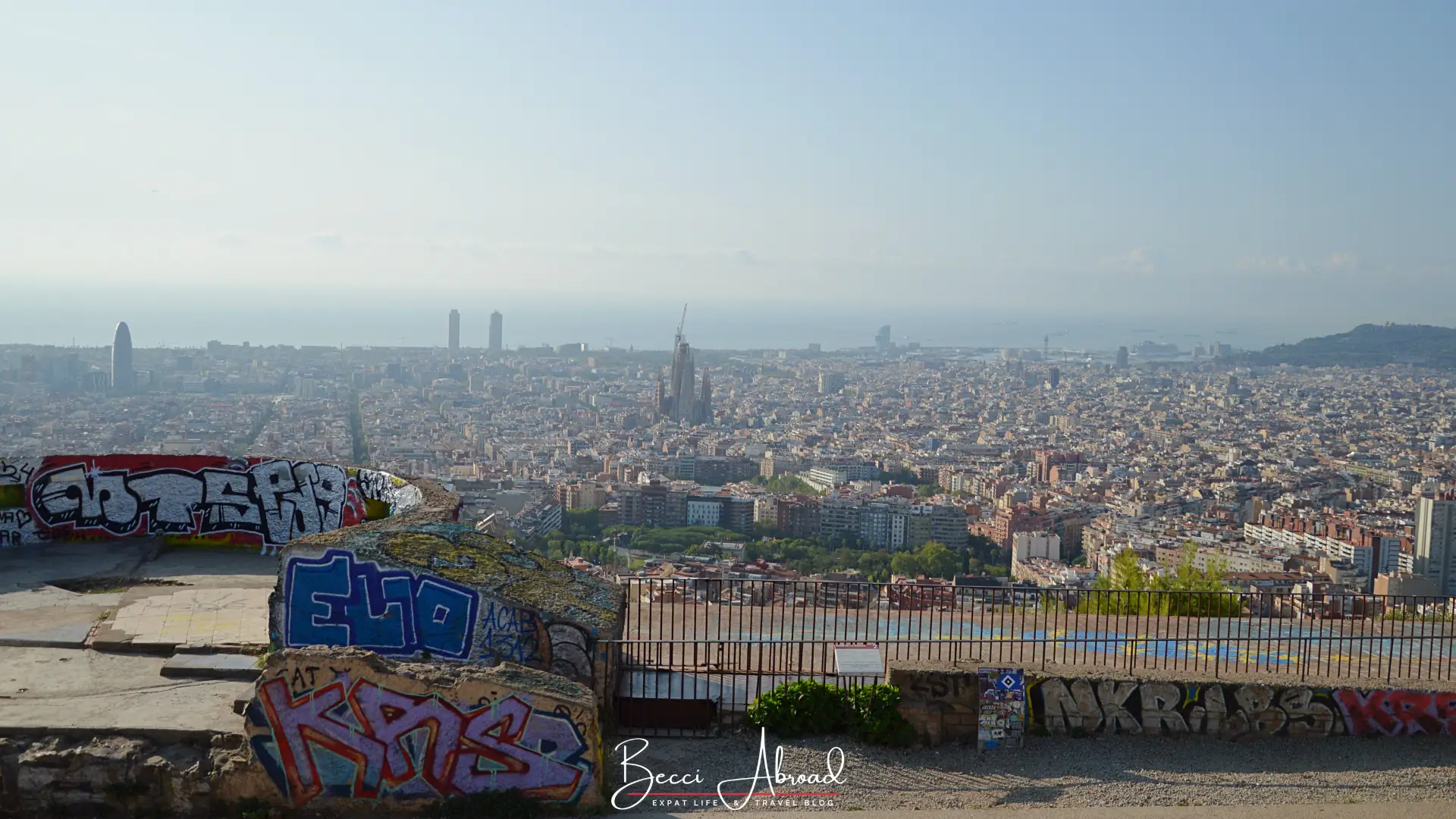
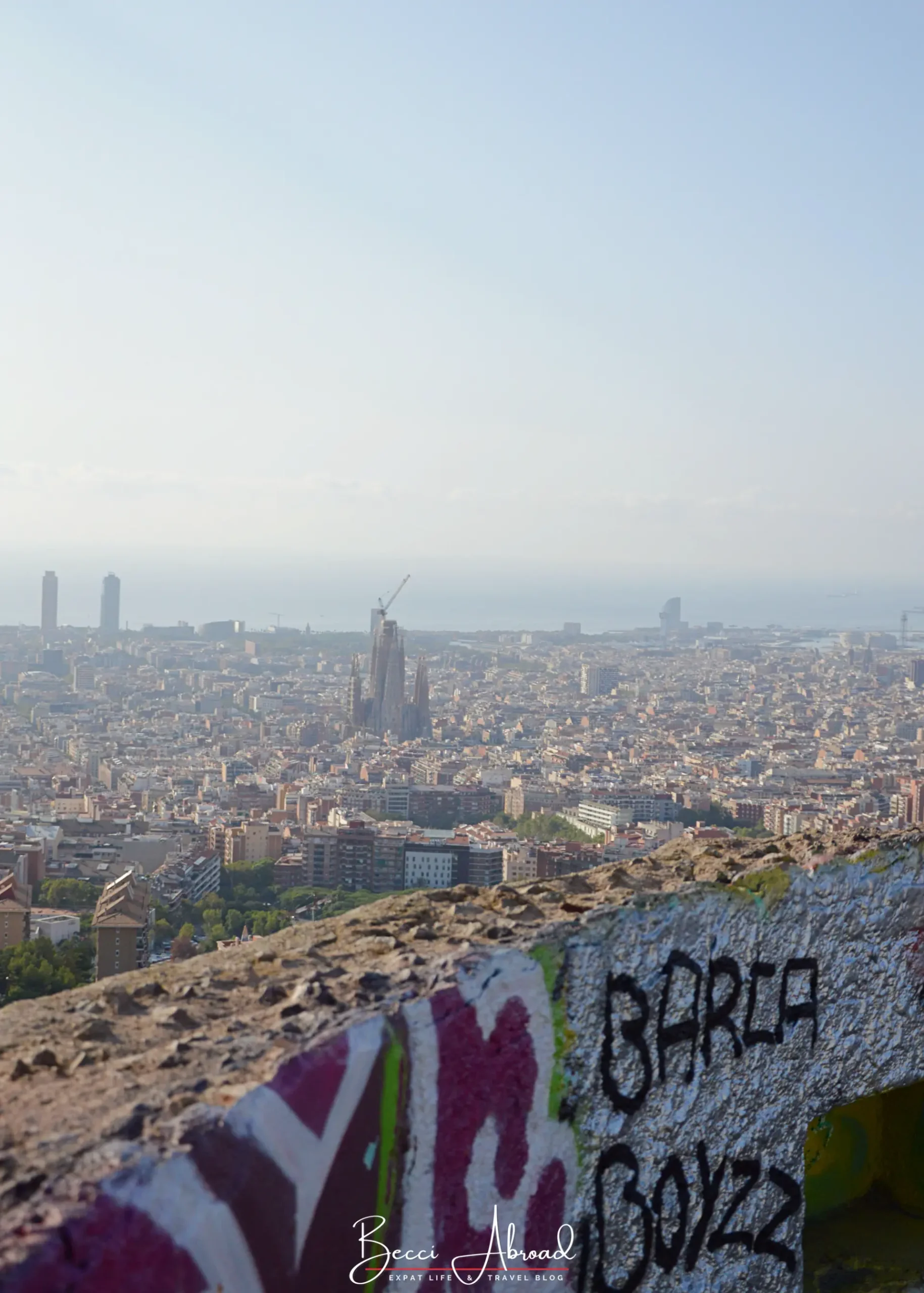
Bunkers del Carmel has quickly become one of the most popular things to do in Barcelona if you’re looking for incredible 360-degree views over the entire city.
Bunkers del Carmel are actually the remains of a Spanish Civil War anti-aircraft battery located on the hill of Turó de la Rovira.
The Bunkers del Carmel viewpoint is completely free of charge to visit, but you do have to climb some stairs and dirty paths to get to the top.
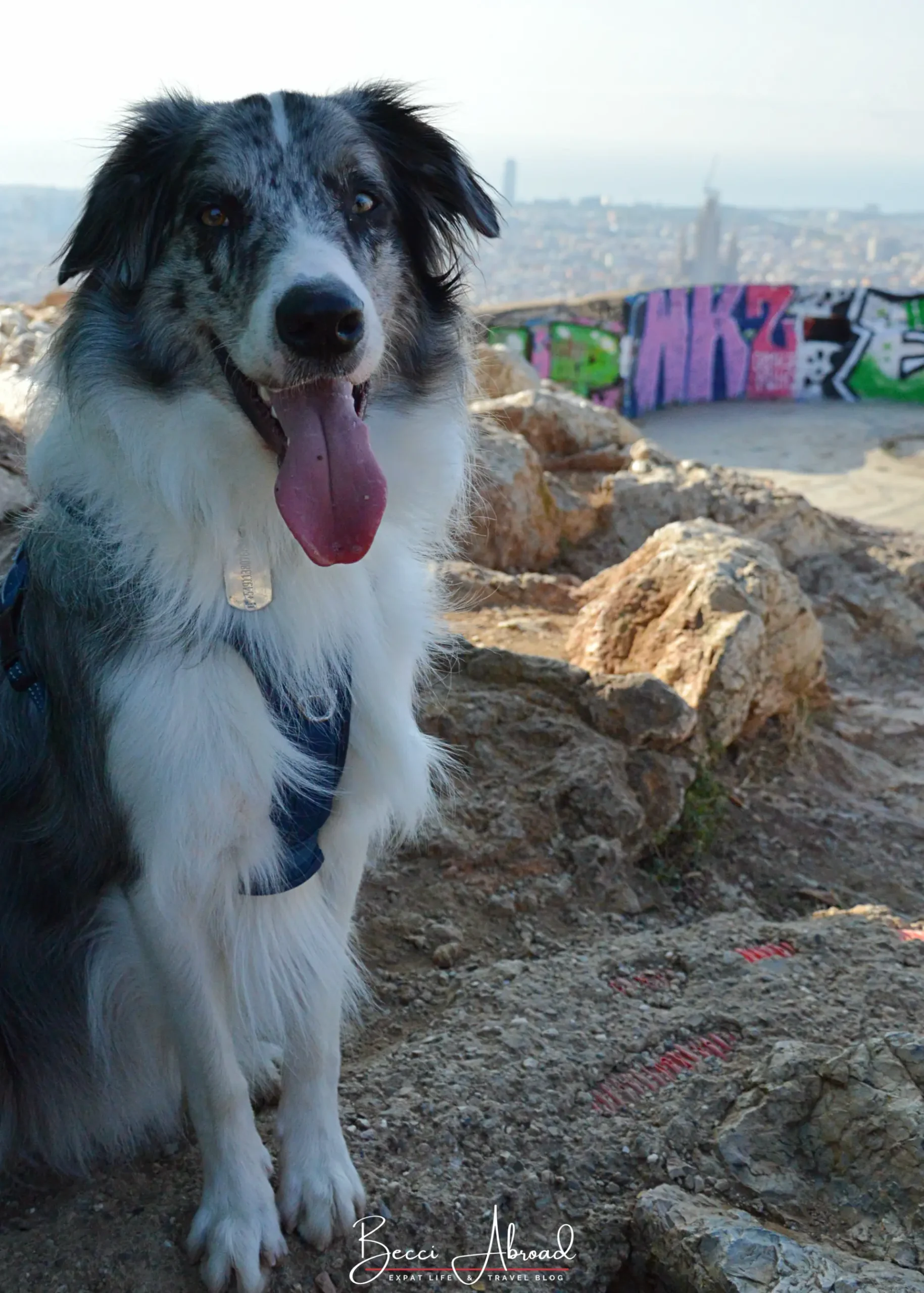
I visited many times while living in Barcelona, both with my dog, Baloo, and when my family visited from Denmark.
Winter is actually my favorite time to visit, because the atmosphere is calmer, the sun sets earlier so you are not waiting until late evening for the golden light, and you are not sweating your way up the hill like in July!
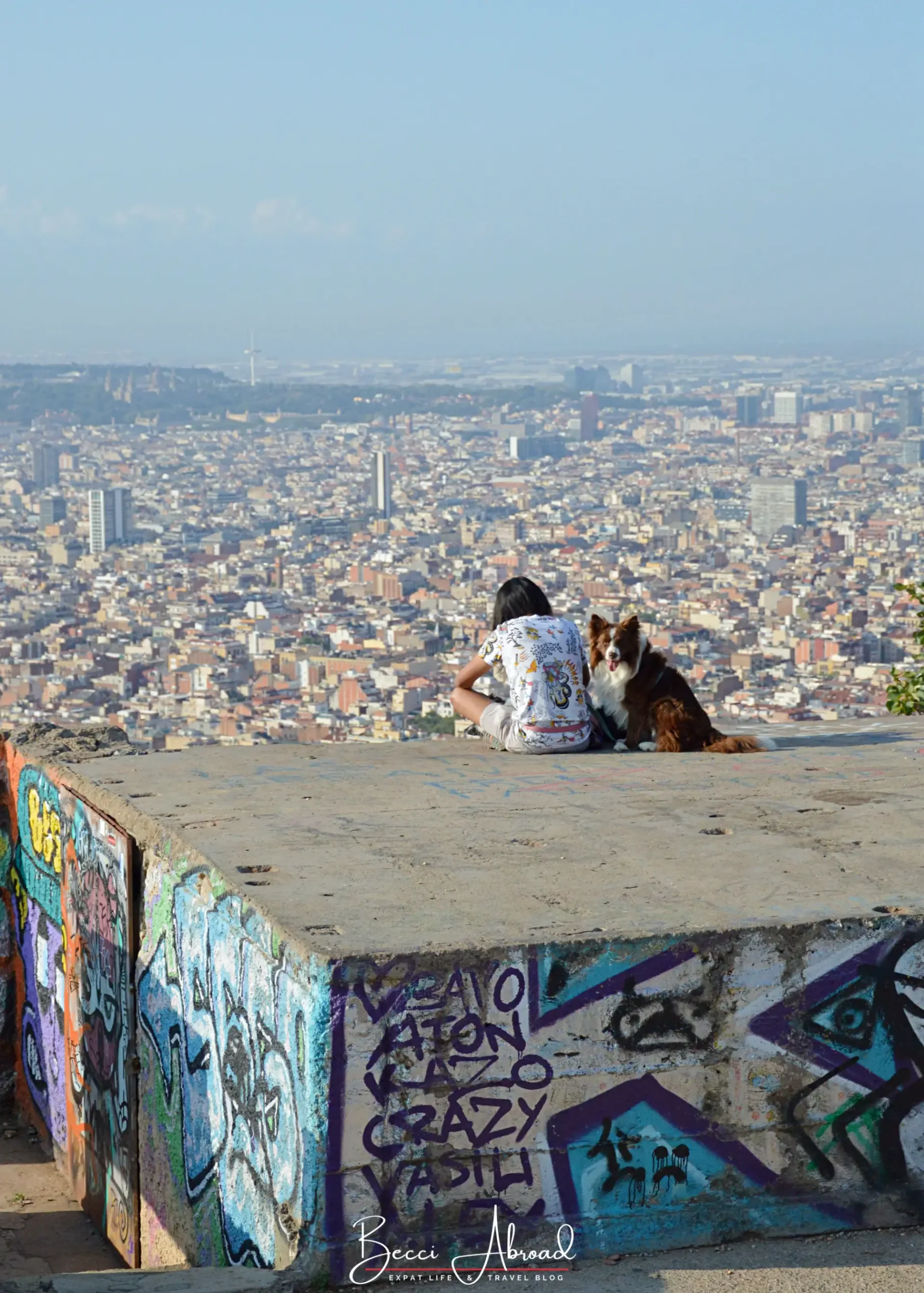
In summer, the Bunkers del Carmel gets overwhelmingly crowded around sunset, and I have purposely avoided visiting at this time.
I did visit early one summer morning with Baloo, and when we reached the top around 9 am, we had almost the whole viewpoint for ourselves – except a guy sitting with his two dogs!
Around 10 am, the first people started to arrive to take selfies from the top, and Baloo and I headed home again.
So, my recommendation is definitely to visit Bunkers del Carmel as early as possible – also if you want to avoid the heat in the summer.
Admission: Free.
Nearest metro: Alfons X (L4) or El Carmel (L5), then a steep uphill walk.
Location: Bunkers del Carmel, Carrer de la Gran Vista 96, Horta-Guinardó.
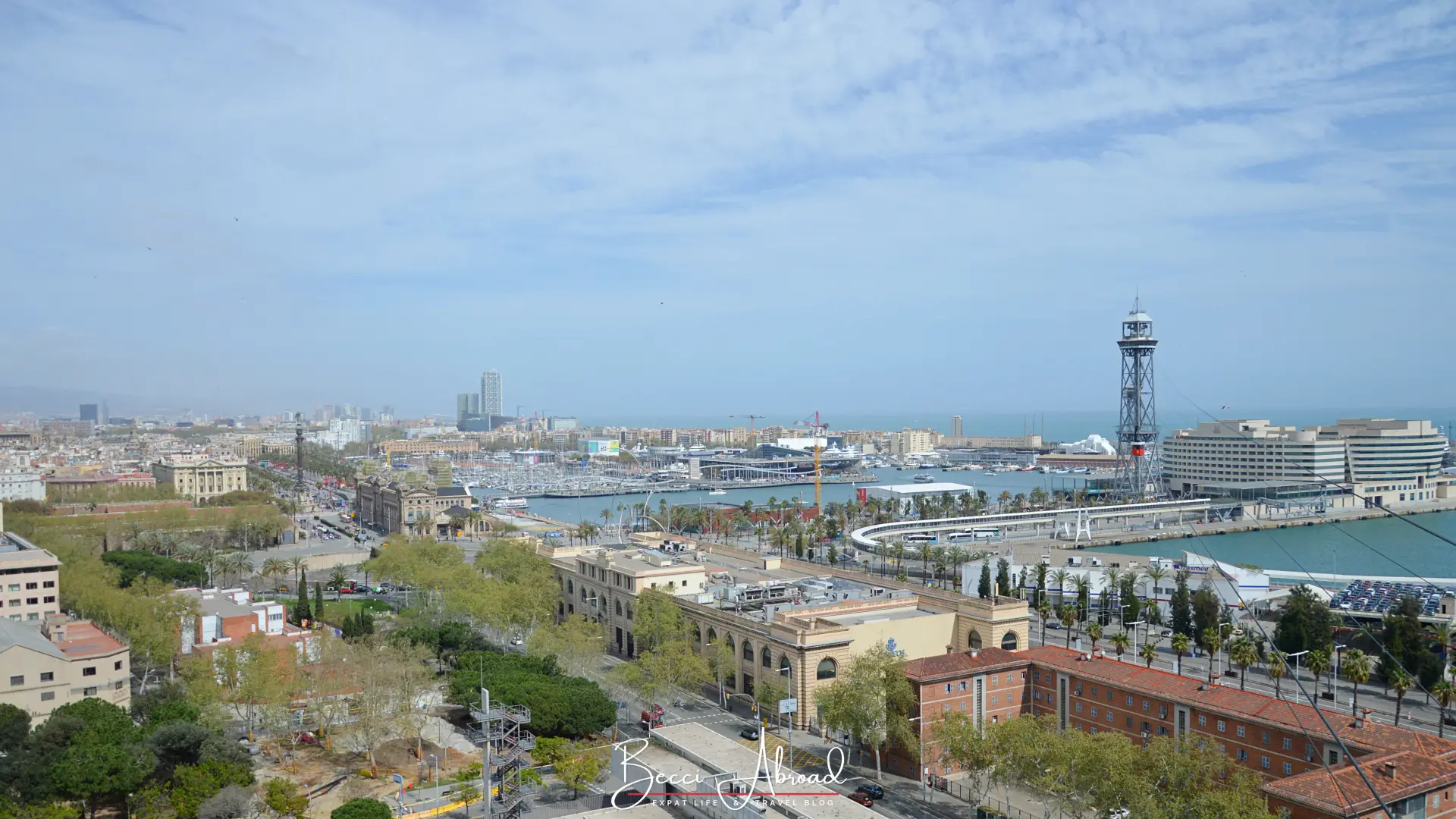
Enjoy the Views of Barcelona from the Montjuïc Mountain
Montjuïc is a mountain or hill that rises over the harbor in the southwest of Barcelona, and you can easily spend a full day exploring Montjuïc!
Montjuïc means “Jewish Mountain” in medieval Catalan, and at the mountaintop sits Montjuïc Castle, a seventeenth-century fortress.
The Montjuïc Castle was originally built to defend the city, but today, it’s a popular tourist attraction in Barcelona, offering sweeping views over the port and the sea.
On Montjuïc, you can also find the Joan Miró Foundation, which holds a vast collection of the Catalan artist’s bold, abstract paintings and sculptures.
Montjuïc also offers an open-air architectural museum, called Poble Espanyol. Poble Espanyol translates to “the Spanish Town”, and the area was built for the 1929 International Exposition. The museum showcases different building styles from all over Spain, so it feels like travelling around Spain without leaving Barcelona.
Whatever else you do up here, do not miss the cable car ride from Montjuïc down toward the beach. The views are breathtaking, and it is a genuinely fun way to descend.
Nearest metro: Espanya (L1 and L3), then the funicular or cable car up the hill.
Location: Montjuïc, Sants-Montjuïc.
Get Amazing Views of Barcelona from Tibidabo Mountain
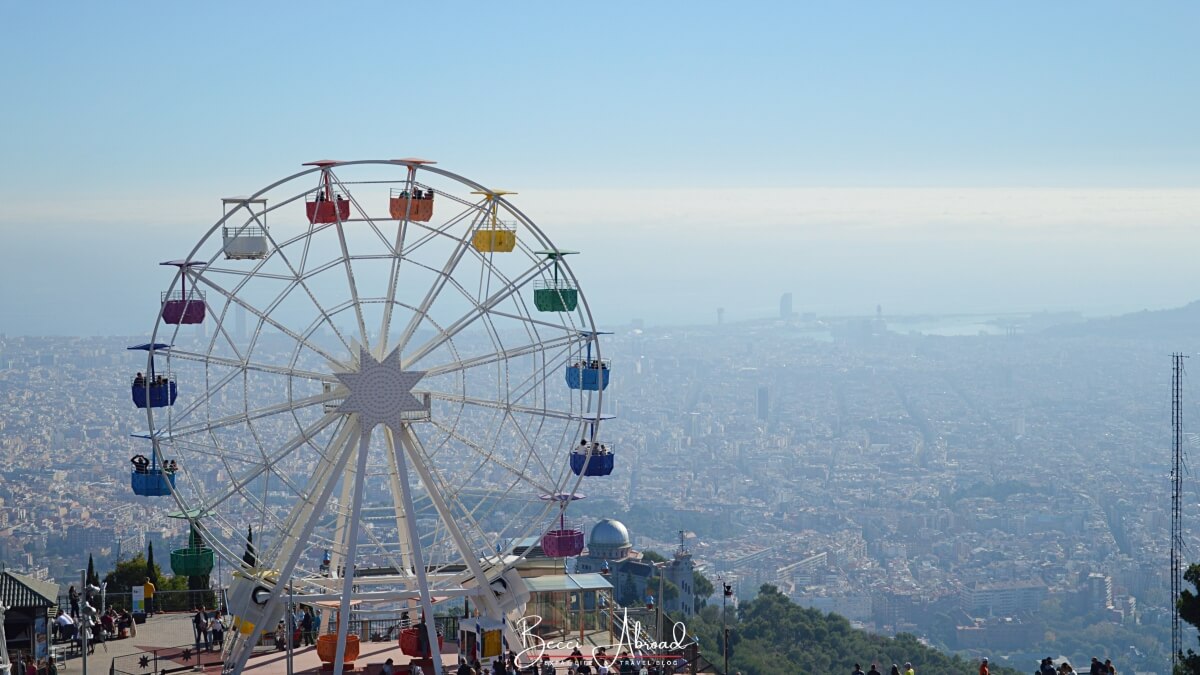
The Tibidabo Mountain is the highest peak of the Collserola mountain range surrounding Barcelona, sitting at 512 meters (1,680 ft).
If you’re in doubt about which of the mountaintops is Tibidabo, just look for the mountaintop on the horizon with the big church!
The church sitting on the top of the Tibidabo Mountain is called Temple Expiatori del Sagrat Cor, or translated as the Temple of the Sacred Heart of Jesus.
The church itself is free to enter, but if you want to climb to the top of the bell tower for an even better view, there is a small entrance fee.
Next to the church sits the main attraction on the Tibidabo Mountain: Tibidabo Amusement Park.
The Tibidabo Amusement Park is one of the oldest theme parks in Europe, dating back to 1899. The amusement park features vintage carousels and a Ferris wheel hanging out over the city views.
Tibidabo is one of the best things to do in Barcelona if you’re visiting with kids!
Admission: The tickets to the Tibidabo Amusement Park start at 39 euros. Access to the Tibidabo panoramic viewpoint is free of charge.
Nearest metro: No metro goes to the top. You can get to the top of the Tibidabo summit either by taking the Tibidabo mountain train, called Cuca de Llum, or by hiking to the top (it roughly takes 1 to 2 hours to hike to the top of Tibidabo).
Location: Tibidabo Panoramic Viewpoint, Plaça del Tibidabo 3-4, Sarrià-Sant Gervasi.
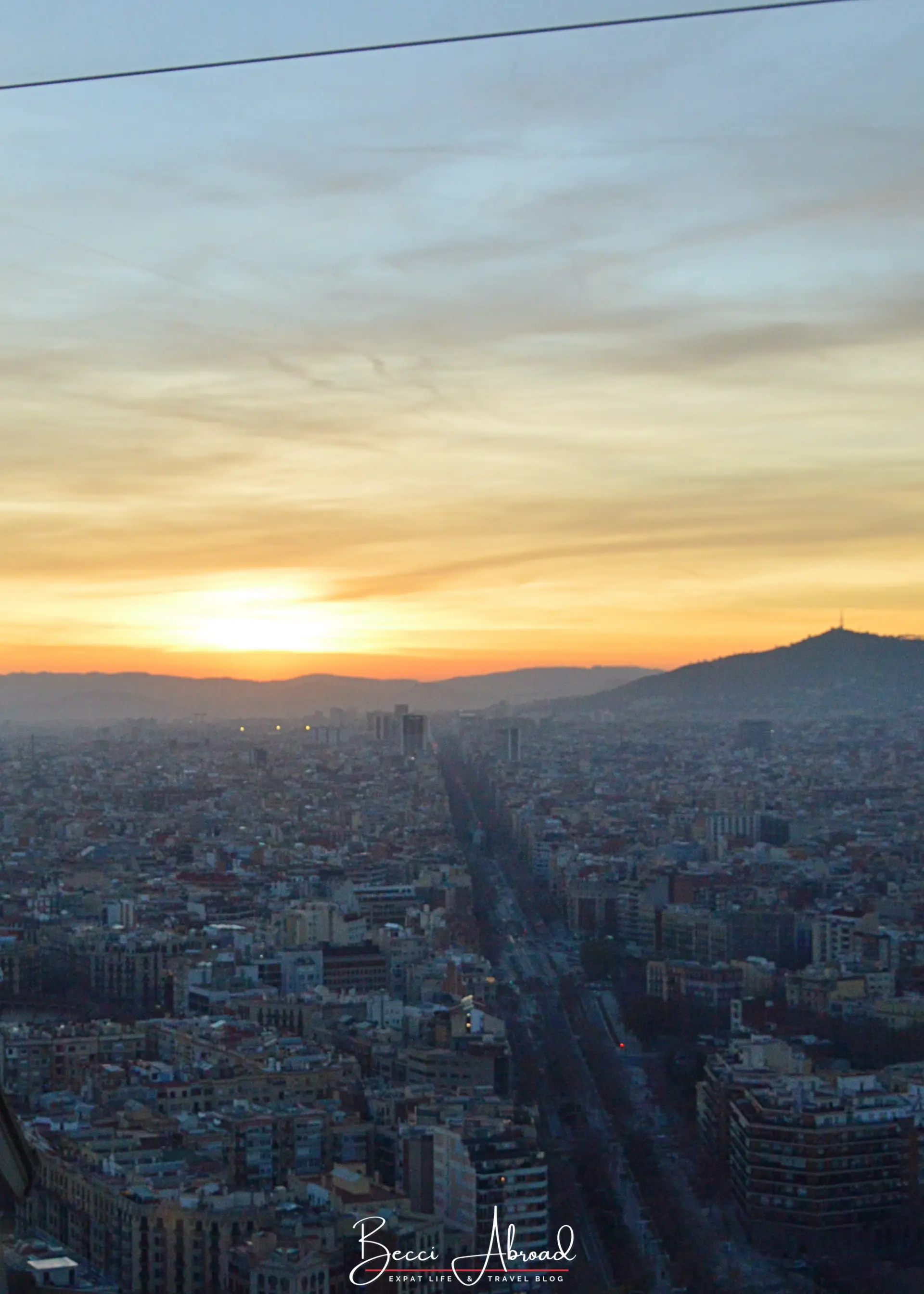
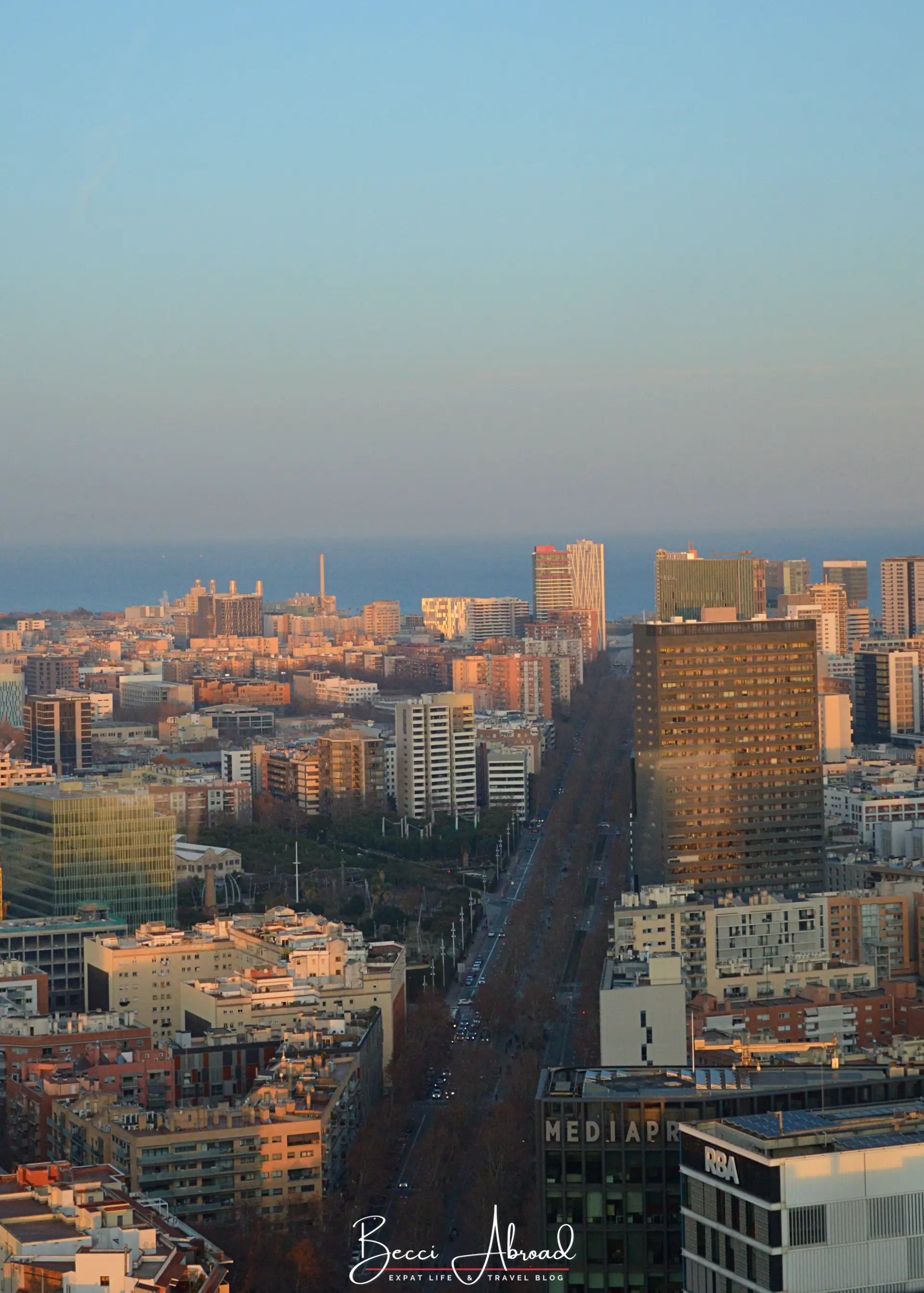
Experience Barcelona from Above at the Torre Glòries Viewpoint
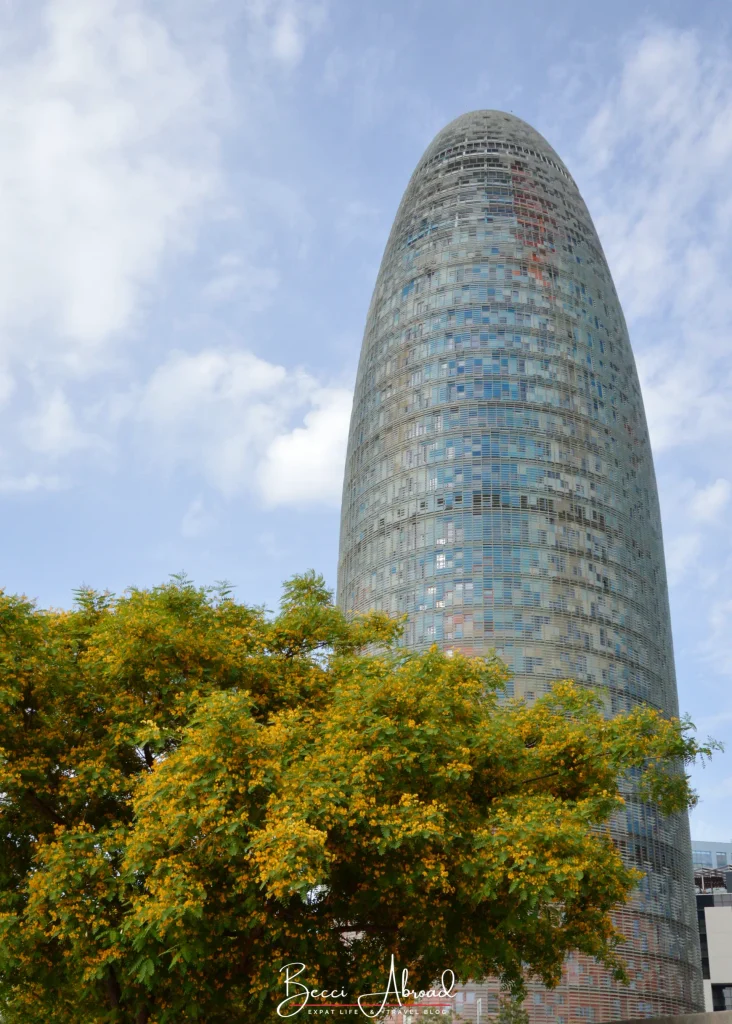
Torre Glòries, formerly Torre Agbar, is the unmistakable bullet-shaped skyscraper in the Barcelona skyline.
Torre Glòries is located in the Poblenou neighborhood and designed by Jean Nouvel, who is said to have been inspired by the peaks of the popular Montserrat mountains near Barcelona when drafting the building.
The top-floor viewpoint sits 125 meters (410 ft) above the city and offers panoramic views in every direction.
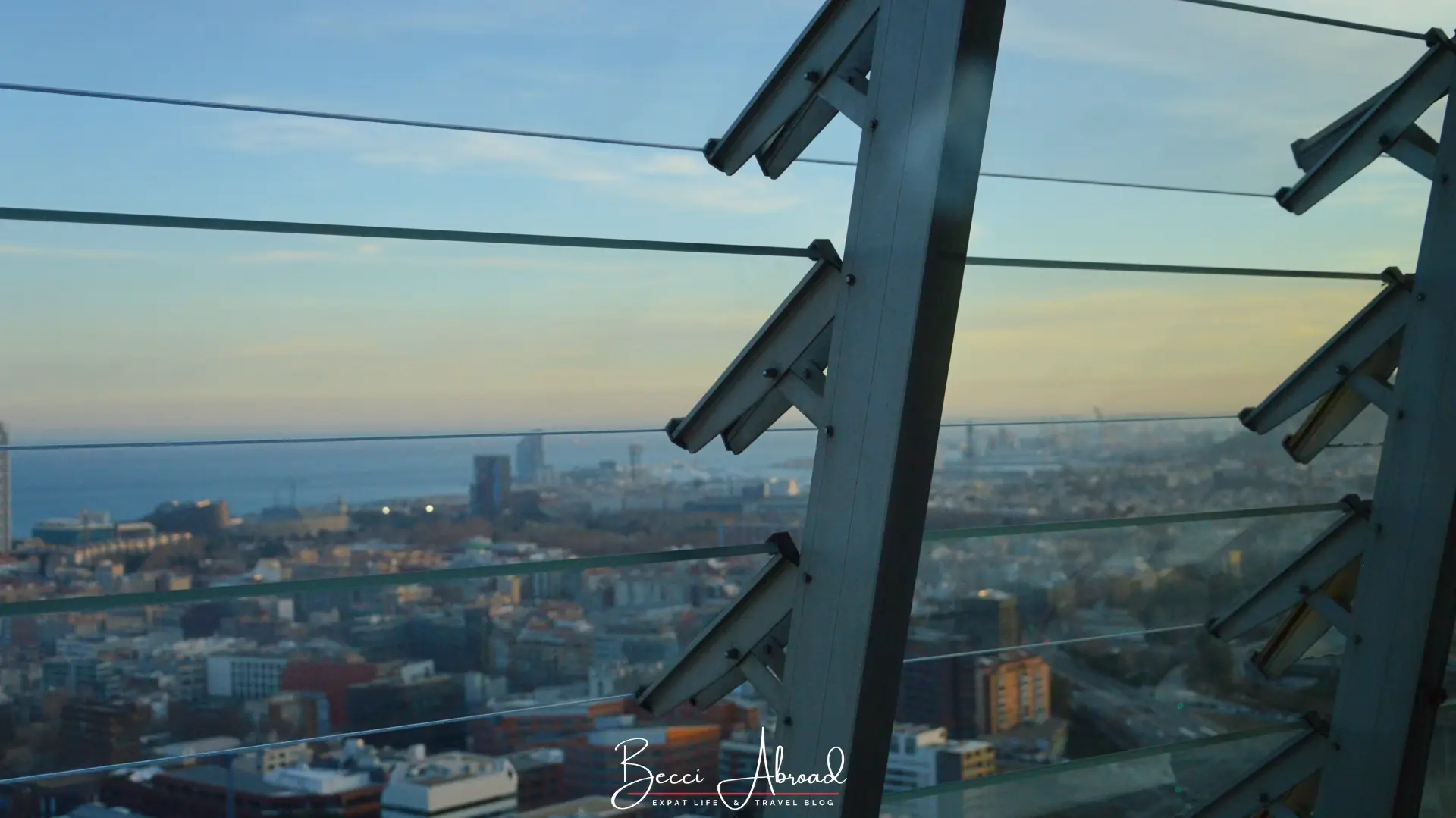
But to be completely honest with you, I was actually quite disappointed when I visited the viewpoint at Torre Glòries.
The metal construction that supports the glass facade of the building blocks a lot of the views. I came away feeling I had paid for something I could get better elsewhere.
The positive thing is there is an elevator going, so you don’t have to walk all the way up to the top floor.
If you only have a budget for one paid viewpoint, I would pick going to the top of Tibidabo Mountain, which has a lot better views.
But there are also plenty of free viewpoints in Barcelona, which in my opinion are a lot better.
Admission: Tickets to Torre Glòries start at 18 euros online for adults, 21 euros at the ticket office. Children under 12 are free.
Nearest metro: Glòries (L1).
Location: Torre Glòries, Avinguda Diagonal 209, Poblenou.
Get your ticket to the Torre Glòries Viewpoint
Where to Next?
Go on a Day Trip from Barcelona
One of the things I really love about Barcelona is the many different easy day trip options you have very close to the city.
If you have more than three or four days in Barcelona, I would definitely recommend using one of them to get out of the city, because there are so many stunning places in Catalonia!
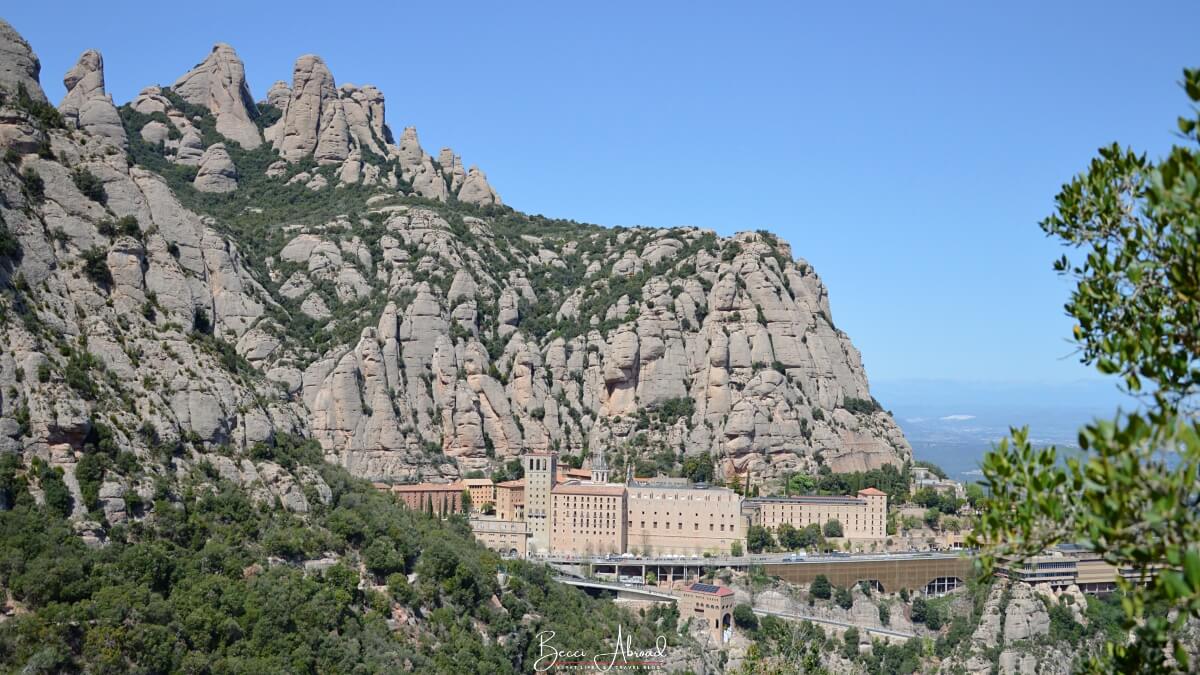
The most popular day trip from Barcelona is to Montserrat, a monastery perched dramatically on top of a mountain range about an hour and a half from the city.
The monastery, officially called Santa Maria de Montserrat, is home to the famous Black Madonna, which is a revered icon in Catalonia. The mountains surrounding the monastery offer plenty of hiking trails of different difficulty and jaw-dropping views over the Catalan countryside.
Being the most popular day trip from Barcelona, Montserrat is also one of the most touristy day trip destinations near Barcelona. If you want to visit Montserrat, I strongly recommend leaving from Barcelona to Montserrat as early as possible from Barcelona to get the most out of your day and explore the area before the crowds hit.
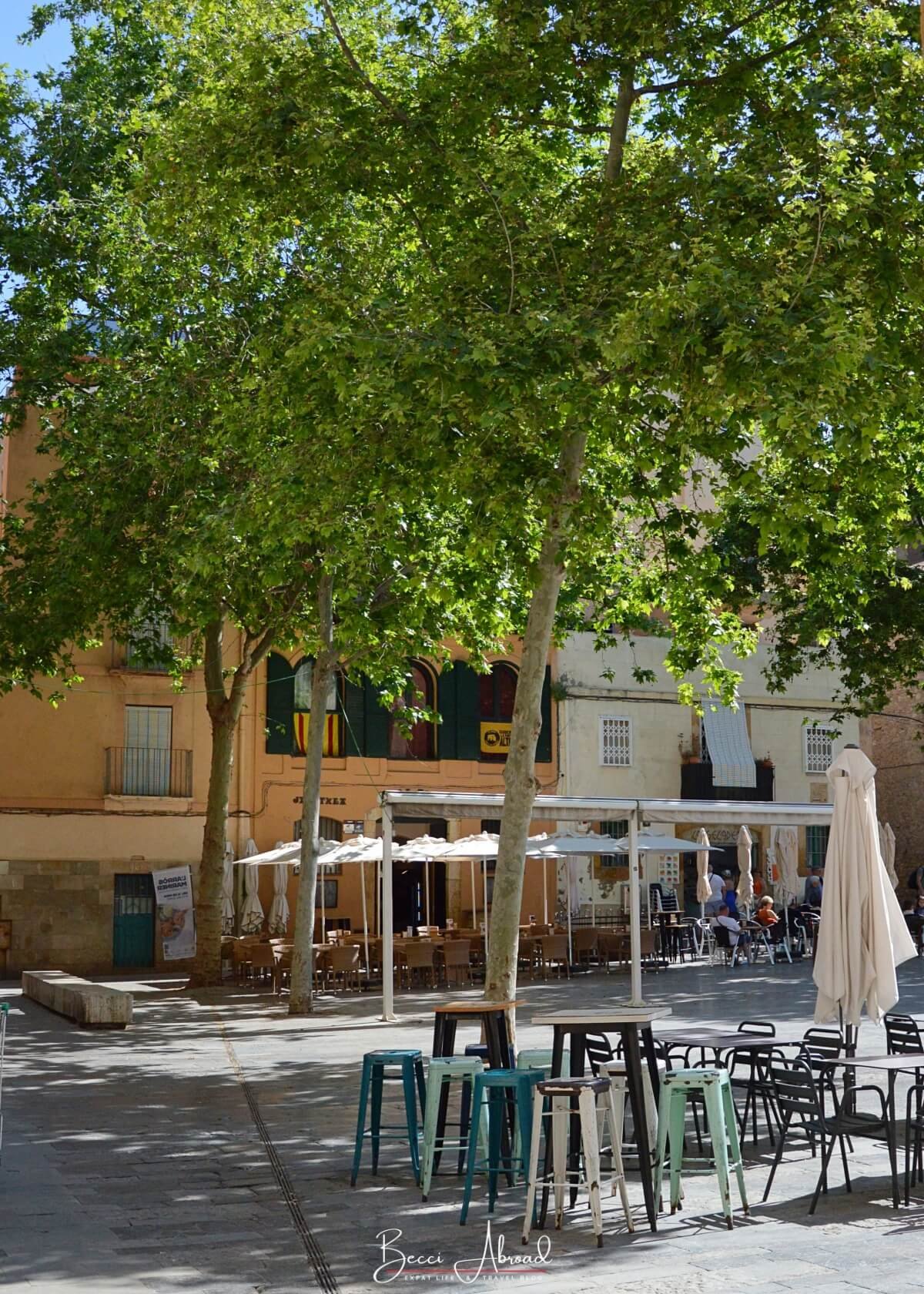
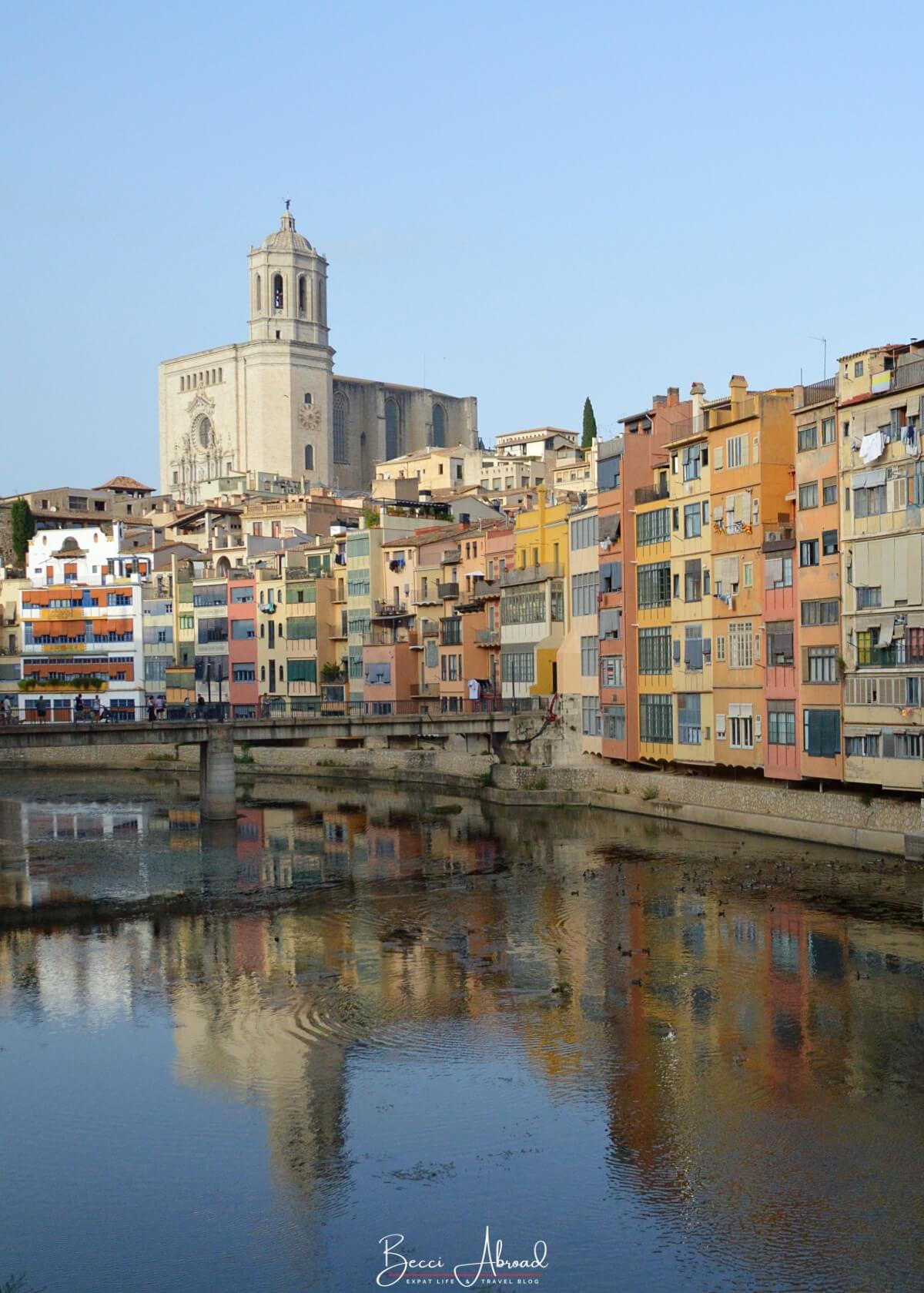
Girona and Tarragona are great options for day trips from Barcelona if you are interested in history and enjoy exploring medieval towns with cobblestoned streets and beautiful old houses.
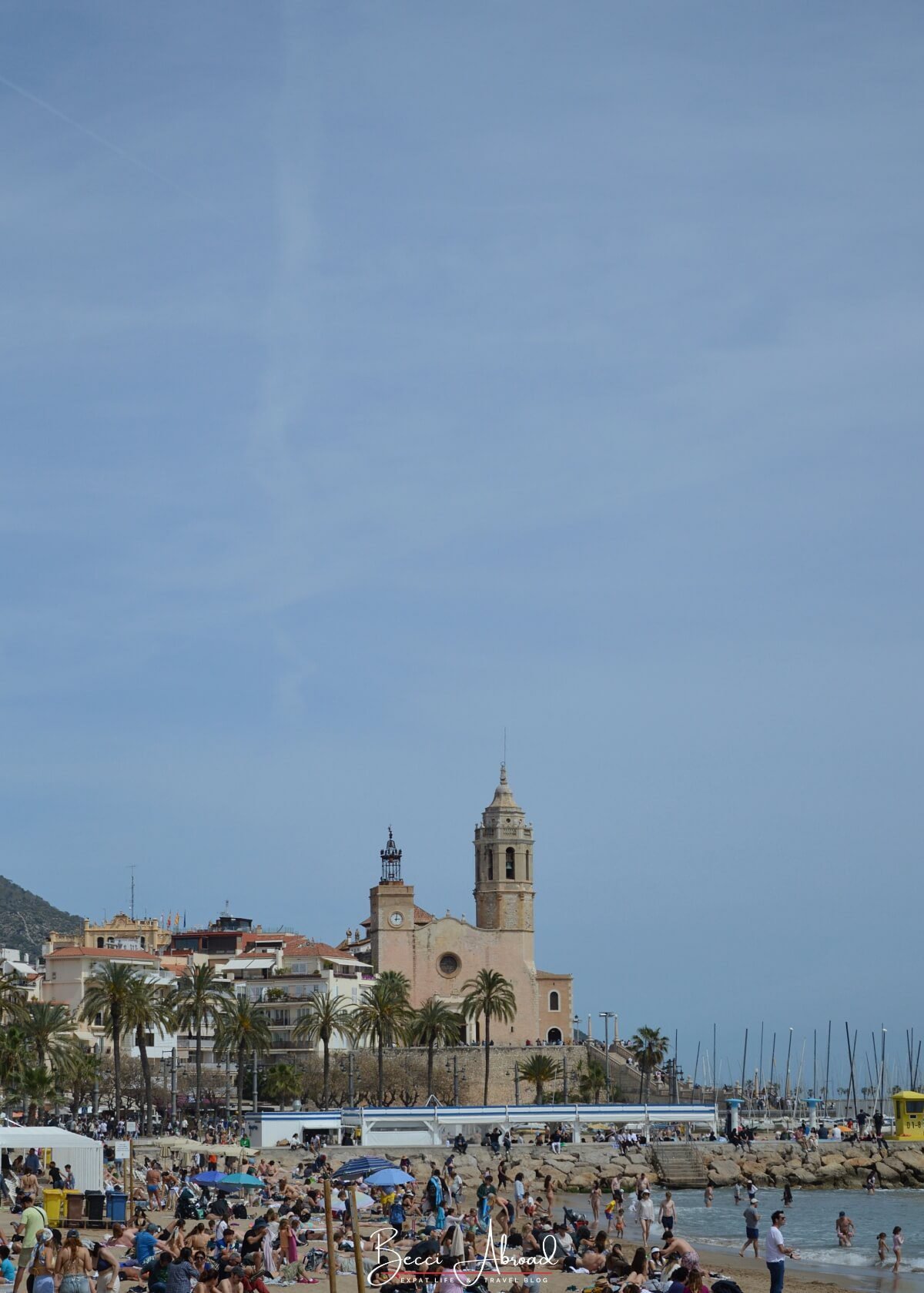
The seaside town of Sitges is a great and easy option for doing a day trip from Barcelona and getting a completely different experience than the busy city life in Barcelona.
Sitges is easily reached by direct train from Barcelona, and the train ride only takes around 20 minutes. The small town offers beautiful beaches, charming old white-painted fishermen’s houses, and more art museums than I have seen in any other Spanish town!
If you want to experience the beautiful Costa Brava coastline north of Barcelona, a day trip to Blanes is the easiest way to explore Costa Brava. Blanes is the only town in Costa Brava that is connected to Barcelona with a direct train.
So, where are you going next?
Get the Most Out of Your First Time in Barcelona
Now we have explored some of my favorite things to do in Barcelona, and I hope you found it useful.
In this section, I want to share some last tips on how to get the most out of your travels to Barcelona.
A Quick Note on Visiting Barcelona Responsibly
Barcelona is one of the most visited cities in Europe, and the locals feel it. Overtourism is a real, ongoing debate here, and in 2026 the city roughly doubled its overnight tourist tax in response.
A few small things make a big difference. Visit the big attractions early or late, eat at least a few meals outside the tourist core, explore neighborhoods like Poblenou, Gràcia and Horta, and treat local markets as markets rather than photo backdrops.
Honestly, these are also the things that will give you a better trip!
Top-rated Tours and Activities in Barcelona for First-Timers
There are many interesting things to do in Barcelona for first-timers, and I have gathered some of the most popular top-rated tours and activities I mentioned above in a neat list for you:
- Sagrada Familia Entry Ticket
- Park Güell Entry Ticket
- Casa Batlló Entry Ticket
- Palau de la Música Catalana Entry Ticket
- Recinte Modernista de Sant Pau Entry Ticket
- Barcelona Cathedral Entry Ticket
- Picasso Museum Entry Ticket
- Torre Glòries Viewpoint Entry Ticket
- Tibidabo Panoramic Area
- The National Museum of Catalan Art

Frequently Asked Questions
Barcelona FAQ
Find answers to commonly asked questions about Barcelona.
Final Thoughts: Is it Worth Visiting Barcelona?
Yes, it is definitely worth visiting Barcelona!
Personally, I think Barcelona is a bit of a must-visit destination for anybody visiting Spain. Even if you’re traveling to Spain and Portugal, I would strongly recommend you still make time to visit Barcelona!
Barcelona is a city that keeps surprising you. Even after two and a half years of living there, I never ran out of things to do.
Start with the classics on this list, be strategic about crowds and tickets, and then leave real room in your itinerary to simply wander.
The honest caveat is the one I keep coming back to. Barcelona in high summer is a different and much less pleasant city than Barcelona in May or October, and no amount of planning fixes that.
Some of my best Barcelona memories are not from any attraction at all. They are from getting lost in a neighborhood and stumbling onto a plaza I had never seen before!