My Experience of Visiting Inside the Palace of Catalan Music in Barcelona
The Palace of Catalan Music in Barcelona is one of Barcelona’s most spectacular buildings!
If you haven’t already added it to your Barcelona bucket list, I strongly recommend that you do it right now!
I’ll wait while you find pen and paper – or add it to your endless Barcelona list on Google Maps.
Alright, have you added the Palace of Catalan Music?
Good!
Before we dive into all the details, I want to start with a small confession:
The Palace of Catalan Music in Barcelona is one of my all-time favorite buildings in the city!
And that’s saying a lot, considering how spoiled for choice Barcelona is with gorgeous buildings!
The Palace of Catalan Music, most commonly known in its Catalan name Palau de la Música Catalana, is an Art Nouveau concert hall. The concert hall is located in the heart of Barcelona’s Old Town, a short walk from Barcelona’s Cathedral and Plaça de Catalunya.
I have visited the Palau de la Música Catalana twice. Once, while I was living in Barcelona, and last time, I visited Palau de la Música Catalana with my friend on my recent trip to Barcelona in January 2026.
Honestly, the Palace of Catalan Music completely stole my heart both times!
So, in case you’re still in doubt about whether it is worth visiting the Palace of Catalan Music (and don’t believe some random blog post you found on the internet), please keep on reading!
By the end of this post, I hope to have you convinced to visit the Palace of Catalan Music!
So, let’s get under the skin of the Palace of Catalan Music!
A Guide to Visiting the Palace of Catalan Music in Barcelona
This post was sponsored by Palau de la Música Catalana. While I’m honored to be working with this great organization, all opinions are my own.
Disclosure: Some of the links below are affiliate links. This means that at no additional cost to you, Becci Abroad will earn a commission if you purchase through one of those links. This helps to pay the bills and the maintenance of the site.
Get to Know the Palace of Catalan Music in Barcelona
Barcelona is packed with famous sights, beautiful buildings, and plenty of things to do, but the Palace of Catalan Music is, in my opinion, one of the most outstanding landmarks!
So, if the Palace of Catalan Music isn’t yet on your Barcelona itinerary, you could strongly consider making time for it!
Before we get into the details of seeing inside the Palace of Catalan Music, let’s get to know Palau de la Música Catalana a bit better!
What is the Palau de la Música Catalana?
Palau de la Música Catalana is a concert hall built in the Catalan modernist style.
Translated to English, Palau de la Música Catalana means “the Palace of Catalan Music” or the “Catalan Music Palace”.
Sometimes, you’ll also hear the Palau de la Música Catalana referred to as simply “el Palau”, i.e., the Palace.
Calling the Palace of Catalan Music just a concert hall doesn’t really do it justice!
Palau de la Música Catalana was built in the early 1900s as a home for Catalan choral music, and the building is one of the most beautiful expressions of Catalan modernisme.
Catalan Modernism was an artistic and architectural movement in Catalonia in the late 19th and early 20th centuries, inspired by the wider European Modernism, also known as Art Nouveau.
Catalan Modernism is the same architectural movement to which Antoni Gaudí belonged when he designed famous Barcelona landmarks such as Sagrada Familia and Casa Batlló.
While the elements and symbolism used in Palau de la Música Catalana are the same as in Gaudí’s works, the style is different.
Modernism draws heavily on nature, and the Palau embraces this wholeheartedly. Inside the Palace of Catalan Music, you can see this influence everywhere from floral motifs to curved forms and organic shapes.
In Catalonia, Modernism was also deeply connected to Catalan identity and cultural pride. The Palau was designed not just as a performance space, but as a statement to celebrate Catalan music, history, and creativity.
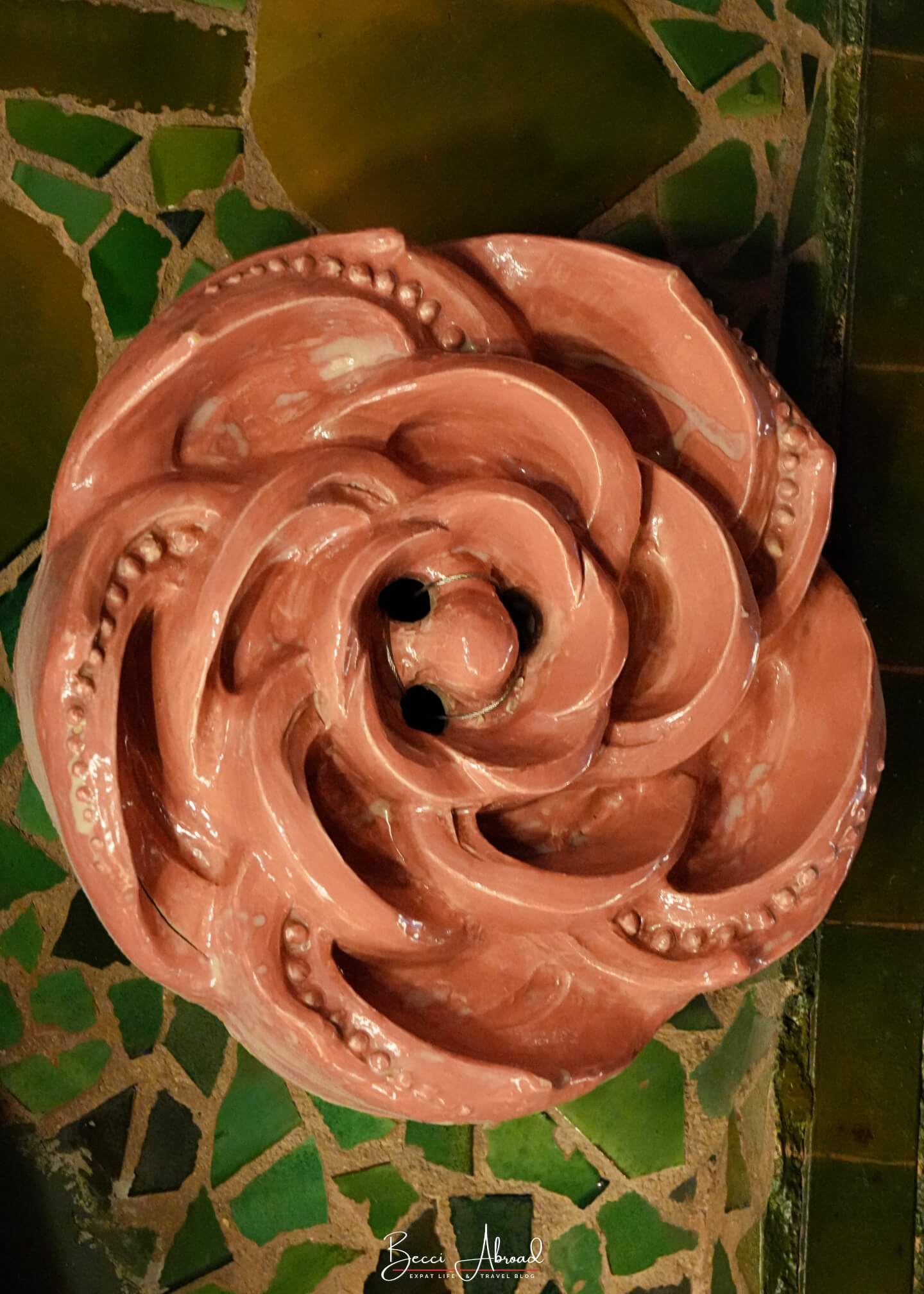
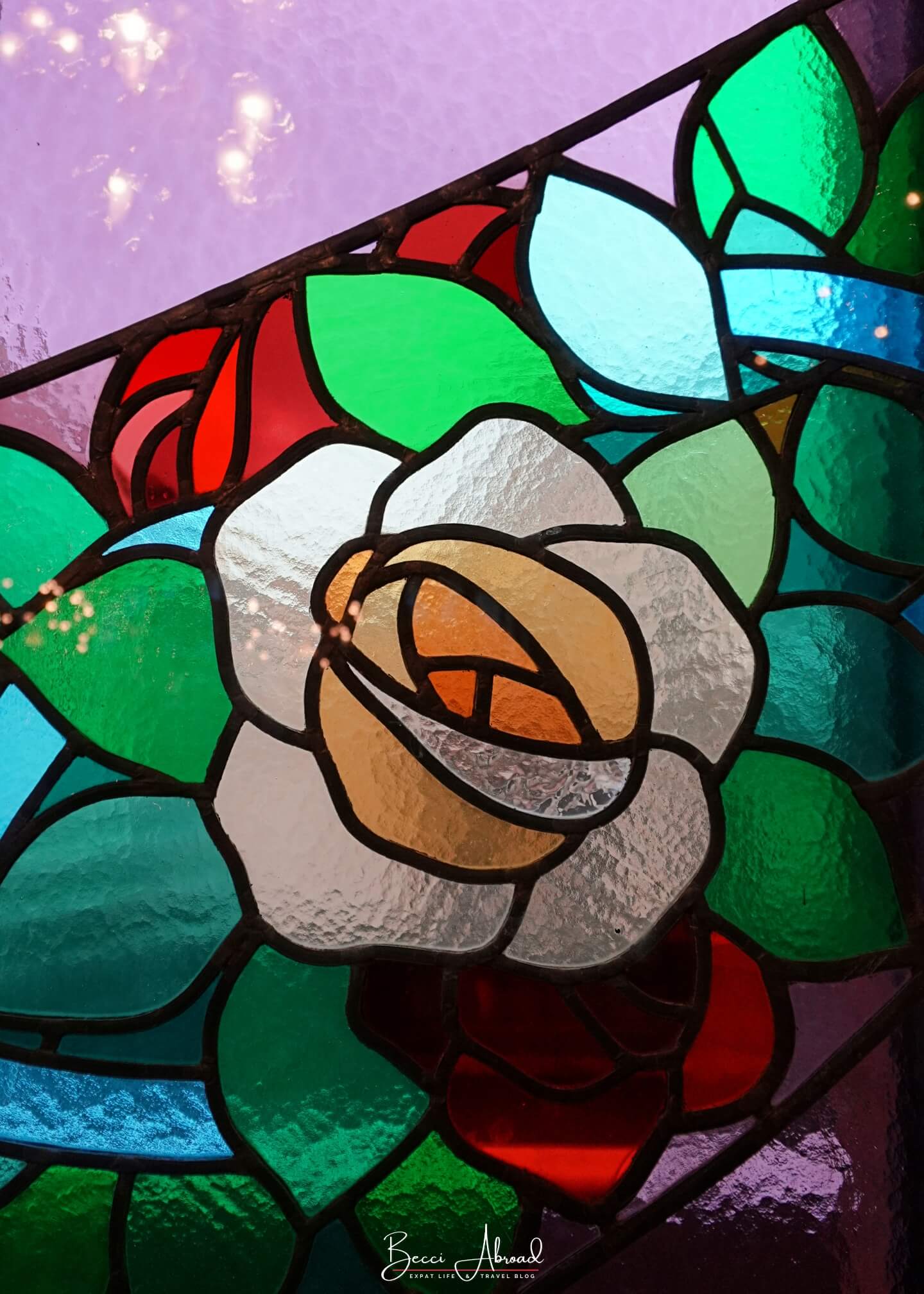
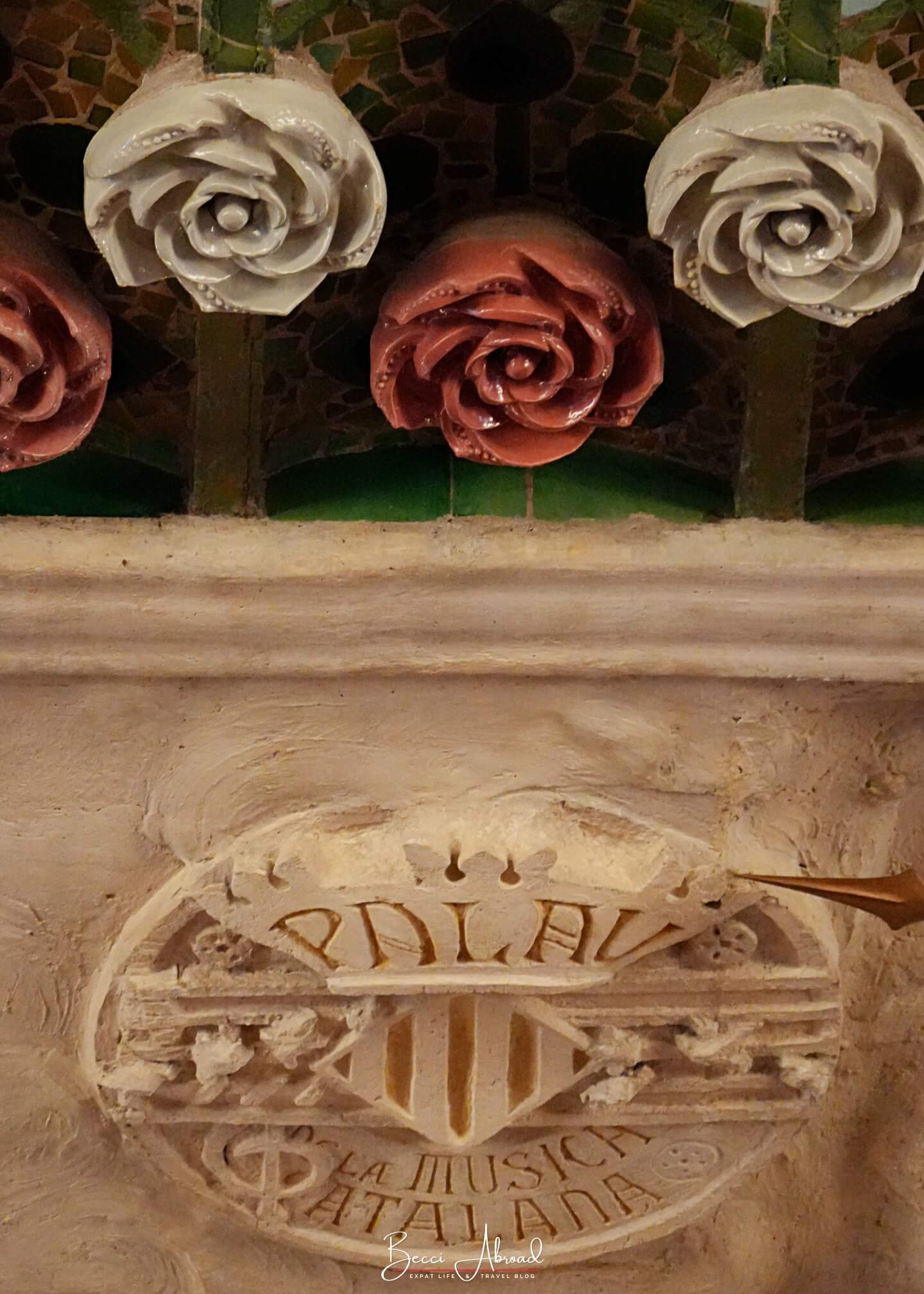
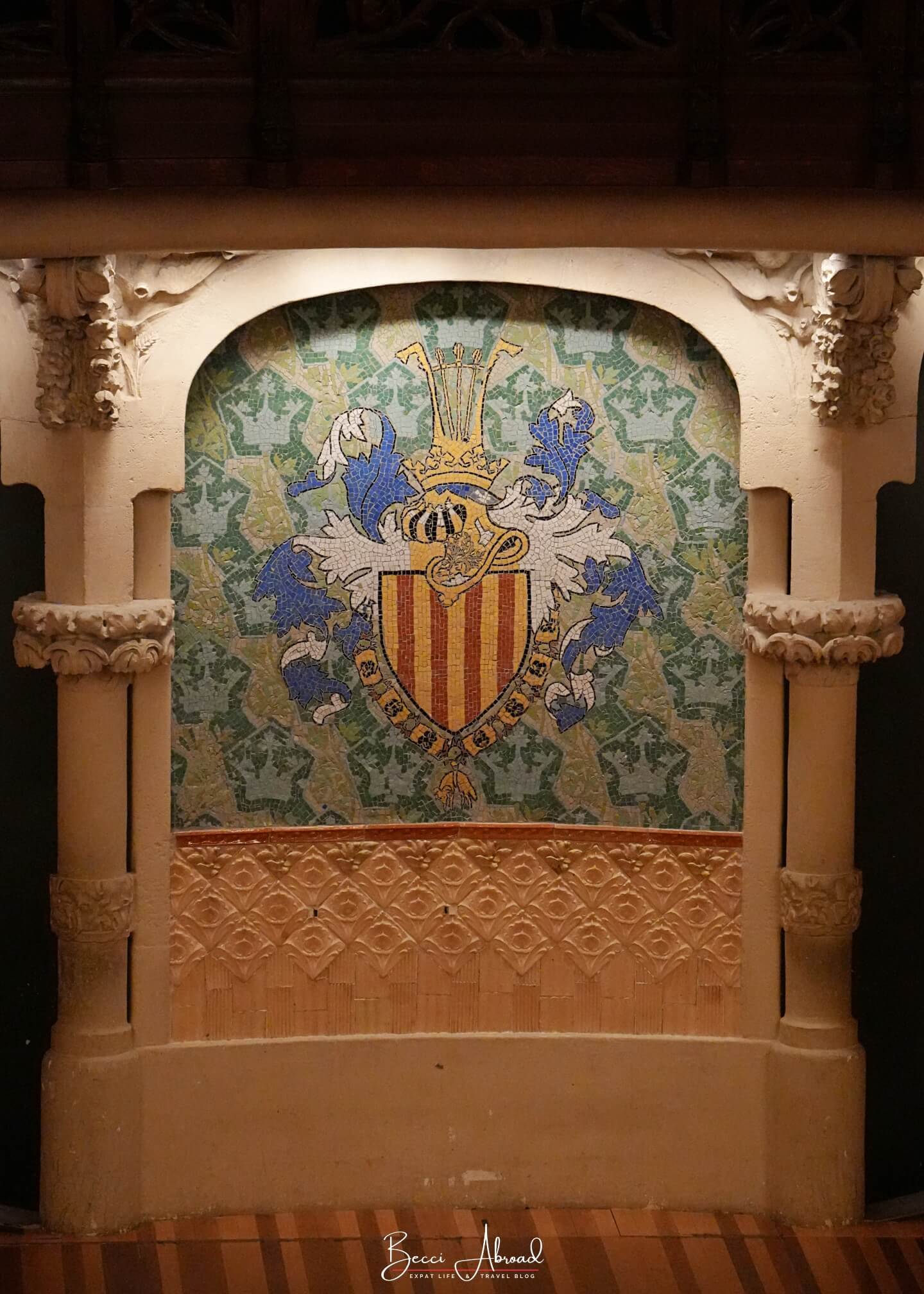
Throughout the concert hall, you’ll see symbols connected to the Catalan culture, such as the Catalan flag, the Sant George’s cross, and the roses from the legend of Sant George and the dragon. Sant George, or Sant Jordi, is Catalunya’s patron saint.
Today, the Palace of Catalan Music is a UNESCO World Heritage Site, and the concert hall hosts everything from classical concerts and opera to flamenco performances.
Even if you’re not planning to attend a concert, I 100% recommend booking tickets to see inside the Palace of Catalan music!
Why Was Palau de la Música Catalana Built?
Palau de la Música Catalana was commissioned by a local choral society, the Orfeó Català.
The choral society fundraised money from the local community to build this impressive building.
Orfeó Català was founded in 1891 to promote Catalan music, language, and traditions. The Palace of Catalan Music was meant as a meeting point for the local community to experience Catalan culture and a permanent space for the choir’s rehearsals and performances.
Palau de la Música Catalana was designed as a statement of national pride and creativity, and stands out as something much more meaningful than a standard concert hall.
The building combines music, architecture, and national identity into one of the most impressive buildings in Barcelona!
Who Designed Palau de la Música Catalana?
Palau de la Música Catalana was designed by the Catalan architect Lluís Domènech i Montaner, and built between 1905 and 1908.
Yes, it only took three years to build this place!!
Lluís Domènech i Montaner was one of the big names of Catalan Modernism, and my favorite Catalan architect (all respect to Gaudí, but Domènech i Montaner’s flower motifs just get me!).
Domènech i Montaner built several impressive buildings throughout Catalonia and Barcelona. Some of Domènech i Montaner’s most noticeable buildings are the Sant Pau Hospital, the Casa Lleó Morera on Passeig de Gràcia (right next to Casa Batlló), and Casa Navàs in Reus.
In my opinion, Domènech i Montaner doesn’t always get the same international hype as Gaudí, which is a shame! Domènech i Montaner’s buildings are incredible, with many colors, details, and symbolism.
What is Palau de la Música Catalana Famous for?
The Palau de la Música Catalana is famous for its stunning Modernist architecture and exceptional acoustics.
Honestly, the Palau de la Música Catalana is a concert hall like you have never experienced before!
Everywhere you look, you’ll be amazed by the details!
Honestly, it’s pretty incredible to think that something that feels so light, colorful, and almost modern is more than a century old (mind that the Palau was officially opened in 1908!).
The Palau de la Música Catalana is also famous because of its status as a UNESCO World Heritage Site.
In my opinion, it’s one of the most beautiful buildings in Barcelona, especially once you step inside.
Get your tickets to the Palace of Catalan Music
Inside Palau de la Música Catalana: What is the Guided Tour Like?
The best way to see inside the Palace of Catalan Music is with a guided tour.
My friend and I did the guided tour to see inside the Palace of Catalan Music, and we had a great time learning about the building and its history.
The guided tour of Palau de la Música Catalana usually lasts around 45–50 minutes and covers several key areas of the building.
For us, the highlight was that with the guided tour, we were able to get up on the stage and had the organ play for us.
Certain parts of the Palace of Catalan Music are only accessible to you when you go on a guided tour, compared to the self-guided visit.
I had reserved tickets for the very first guided tour in English, which starts at 9 am, in the hope of getting some good pictures without too many people on. This was a great decision because when we were wrapping up around 11 am, more and more people started arriving, and the café was filling up.
Let’s explore what you’ll get to see inside the Palace of Catalan Music:
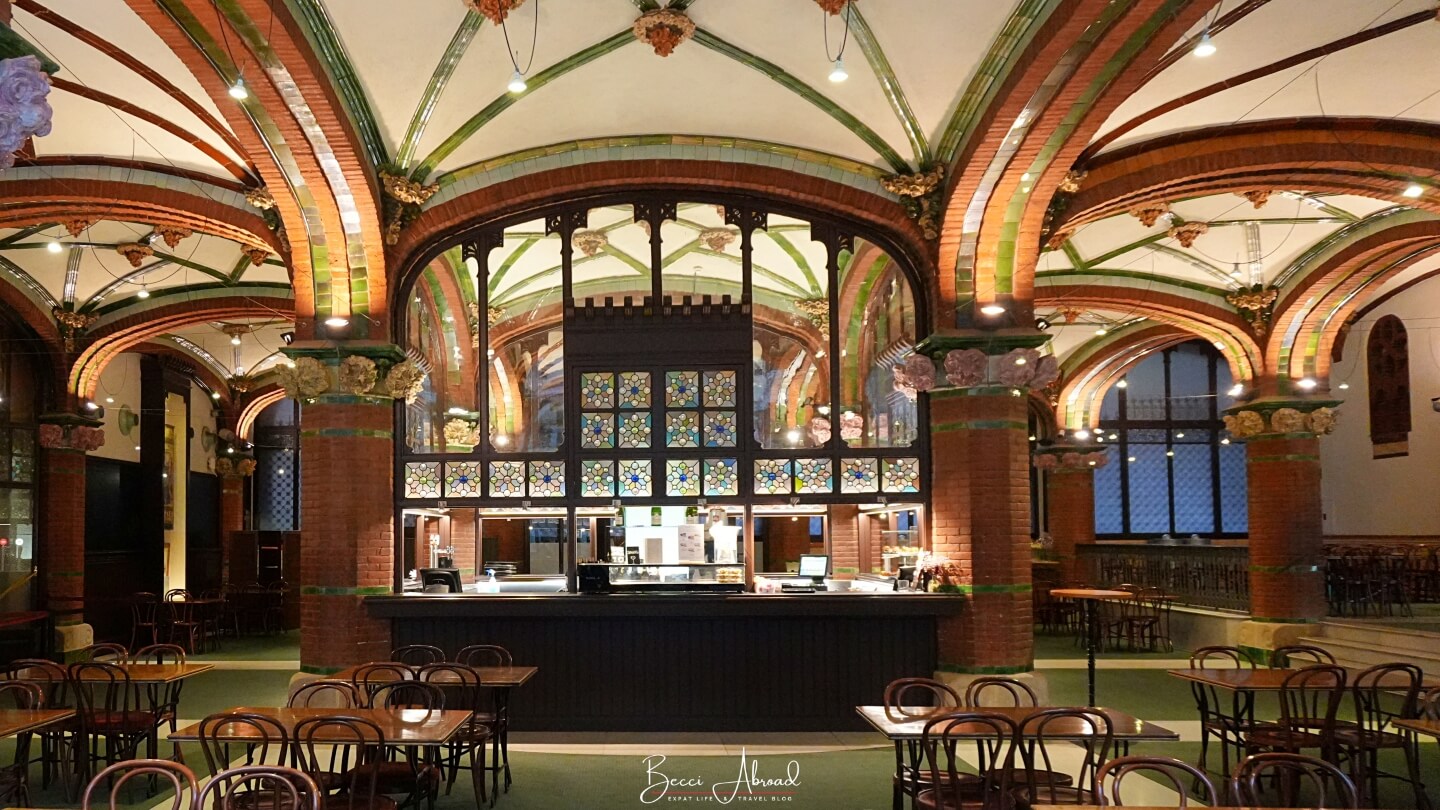
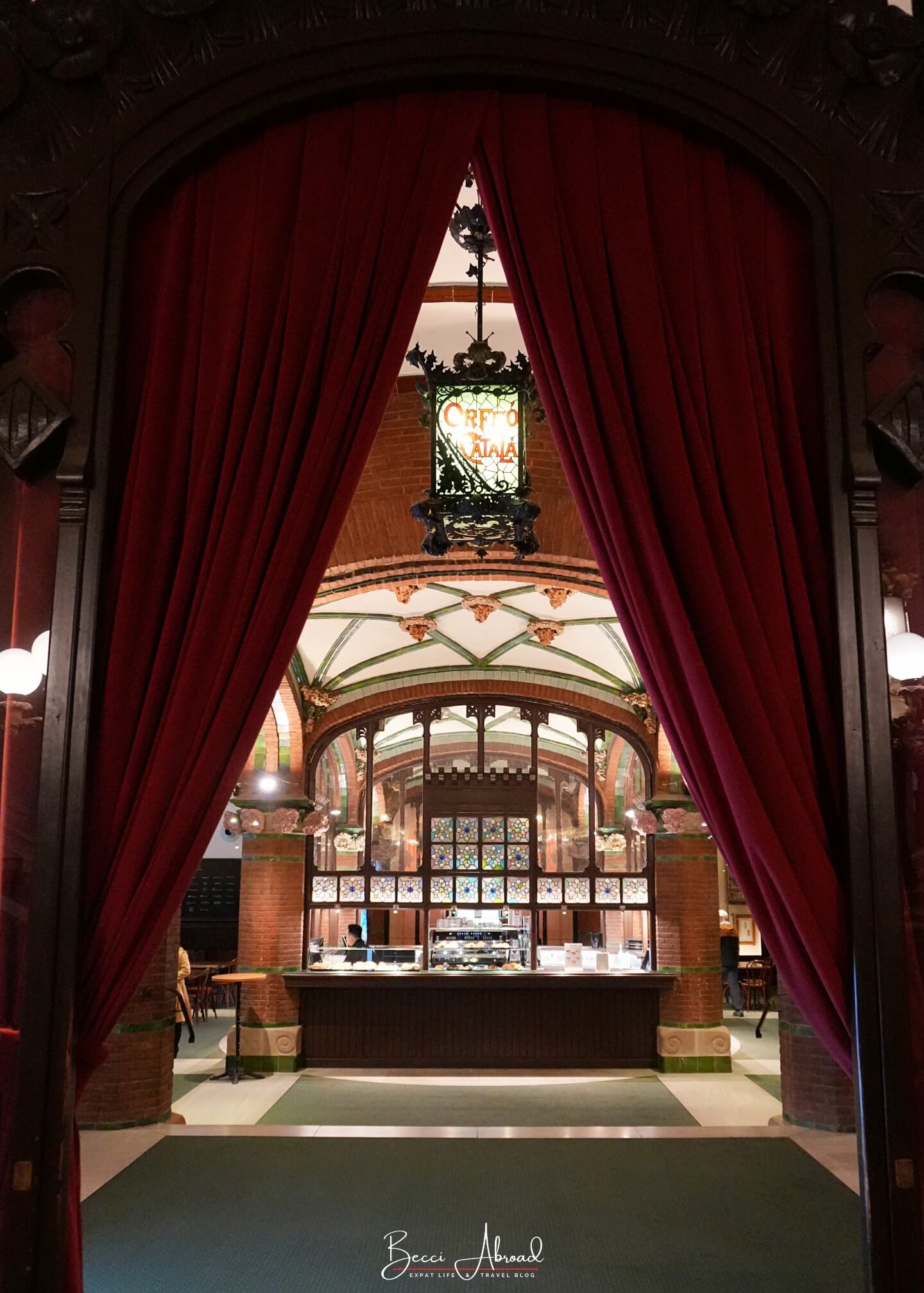
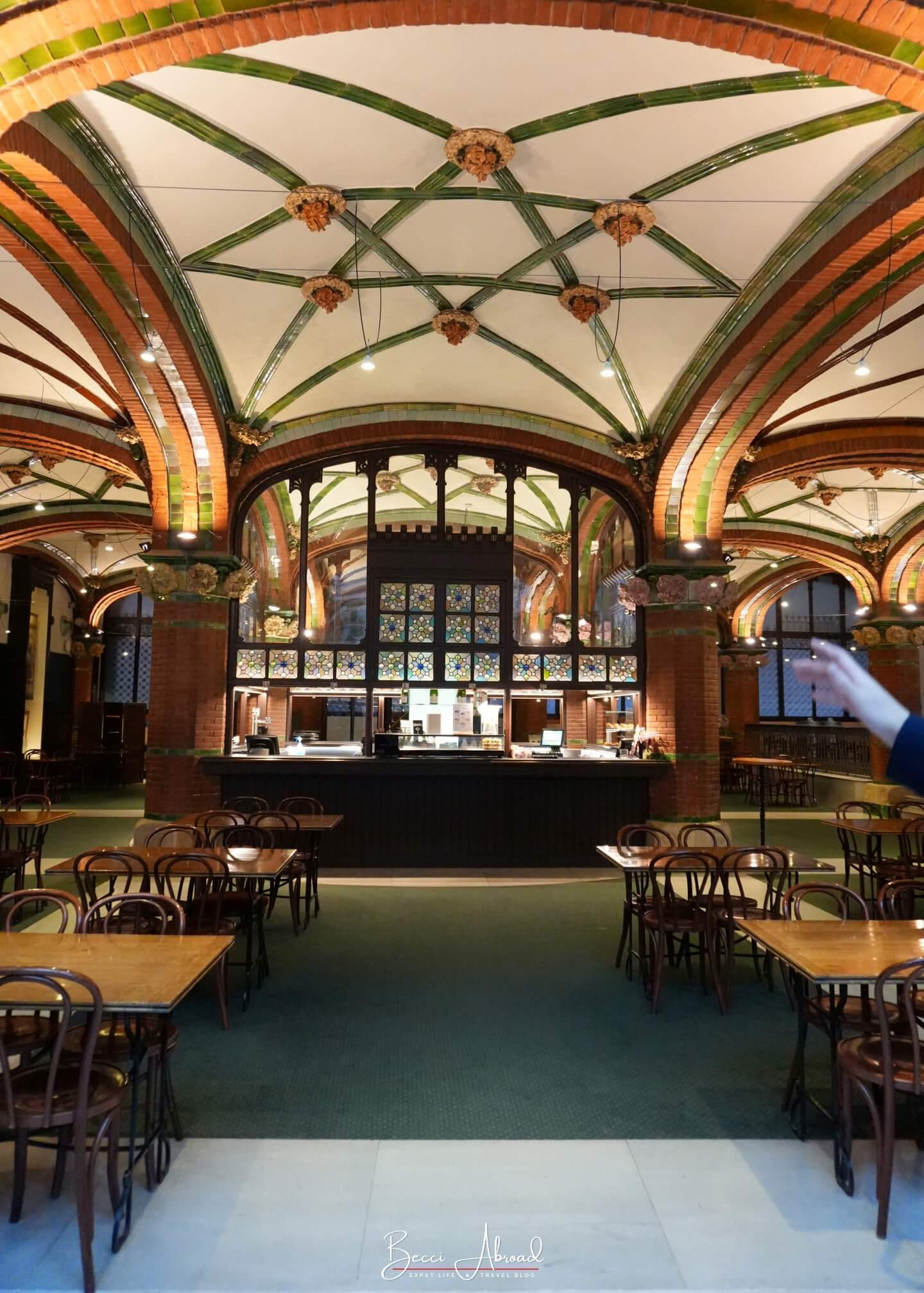
The Foyer and Café Palau
The foyer is the main entrance area, and it already gives you a taste of the building’s rich Modernist style.
The space is decorated with elegant columns, arches, and subtle mosaic details. Compared to the concert hall, the foyer feels slightly more understated.
Just off the foyer, you’ll find Café Palau, a café that blends the historic setting with a nice place to sit down with a coffee or a glass of wine.
If you have a bit of extra time, I recommend stopping here to soak up the atmosphere. It’s a calm, social space that reminds you that the Palau de la Música Catalana isn’t just something to look at. It’s a place people still use, meet, and enjoy every day.
In the far right-hand corner, you’ll also find a small souvenir shop selling products and books about the Palau.
For the guided tours, you’ll meet with the guide by the black wall right between the souvenir shop and the entrance to the rehearsal hall.
You don’t need a ticket to visit the foyer and the Café Palau. But again, I strongly recommend you sign up for one of the guided tours to get the full experience of this unique place.
The Café Palau is open Monday to Sunday from 9 am to 12 pm (midnight).
The Rehearsal Hall
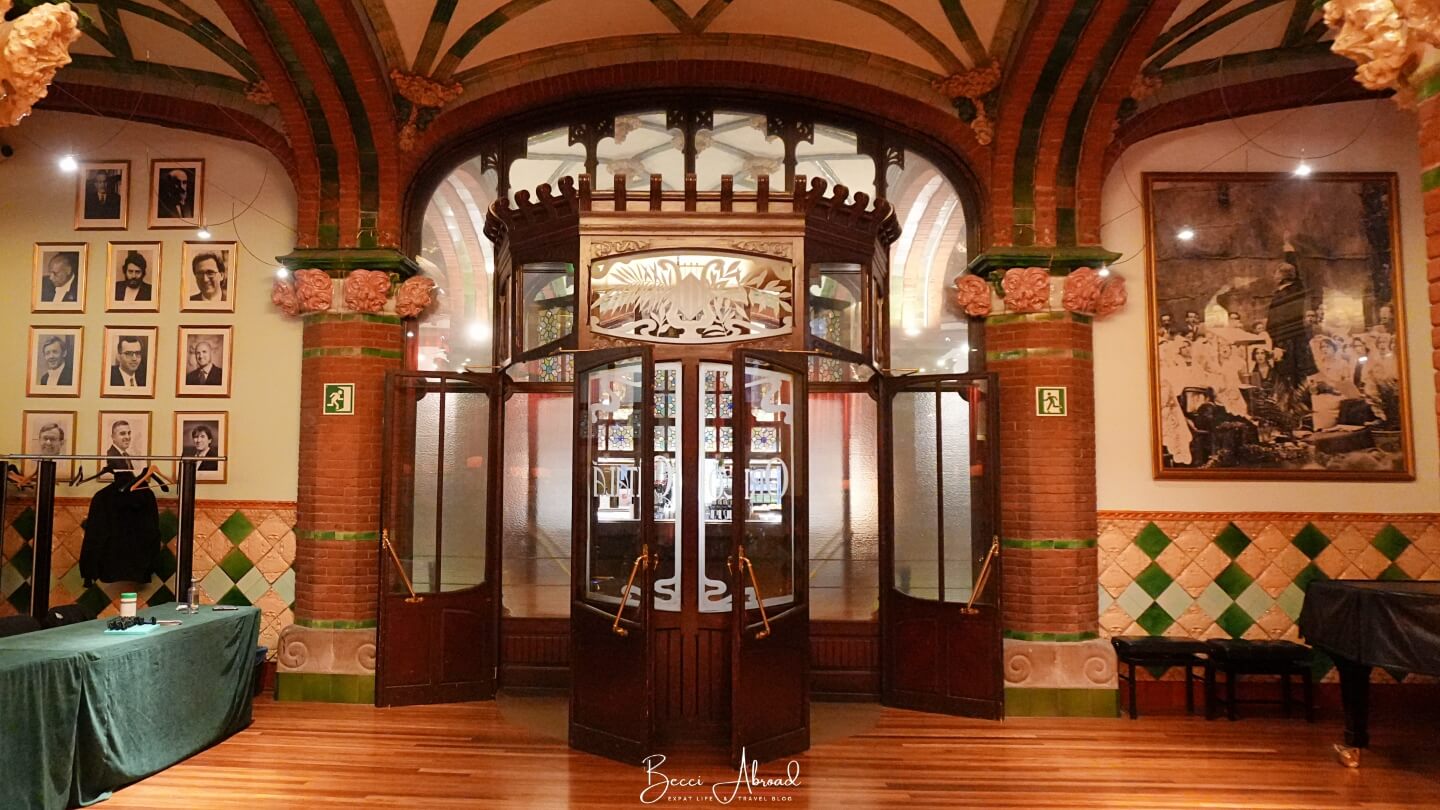
You’ll start the guided tour of the Palace of Catalan Music in the rehearsal hall.
The rehearsal hall is a smaller auditorium used for rehearsals (surprise, surprise) as well as smaller concerts, seminars, and conferences.
The guided tour starts with a short video that tells you the history of the Palace of Catalan Music and the choral society, Orfeó Català.
The video also features interviews and testimonies from local and international artists who have performed at the Palace of Catalan Music, as well as a lists some of the most important artists who have performed in the concert hall.
By the entrance of the rehearsal hall, you can see the first stone that was placed when the construction of the concert hall started in 1905.
You’ll only get access to the rehearsal hall if you do the guided visit of the Palace of Catalan Music.
The Grand Staircase
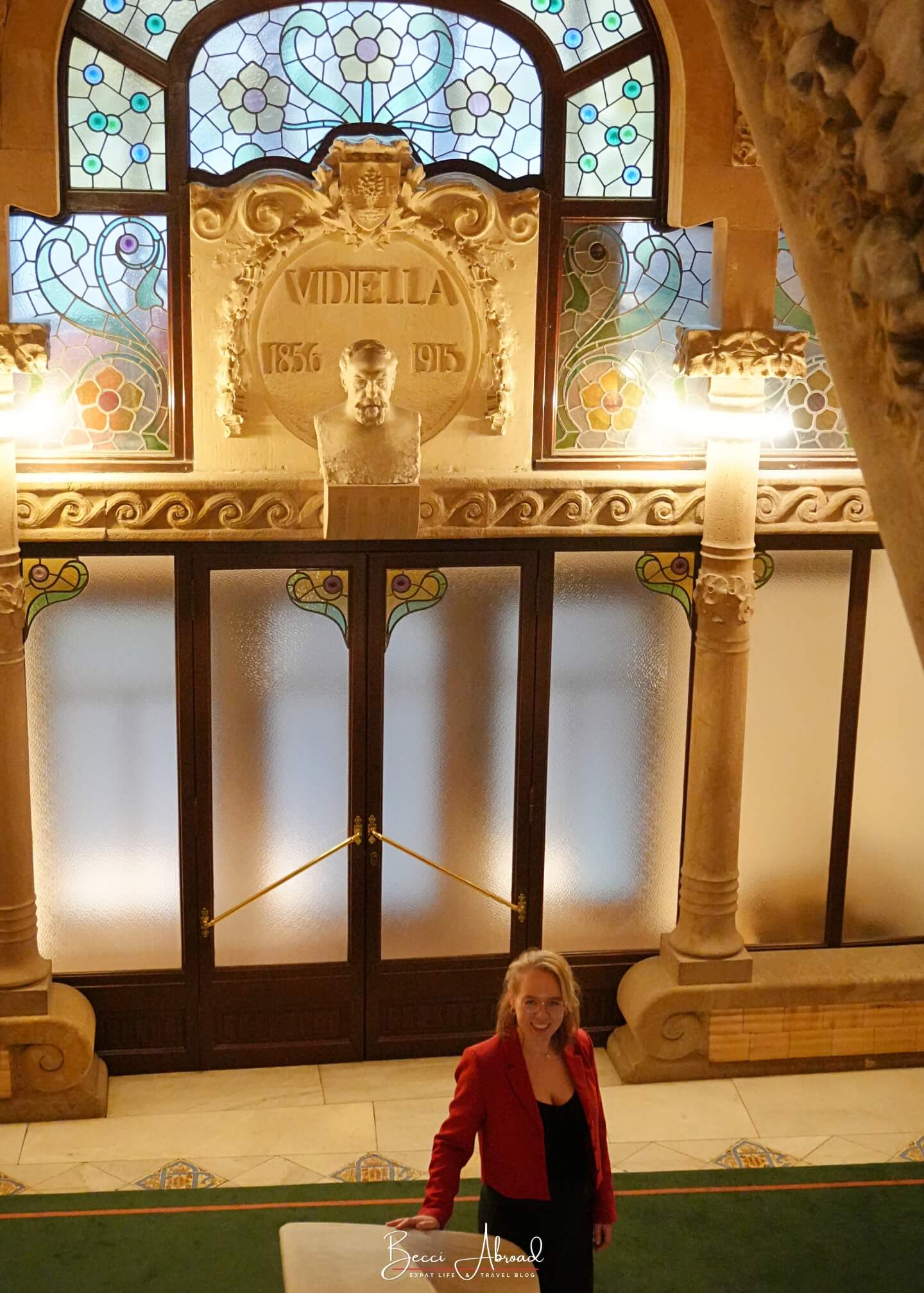
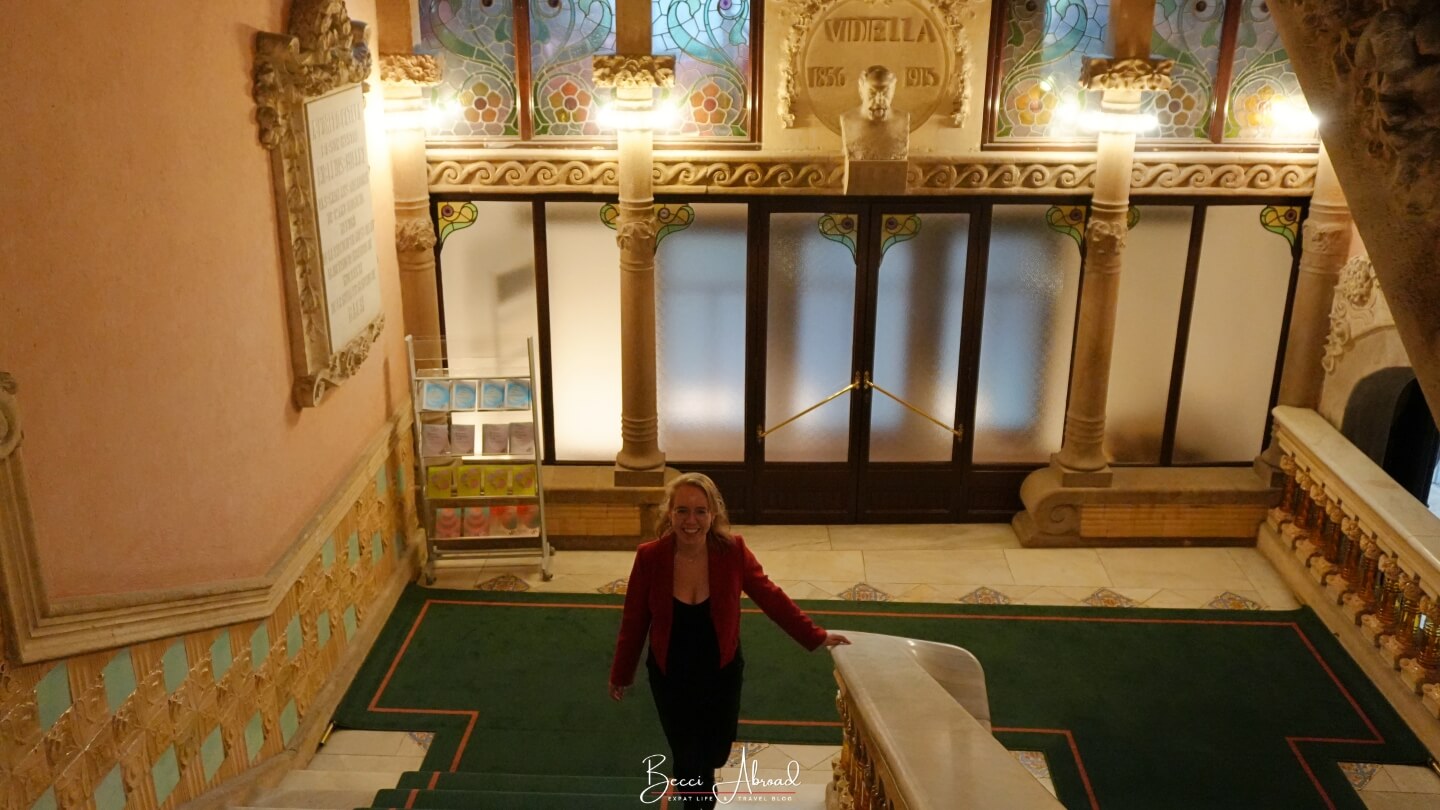
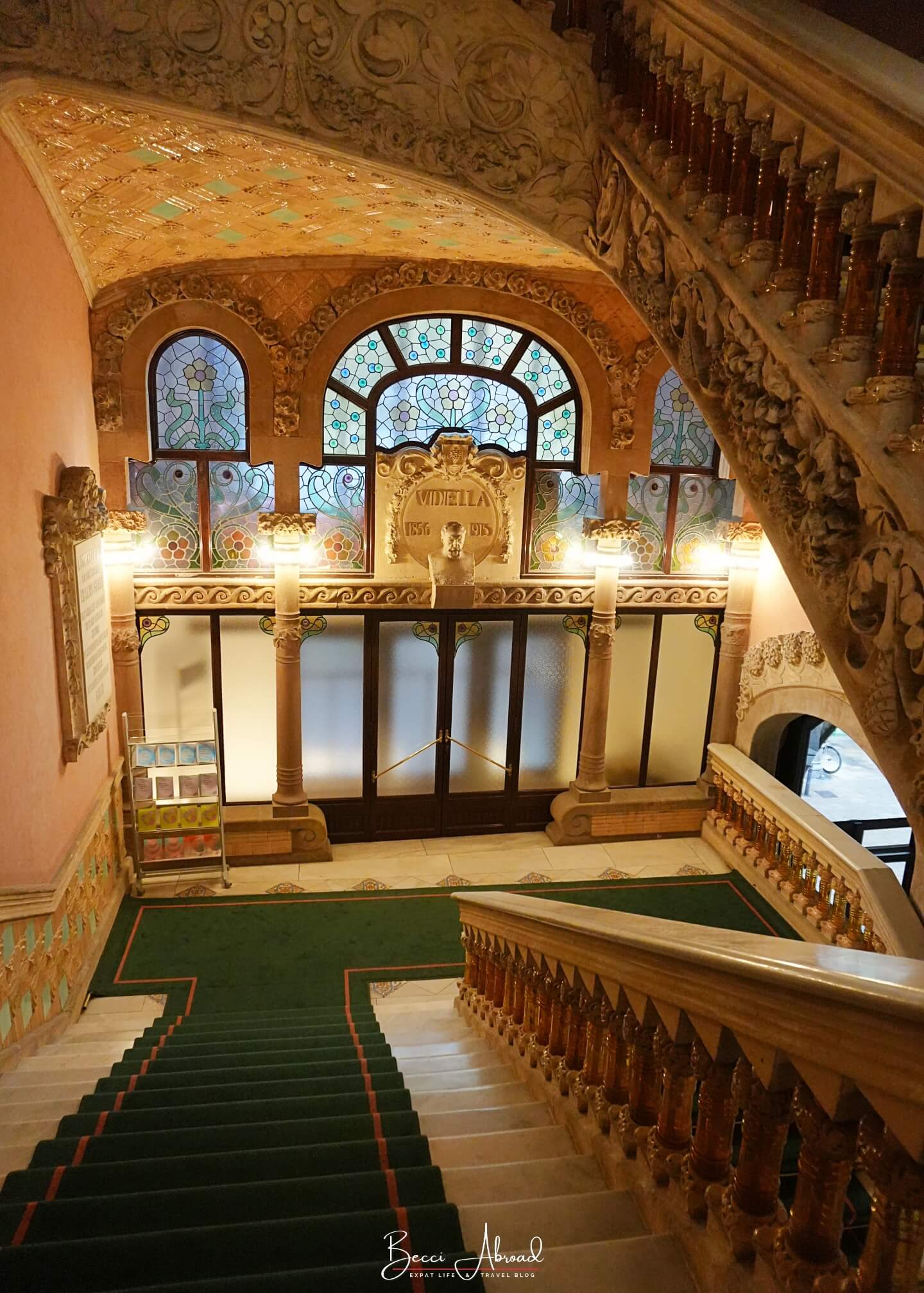
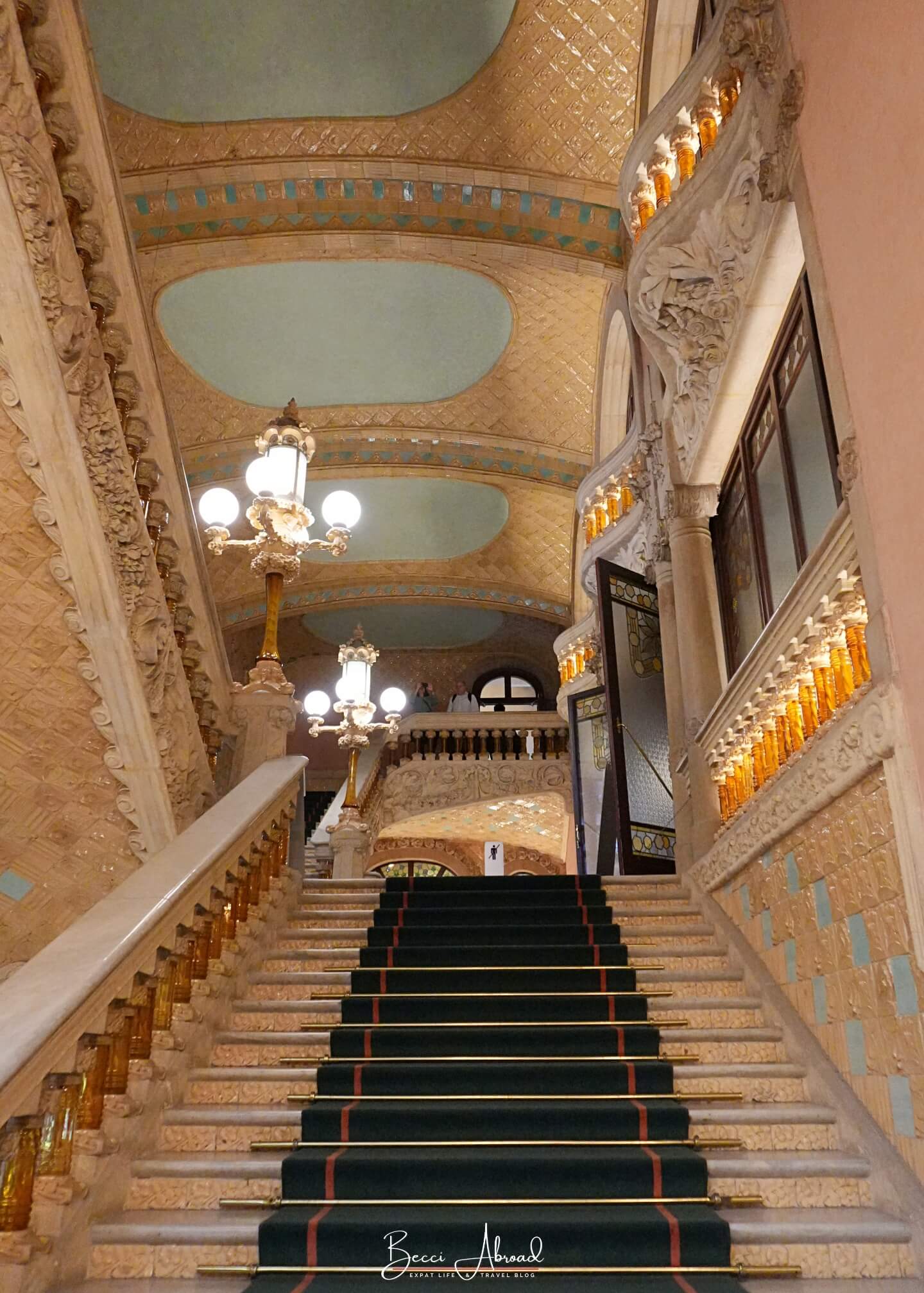
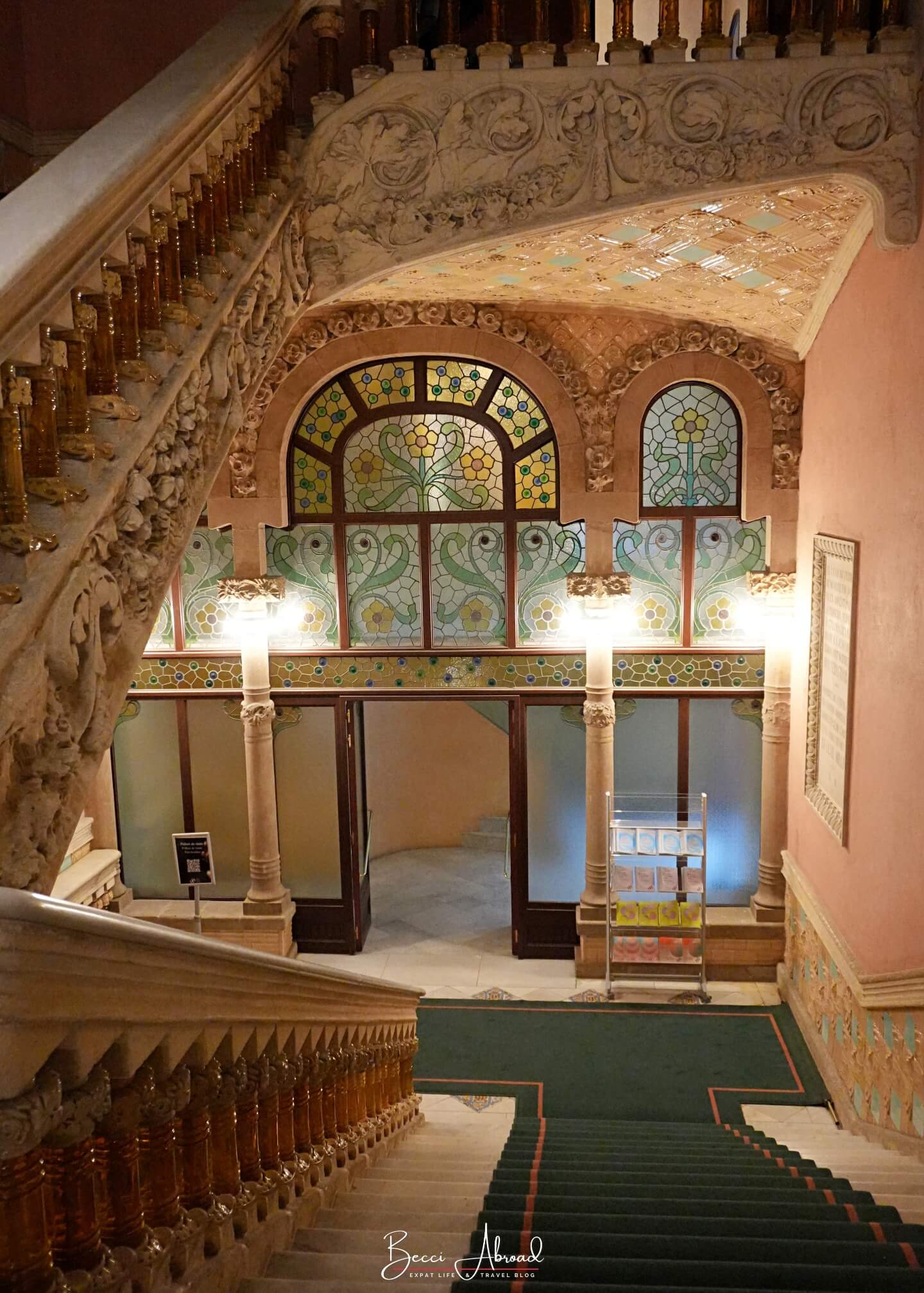
The Grand Staircase connects the different levels of the Palau, but it feels less like walking up a staircase and more like being guided into a work of art.
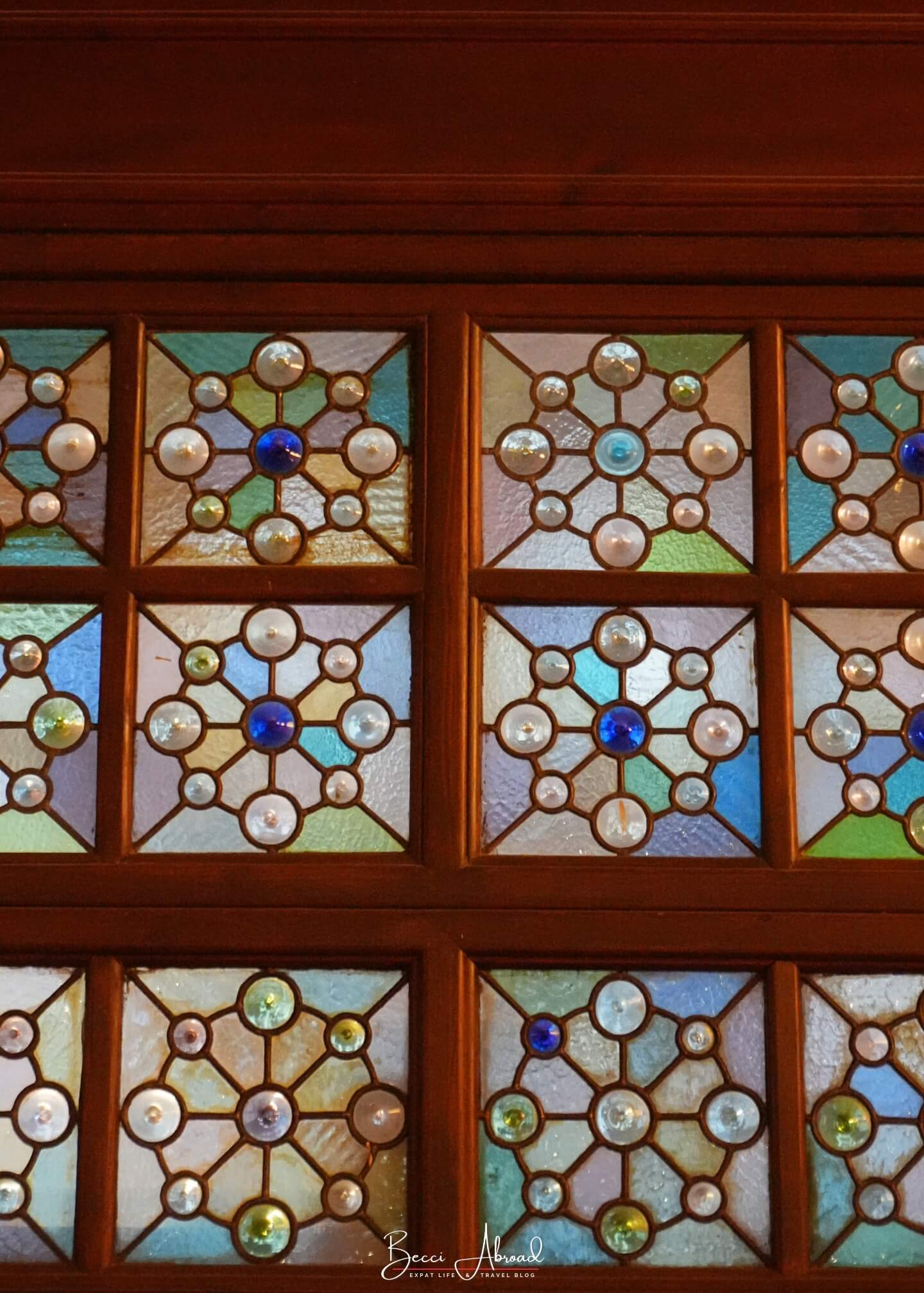
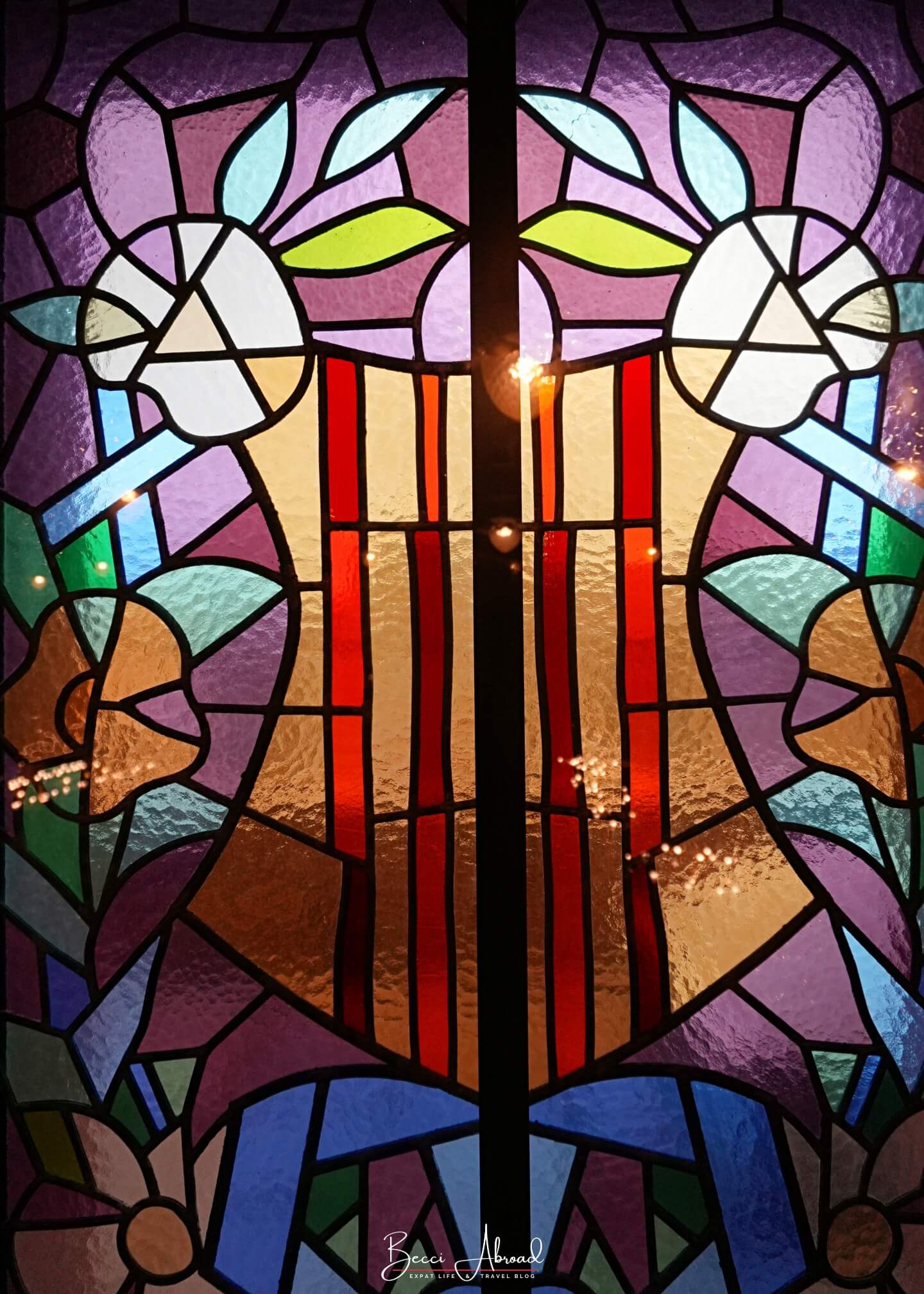
The staircase is richly decorated with stained-glass windows, carved stone, and colorful mosaic details.
The columns and walls are covered in floral and organic motifs, very typical of Catalan Modernism and especially the architect Domènech i Montaner’s style of Modernism (and I love it!).
There’s something new to notice at every turn.
If you’re doing a guided tour, the guide will also stop and explain some of the symbols and statues on the stairs.
I recommend that you go back to the staircase once the tour is over to admire the details with more calm and take more photos.
The Concert Hall from the First Floor
As you make your way up the staircase, the next stop on your tour is the main concert hall!
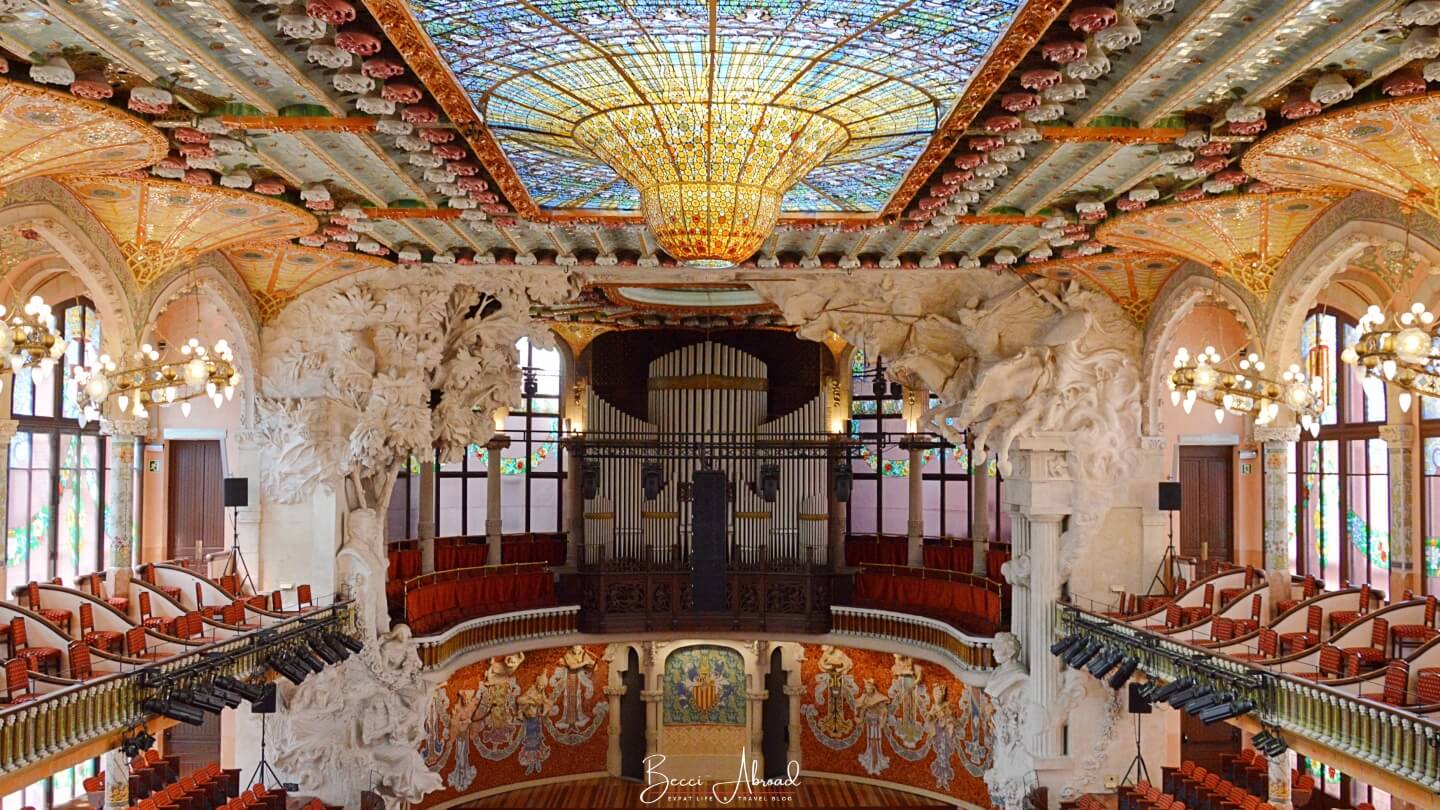
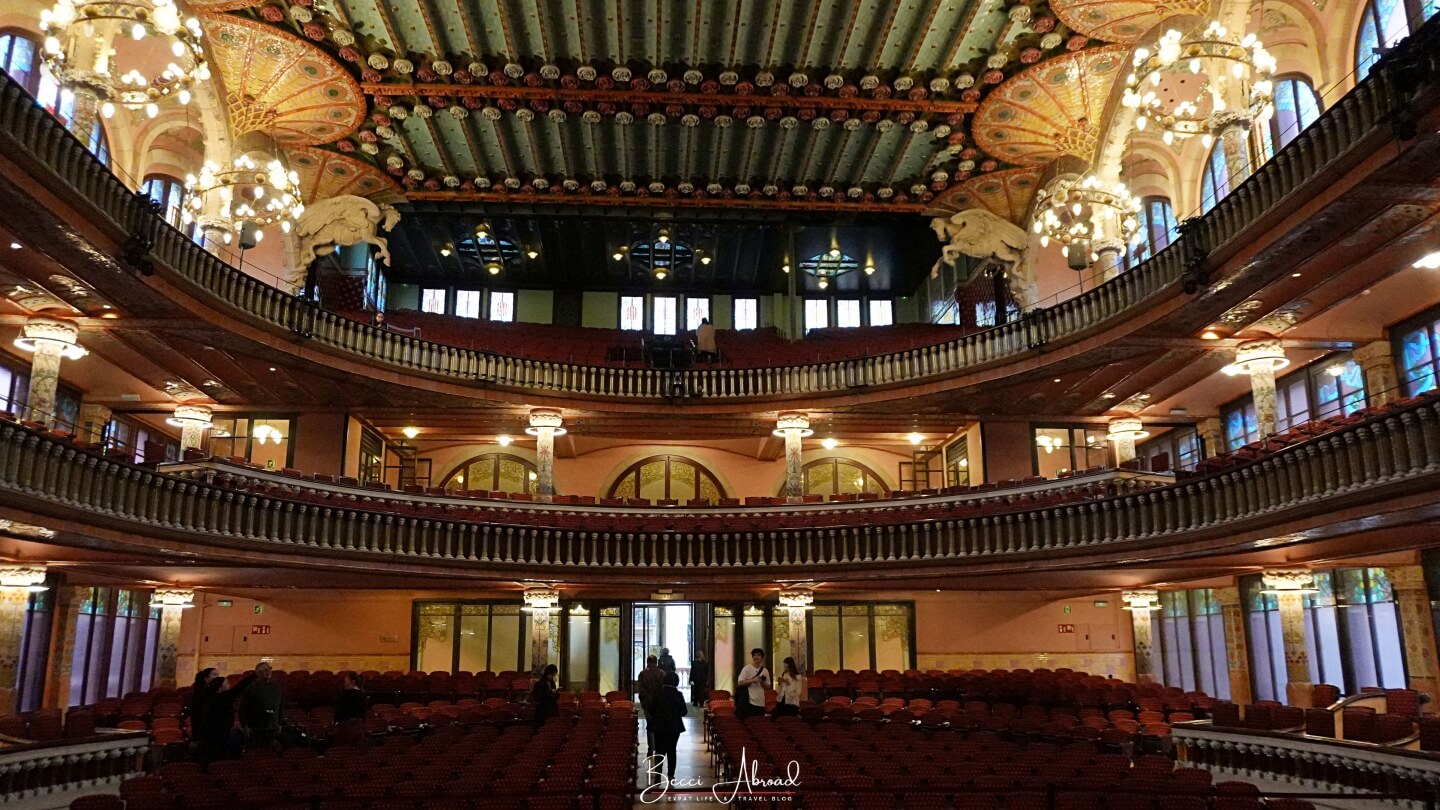
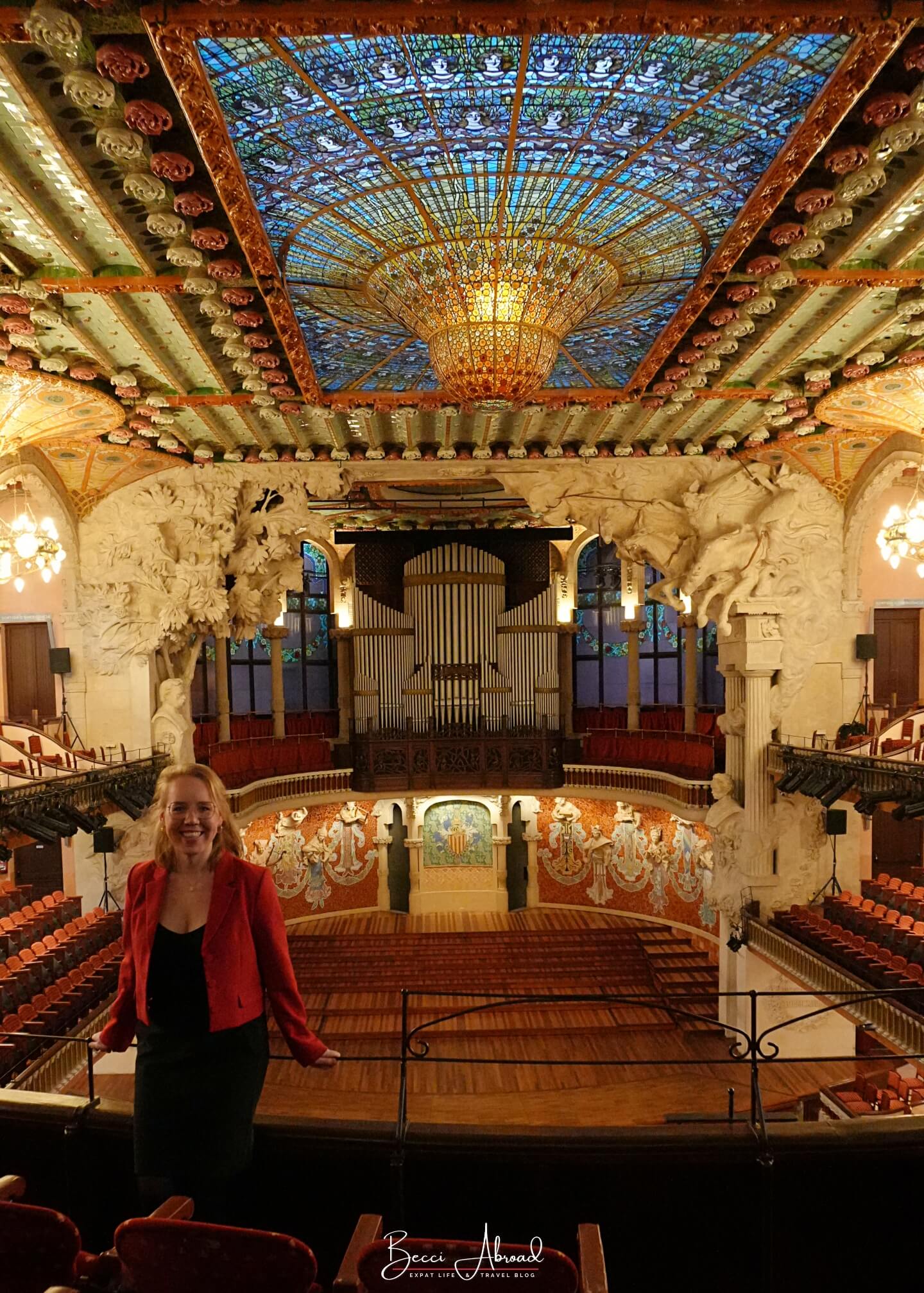
The main concert hall is the absolute centerpiece of the Palace of Catalan Music, and where everything comes together: music, light, and color!
In a way that feels almost overwhelming, in the best possible sense.
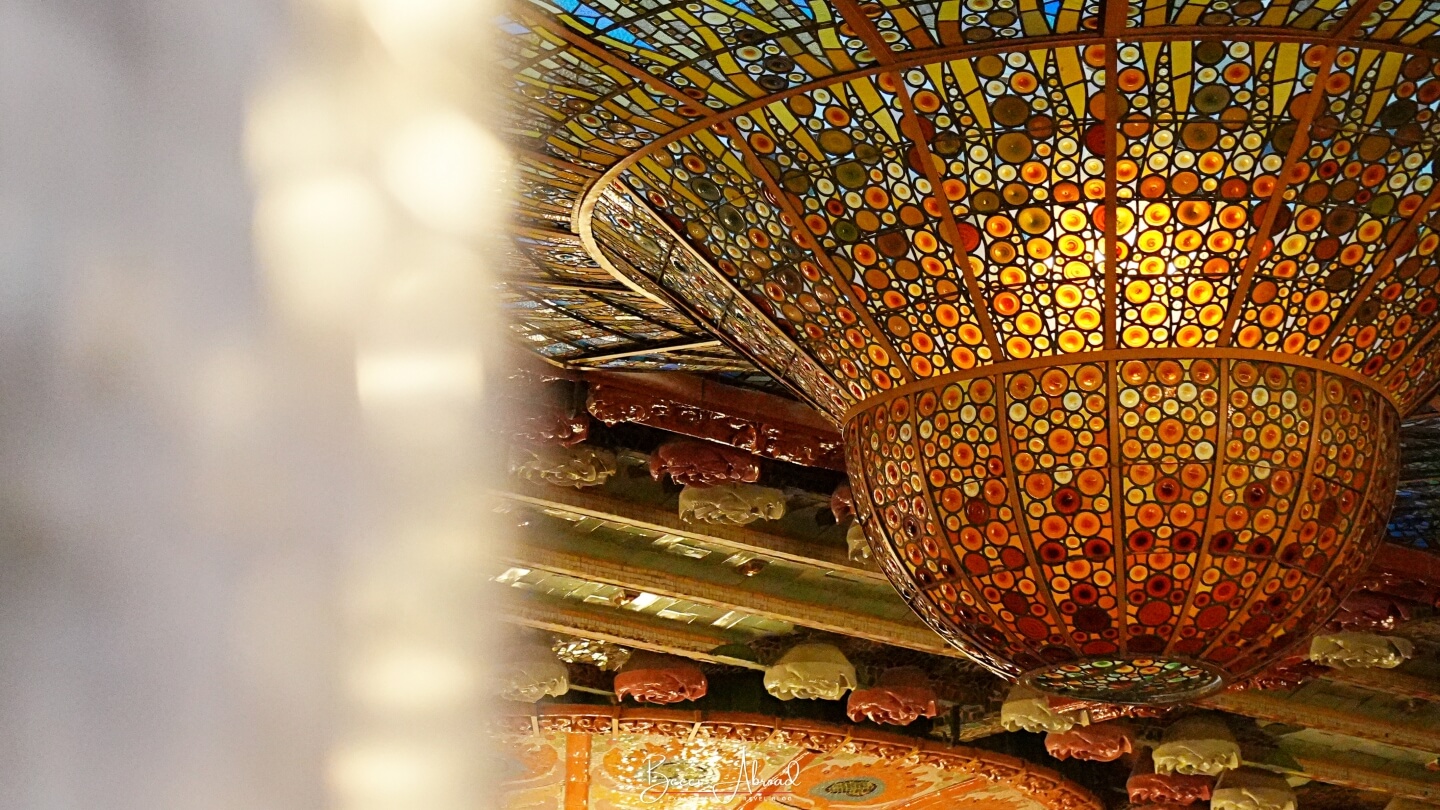
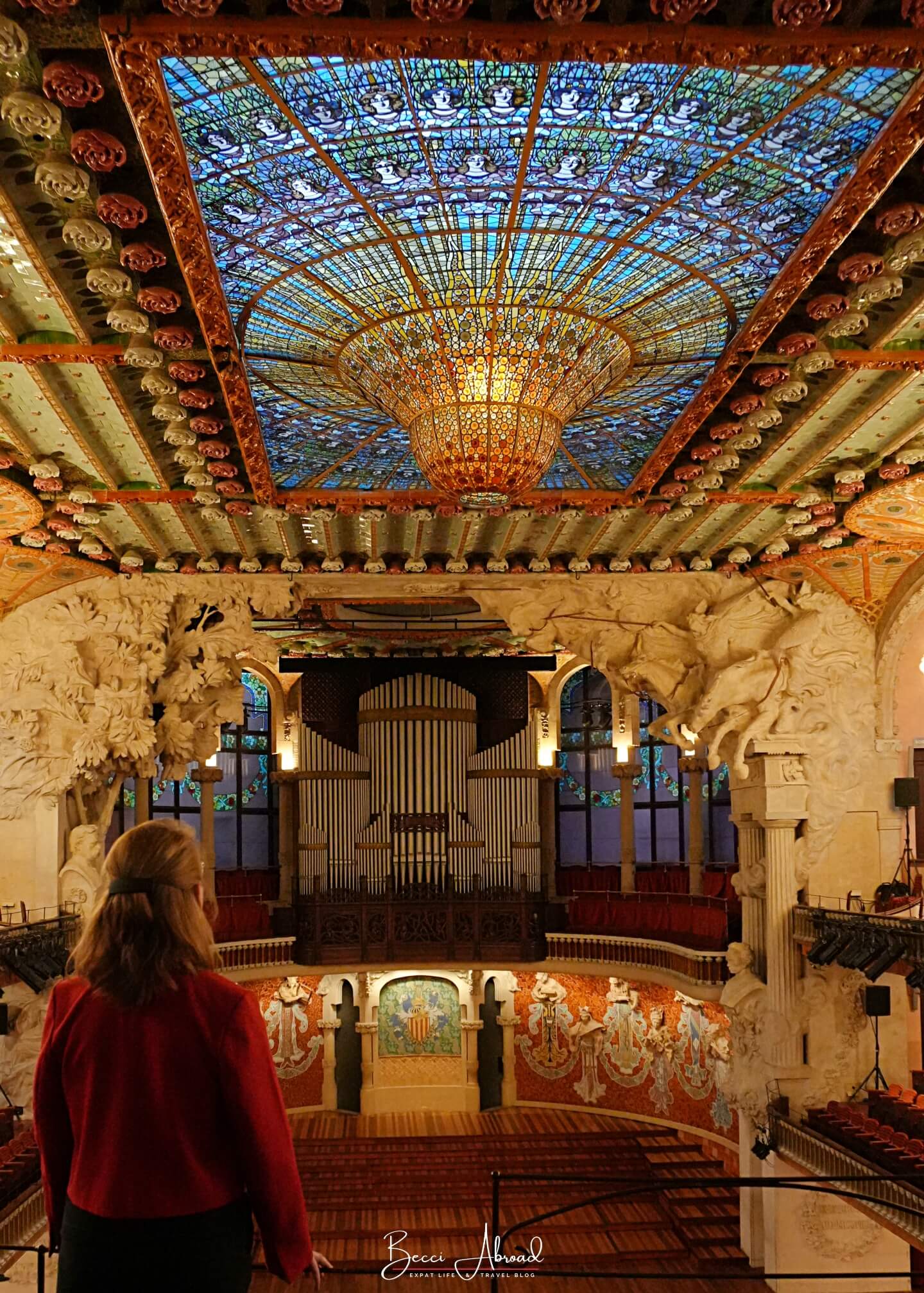
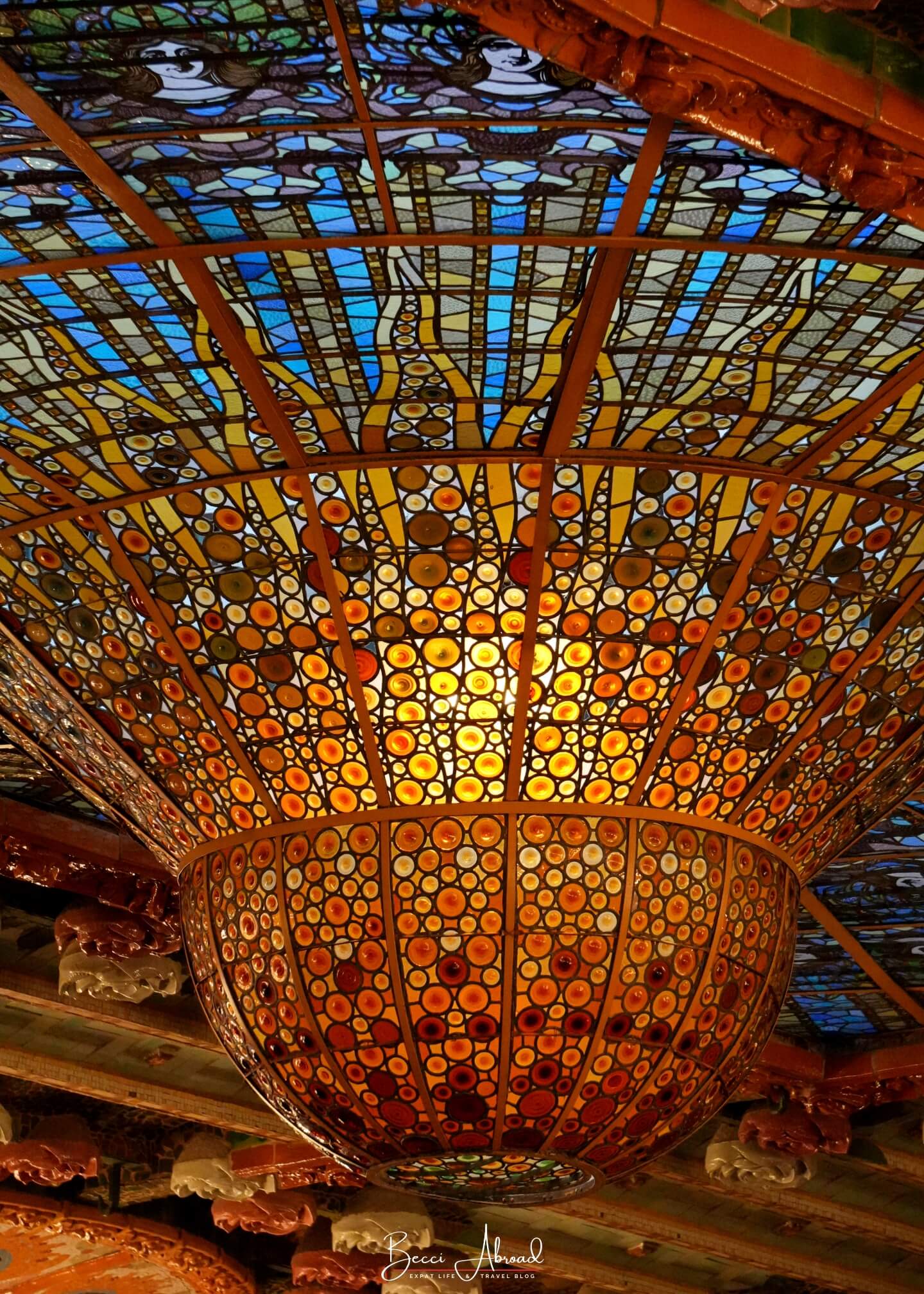
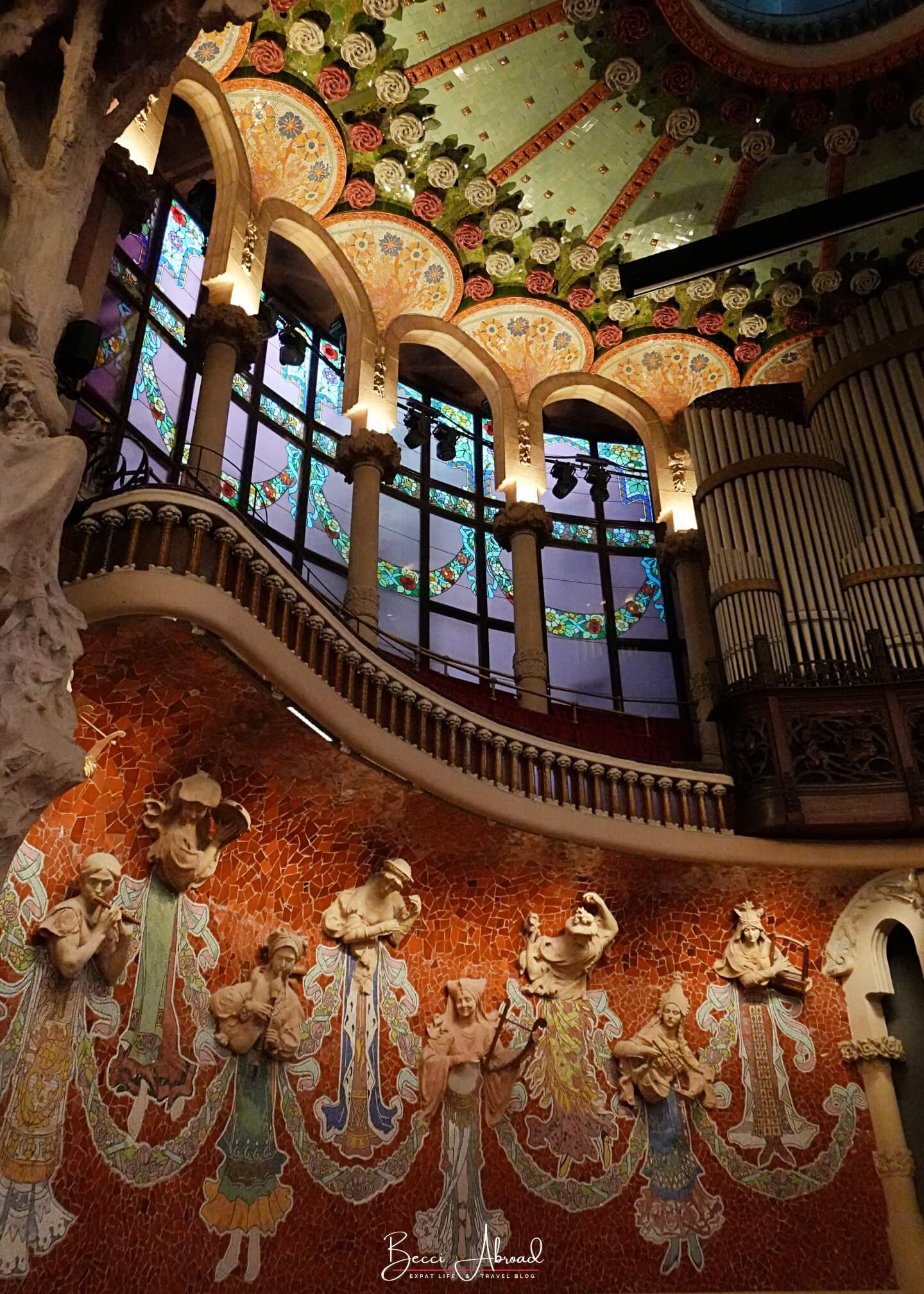
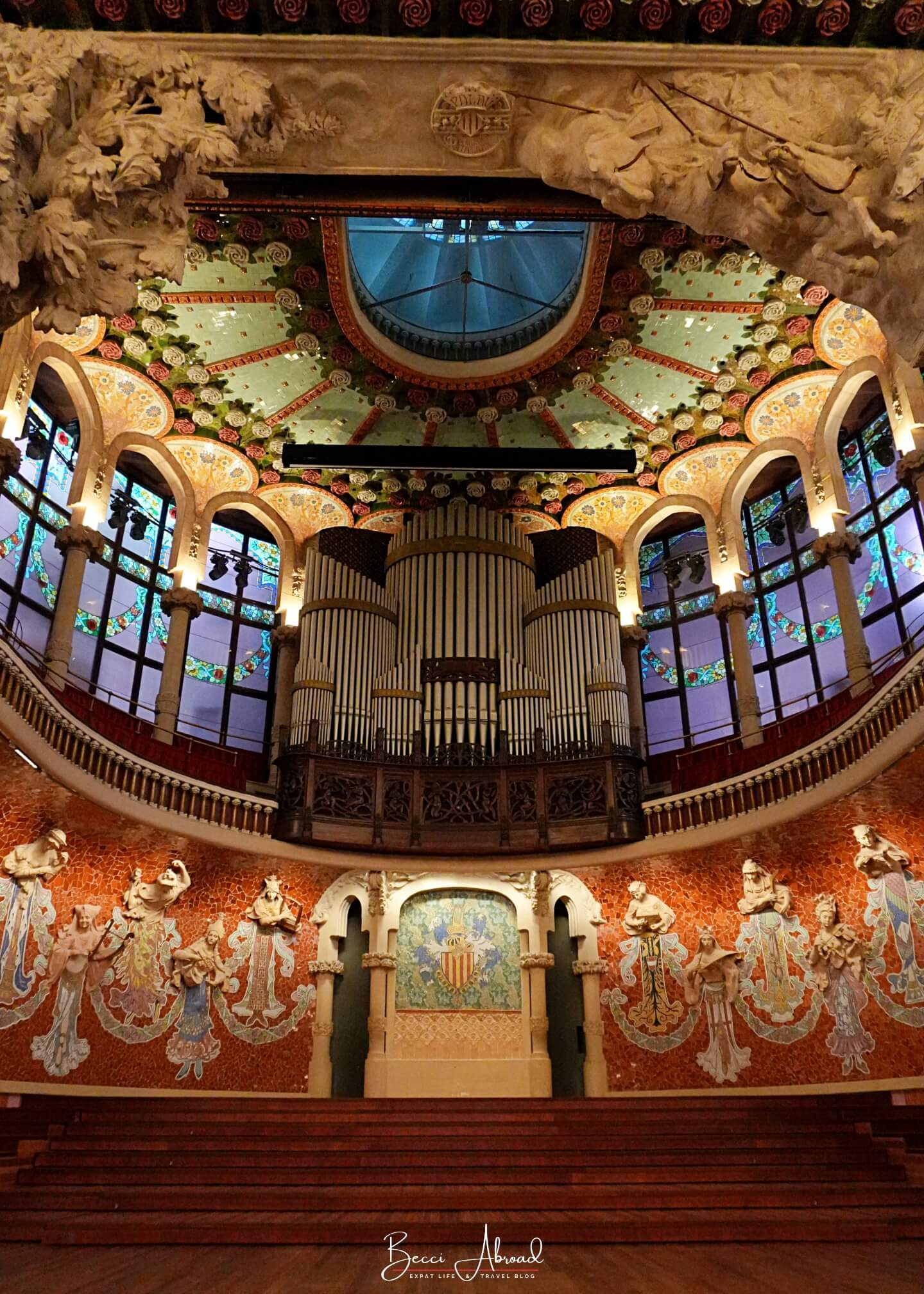
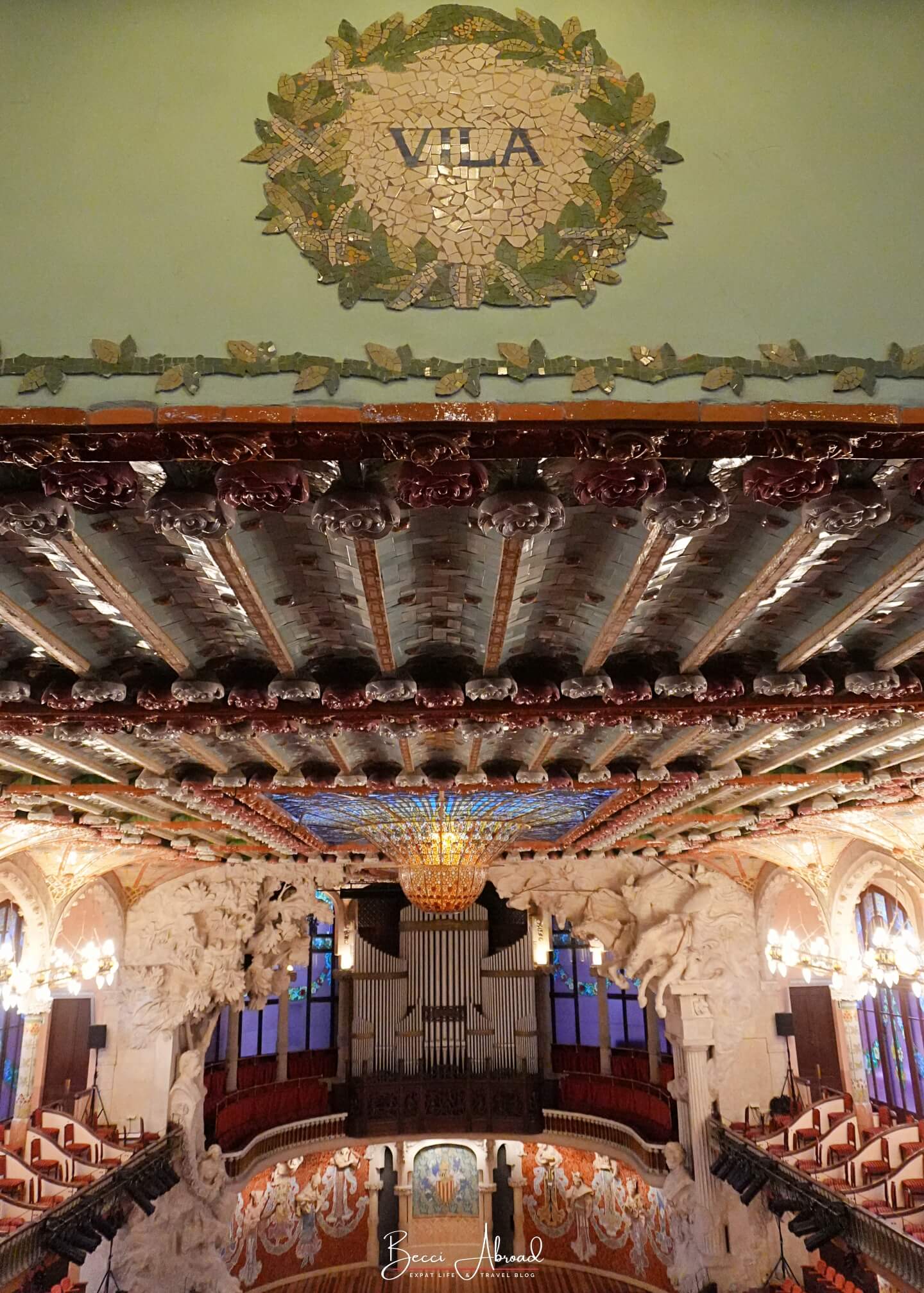
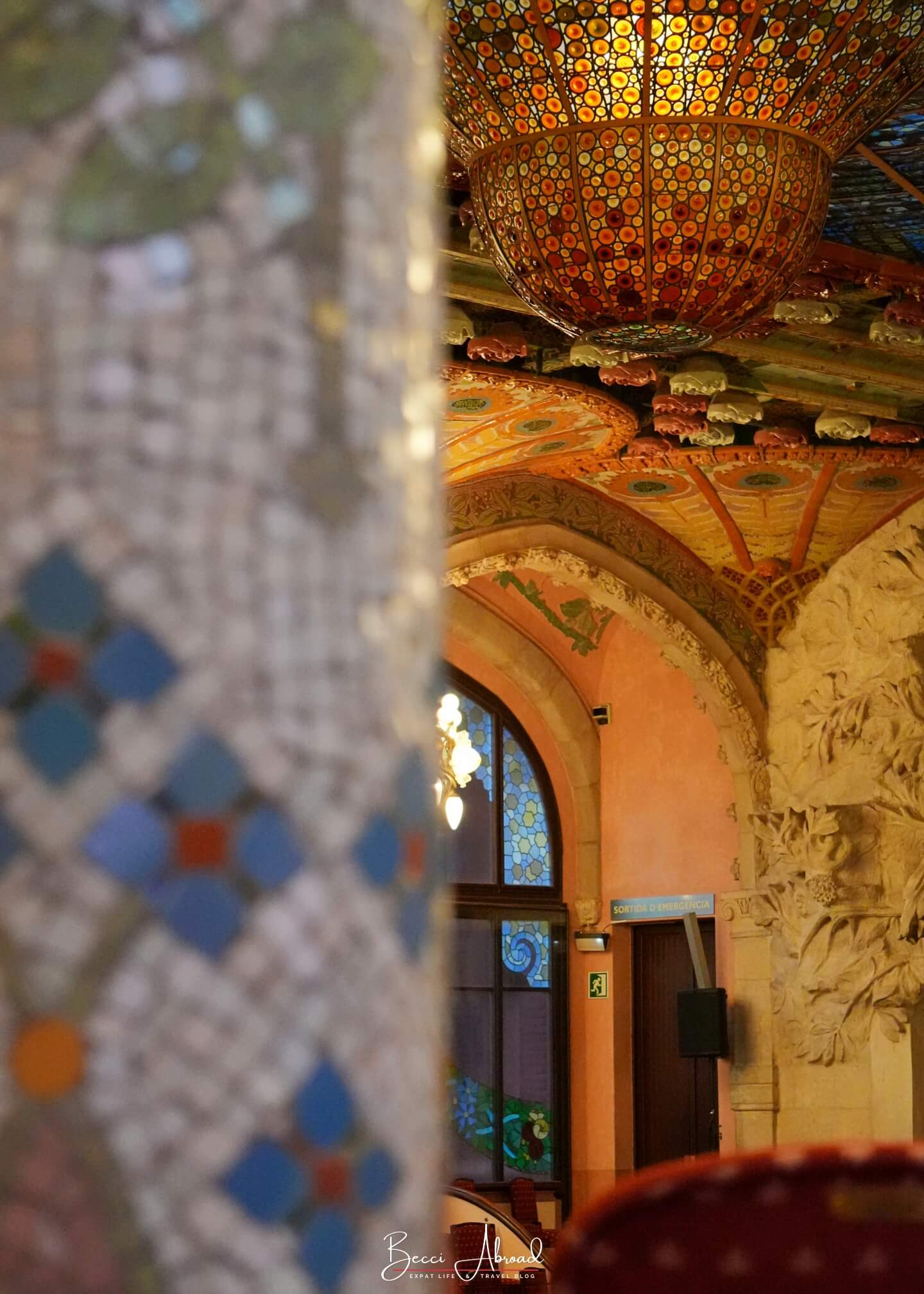
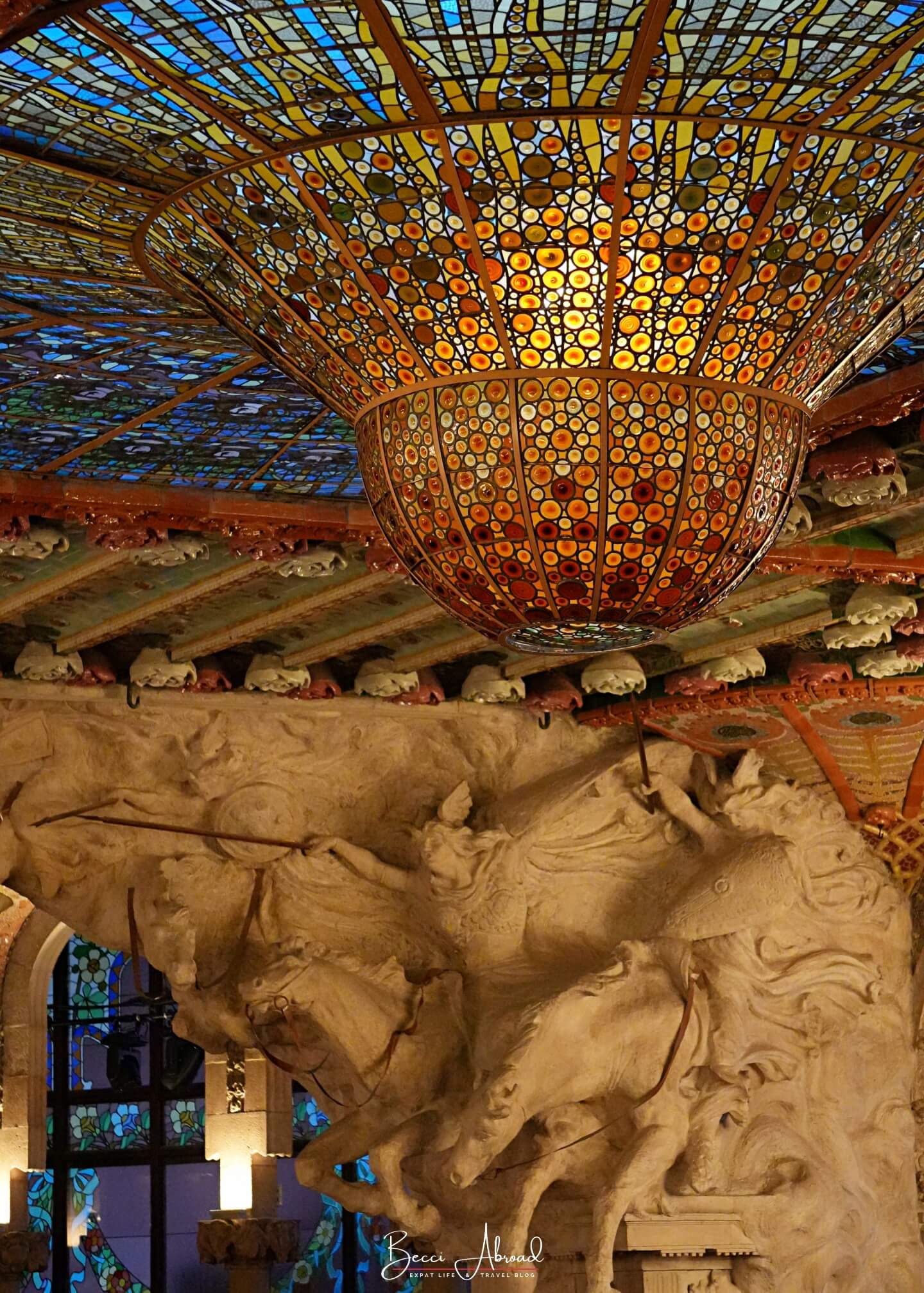
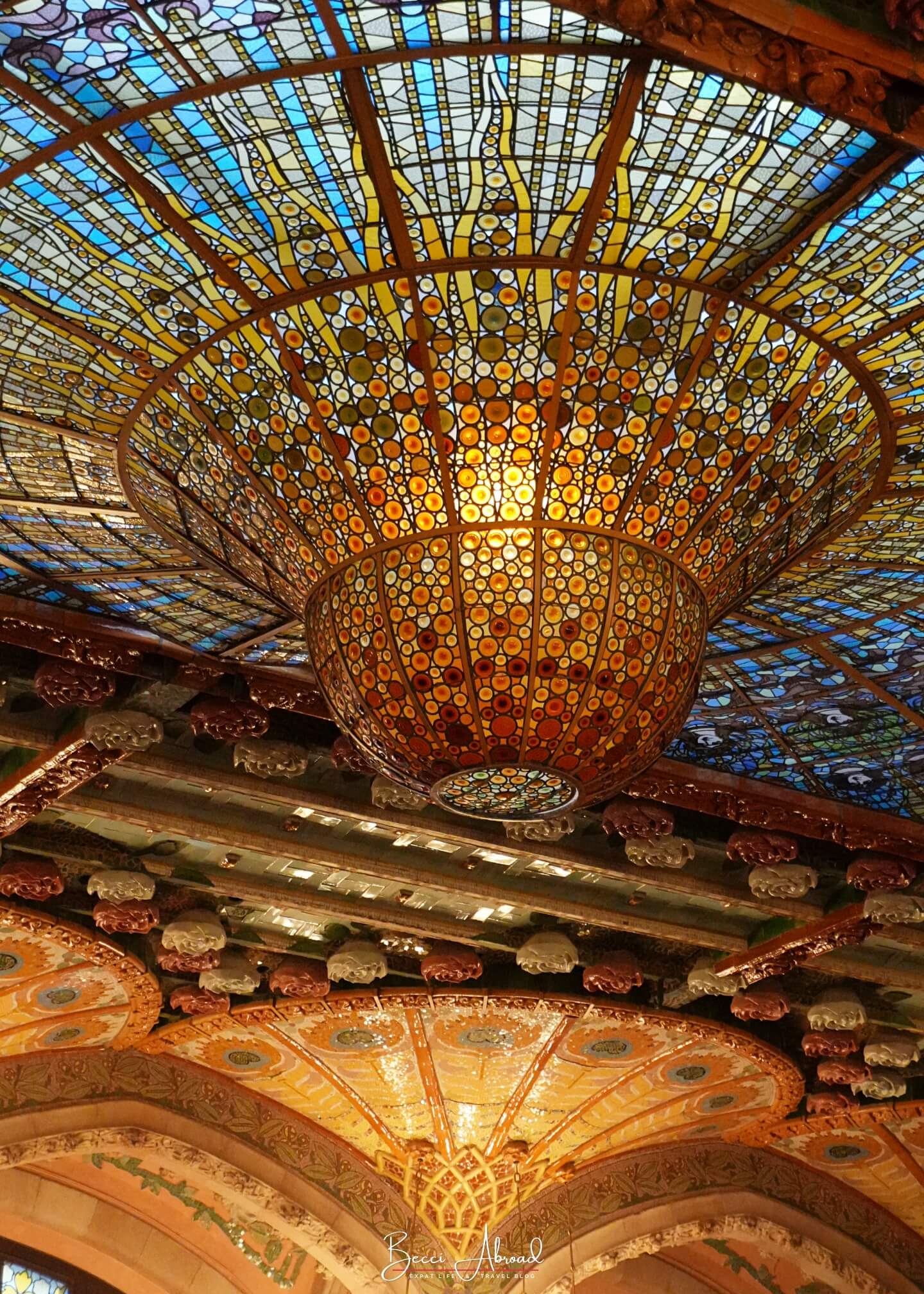
One of the most famous features of the concert hall at the Palace of Catalan Music is the central stained-glass skylight.
The skylight and the massive glass windows on the side ensure that natural light flows into the concert hall despite the building being placed in the narrow streets of el Born neighborhood.
The stained-glass skylight is shaped like an inverted dome that glows with warm colors and gives the space an open, almost airy feeling.
If you stand just under the dome, you can see that the center of the dome looks like a sun shining from above.
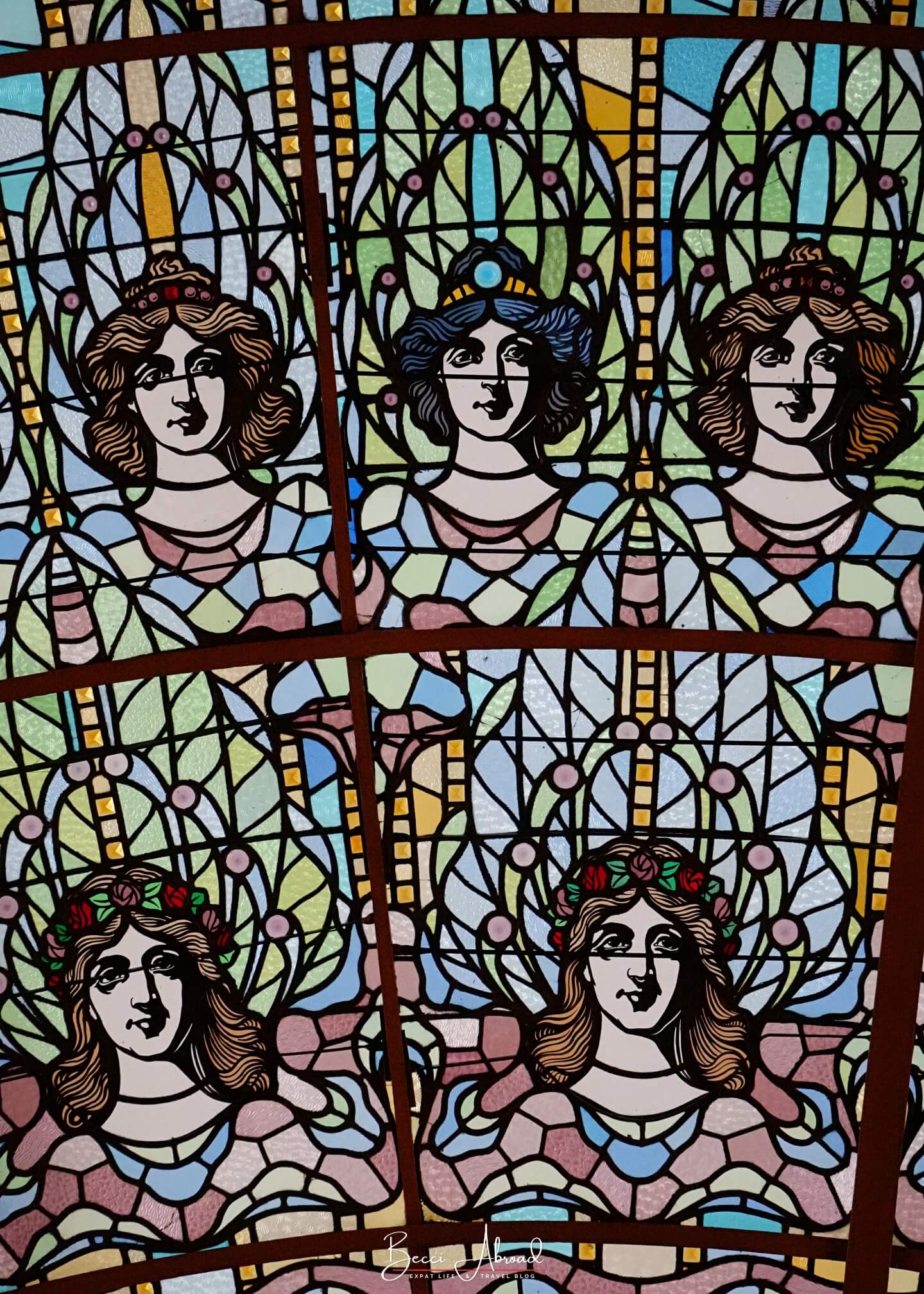
In the blue glass surrounding the beautiful sun, you can see small faces of women.
The faces of women in the dome of the Palace of Catalan Music were placed there because the Catalan choral society, Orfeó Català, was one of the first choral societies to accept women and children into their choirs.
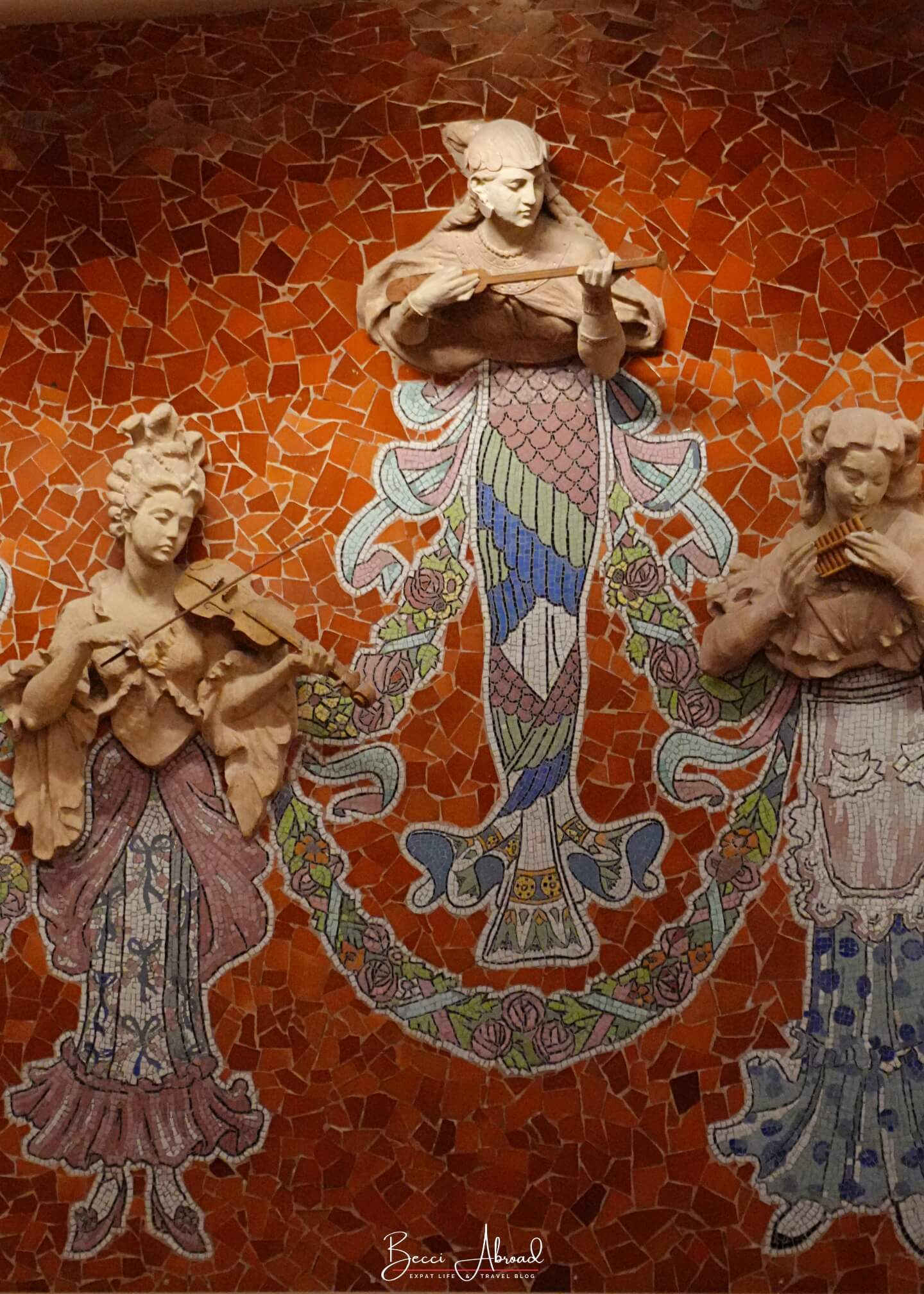
All around the concert hall, you’ll notice different sculptures, mosaics, and decorative details.
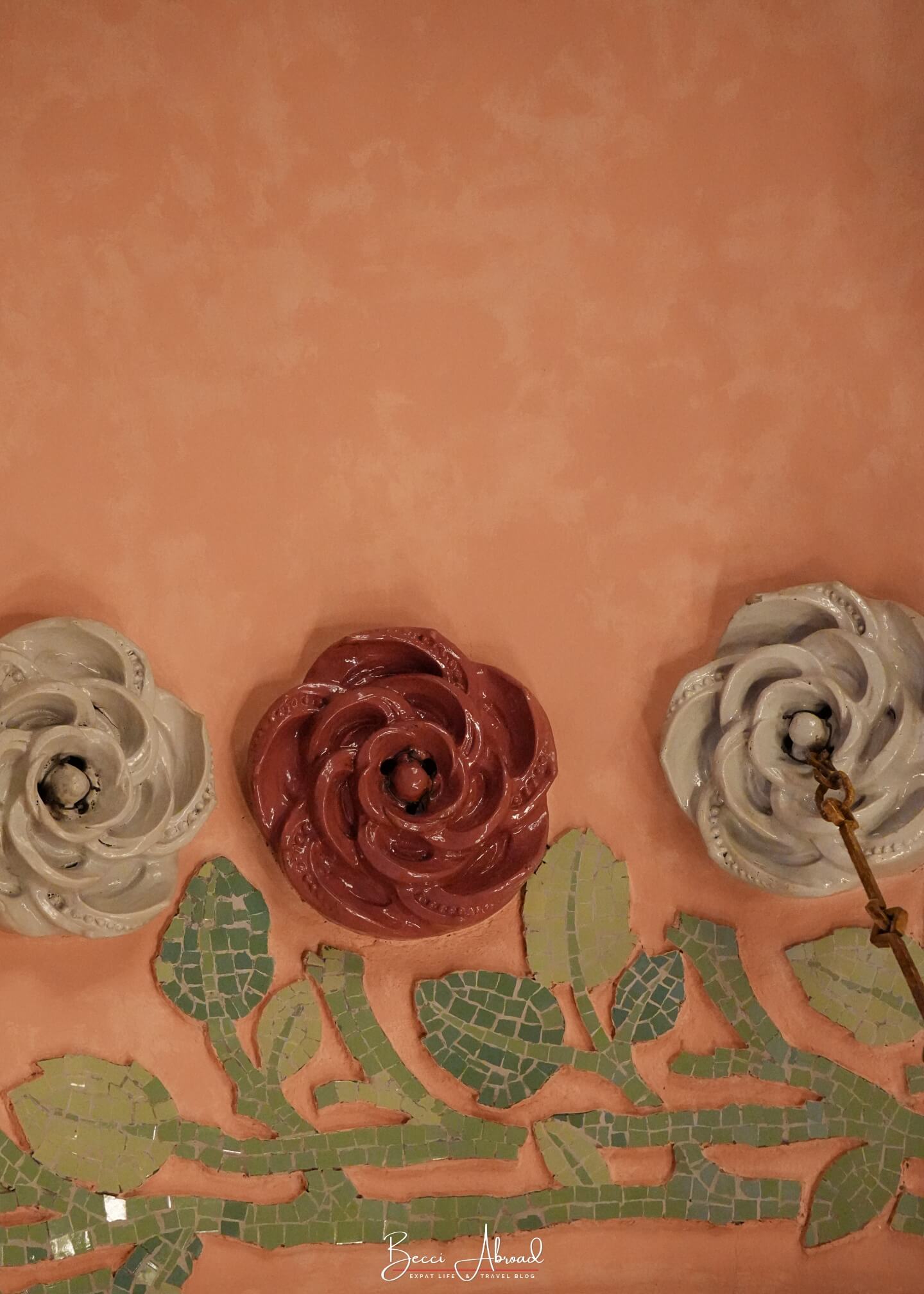
Many of the details are connected to Catalan culture and national identity, such as the many roses referring back to the Catalan legend of Sant George and the dragon, where the dragon’s blood turned into roses.
In my opinion, this is one of the most beautiful interiors in all of Barcelona!
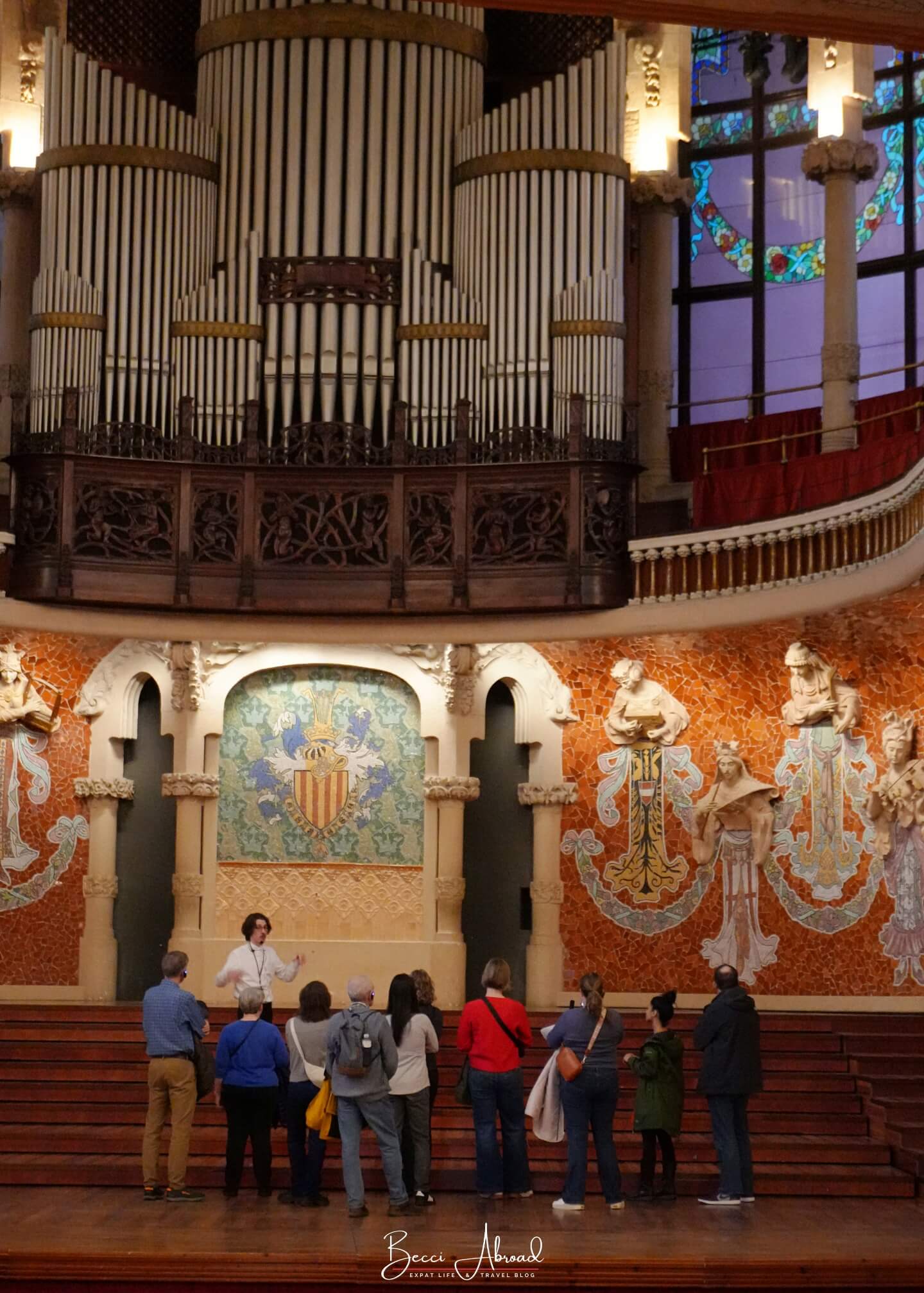
The stage itself is framed by figures and motifs inspired by both classical and folk traditions.
The most dominant feature is the sculptures of women representing music from different cultures around the world. The women are meant to be muses and inspiration for the artists on stage.
The highlight of our guided tour was that we were allowed up on the stage. The guide even got the organ to playwhile we were standing on the stage!
It isn’t every day that the guided tours can offer the on-stage experience!
In my opinion, the main concert hall is one of those rooms where you instinctively look up, then around, and always find something new to look at.
Sit there for a moment, and try to take it all in. And of course, photos are a must!
But honestly, no picture really does justice to how breathtaking the concert hall feels when you’re standing inside it.
The Lluís Millet Hall
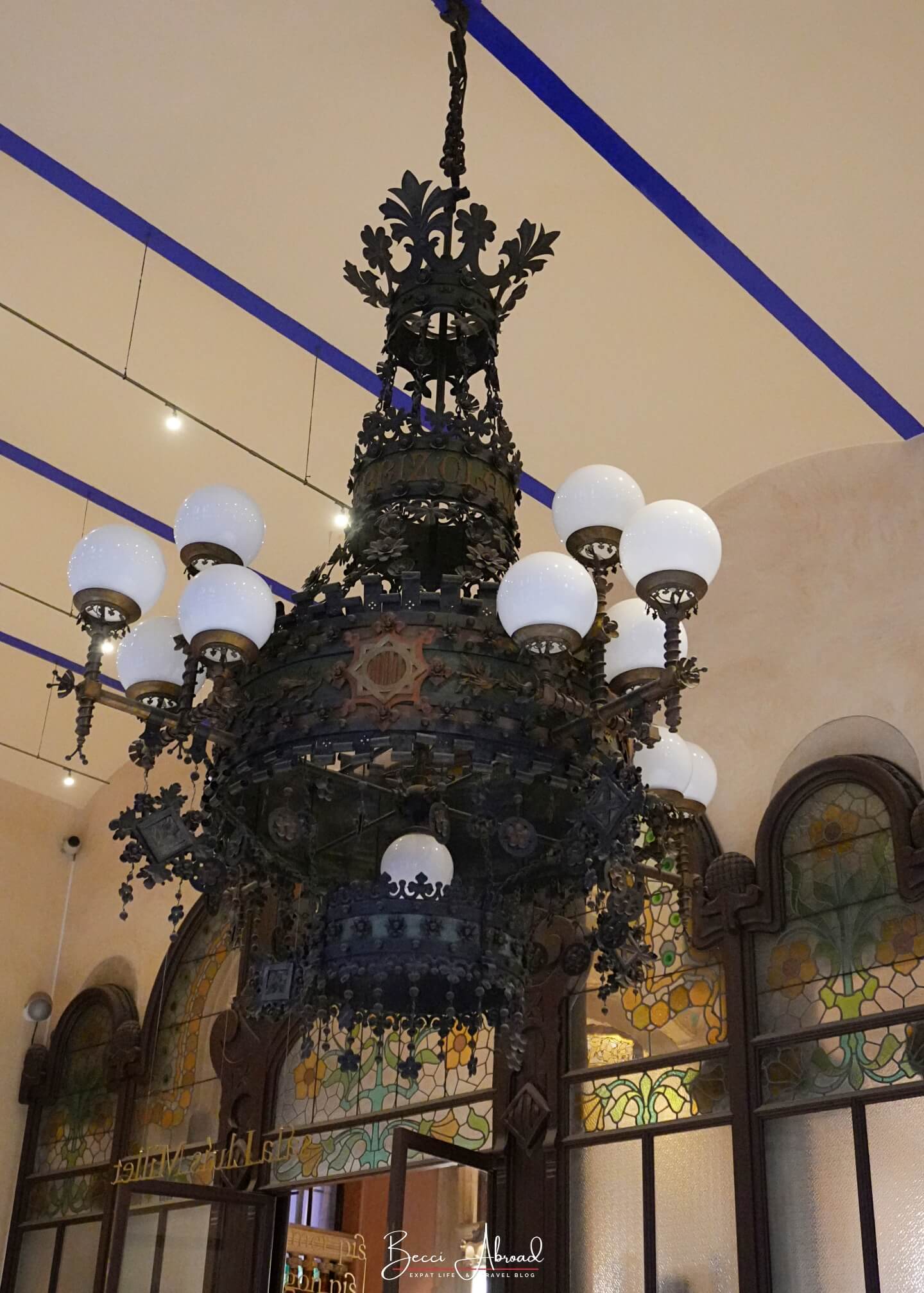
The Lluís Millet Hall is a quiet and serene space located right in front of the entrance to the concert hall on the first floor of the Palace of Catalan Music.
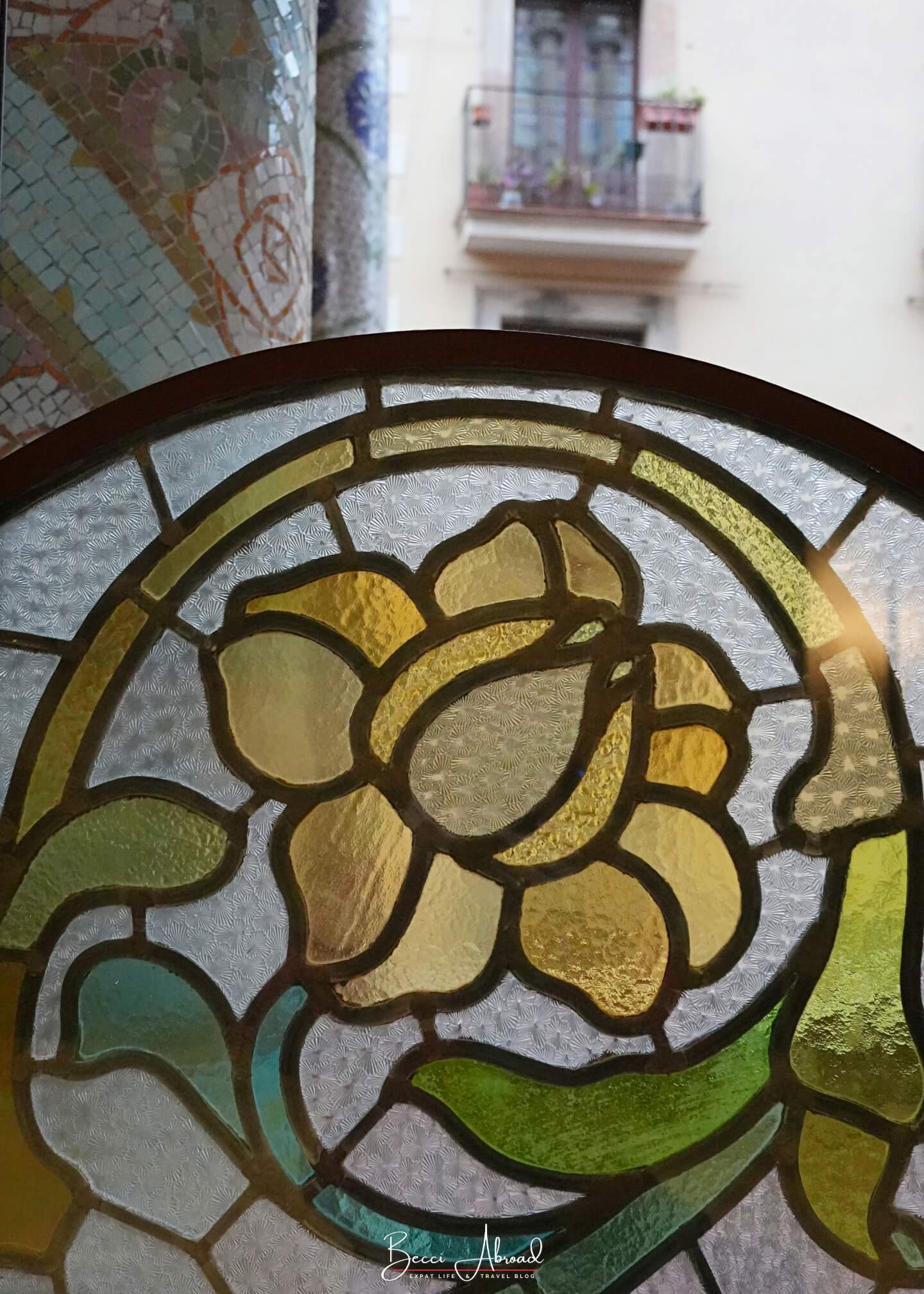
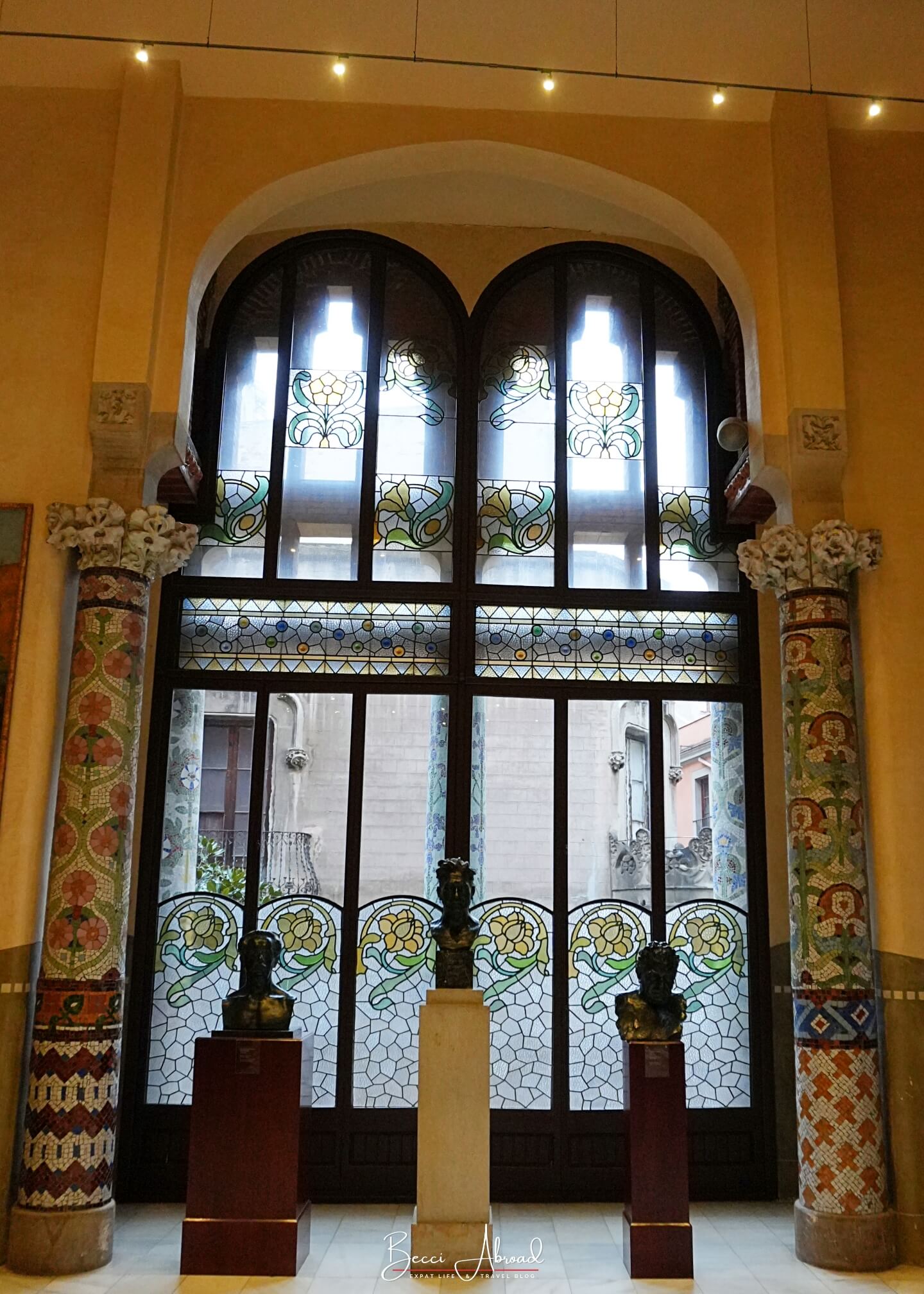
The hall is named after Lluís Millet, one of the founders of the Orfeó Català, and features huge floor-to-ceiling stained-glass windows overlooking the street.
Apart from the huge stained-glass windows and a gigantic Gothic chandelier, the Lluís Millet Hall is less overwhelmingly decorated than the concert hall.
The soft colors and natural light coming through the windows create a calm atmosphere contrast to the more dramatic spaces in the building.
Around the hall, you have statues of famous people related to the concert hall, such as its founders of the Orfeó Català, Lluís Millet and Amadeu Vives, and the architect Domènech i Montaner
The Balcony with the Mosaic Columns
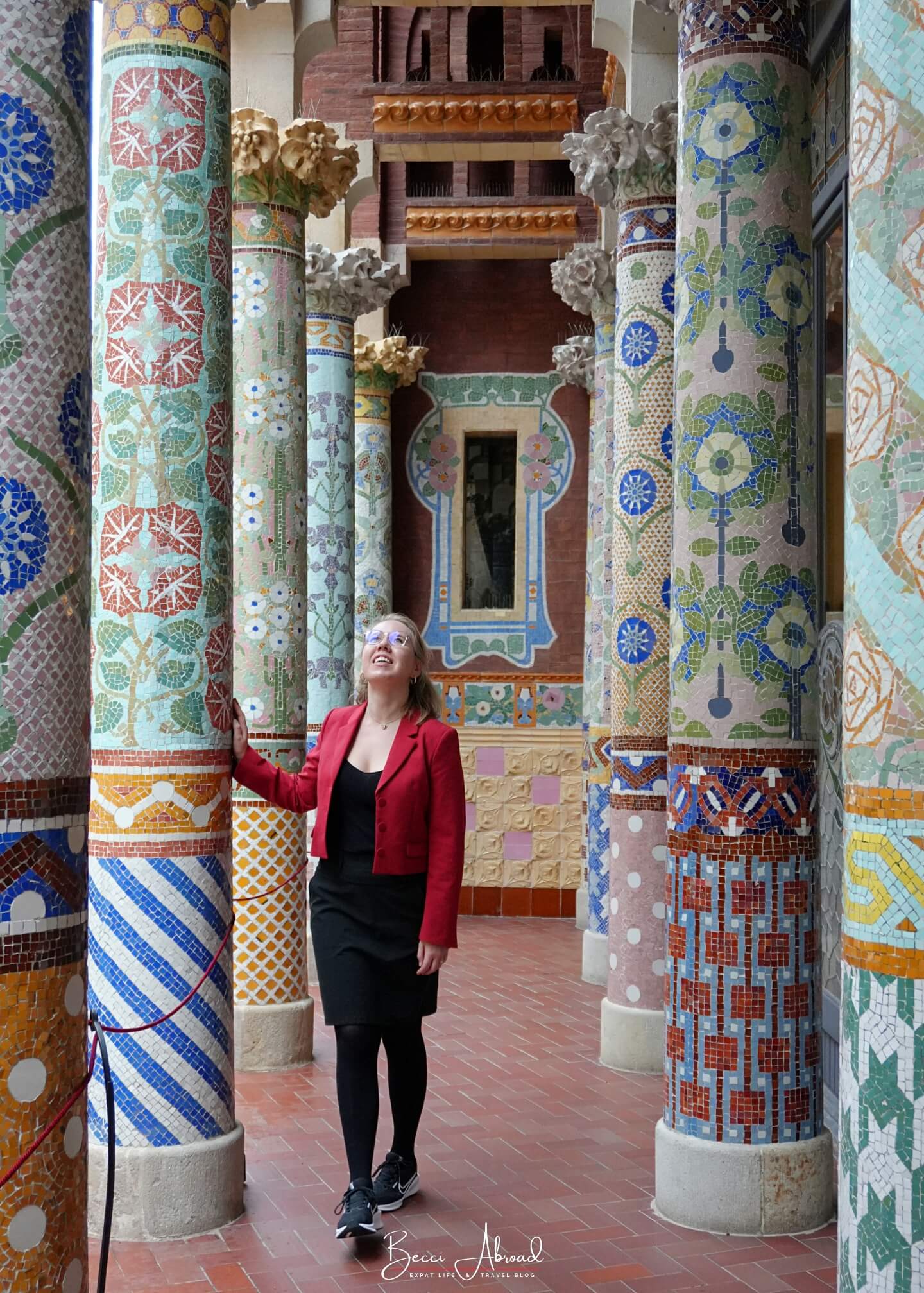
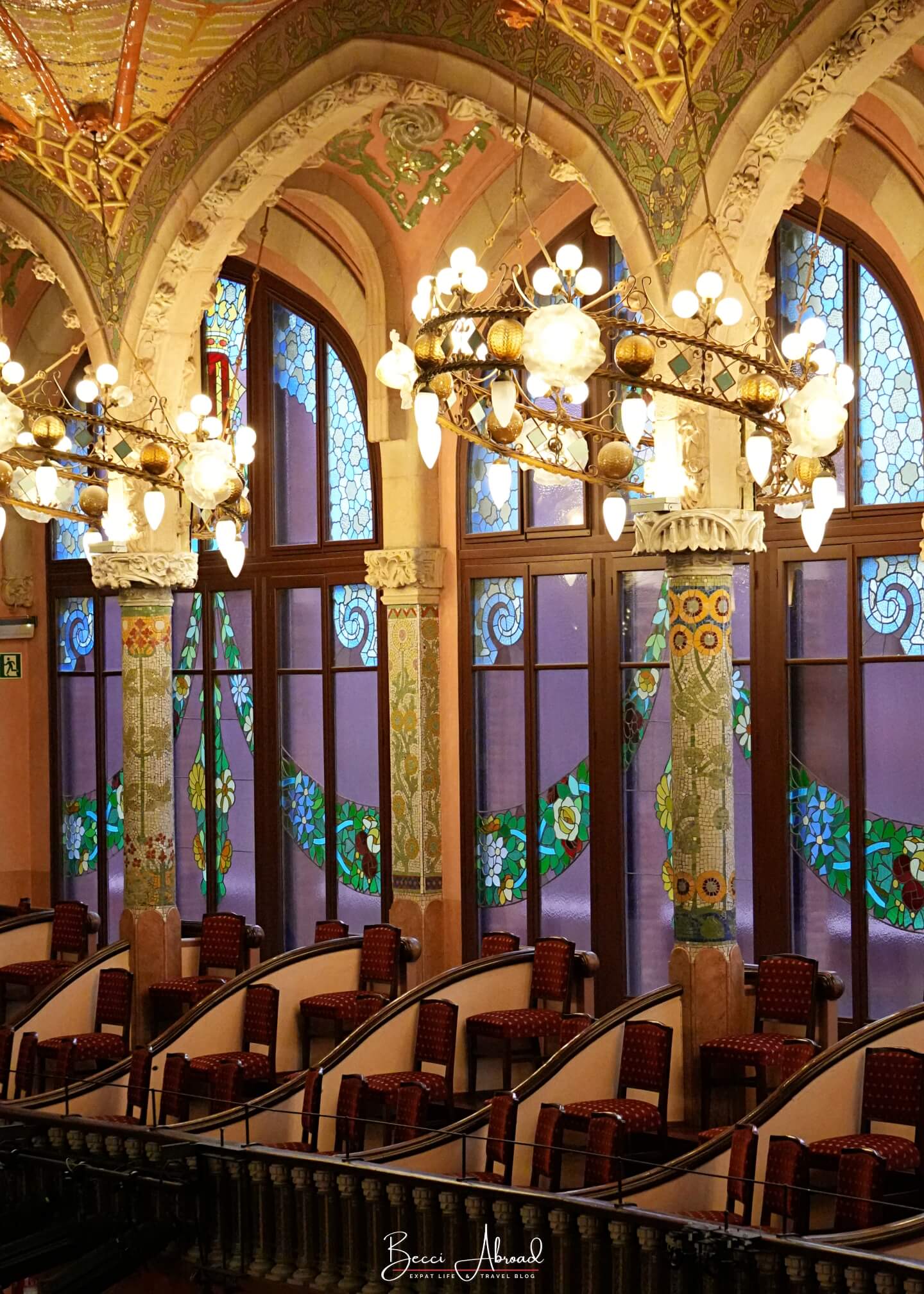
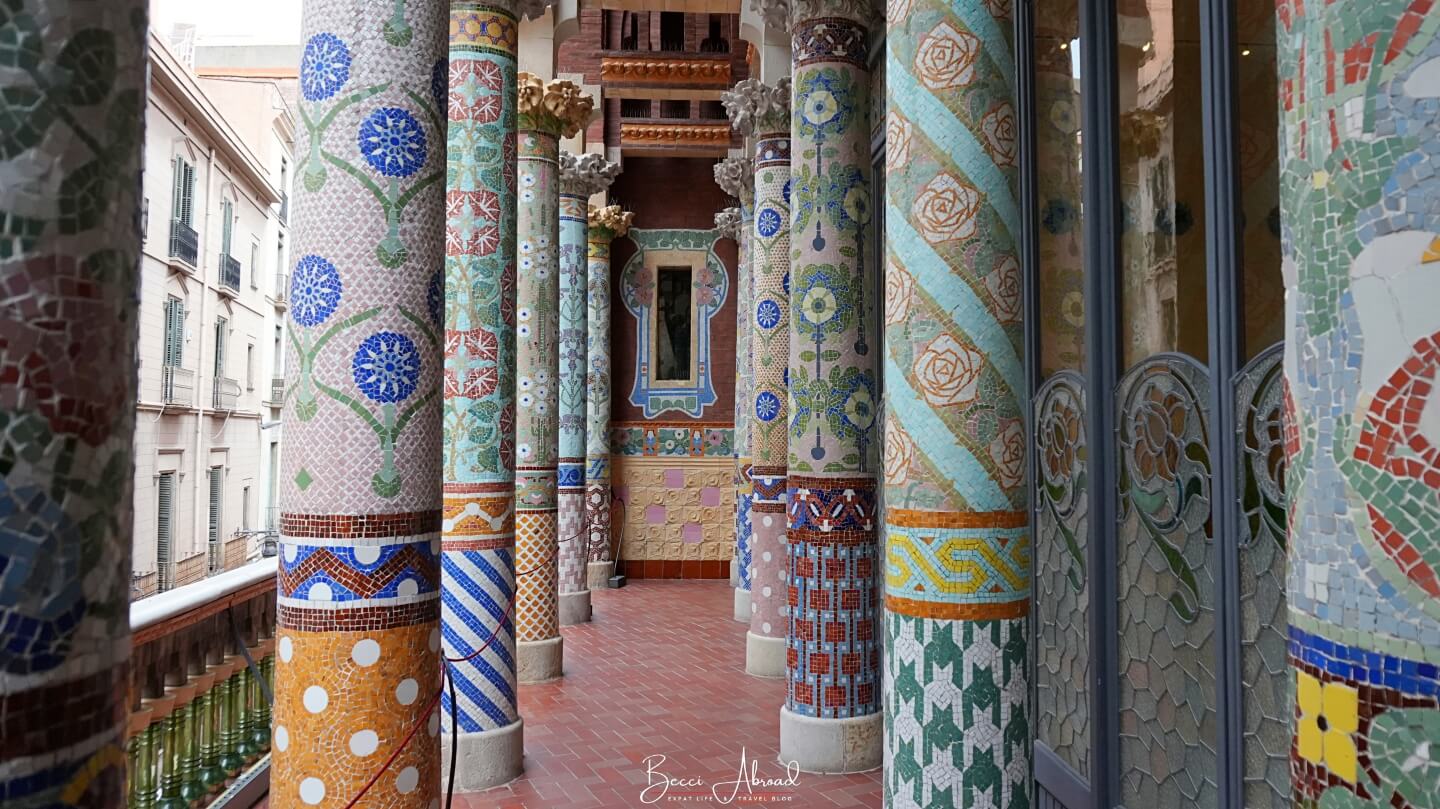
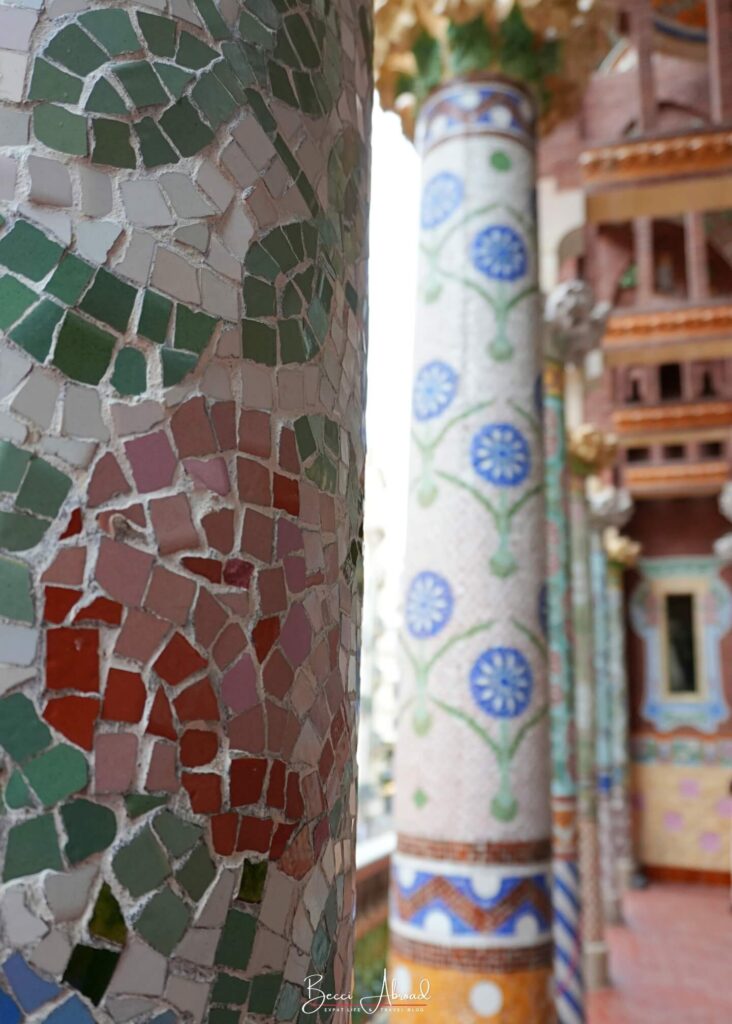
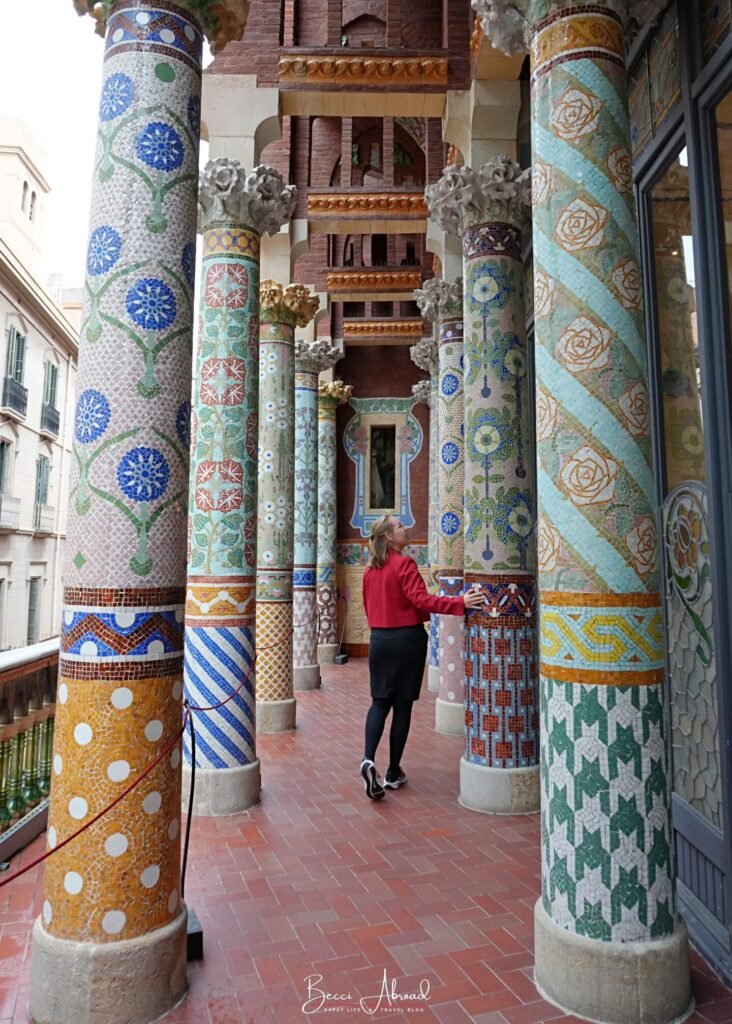
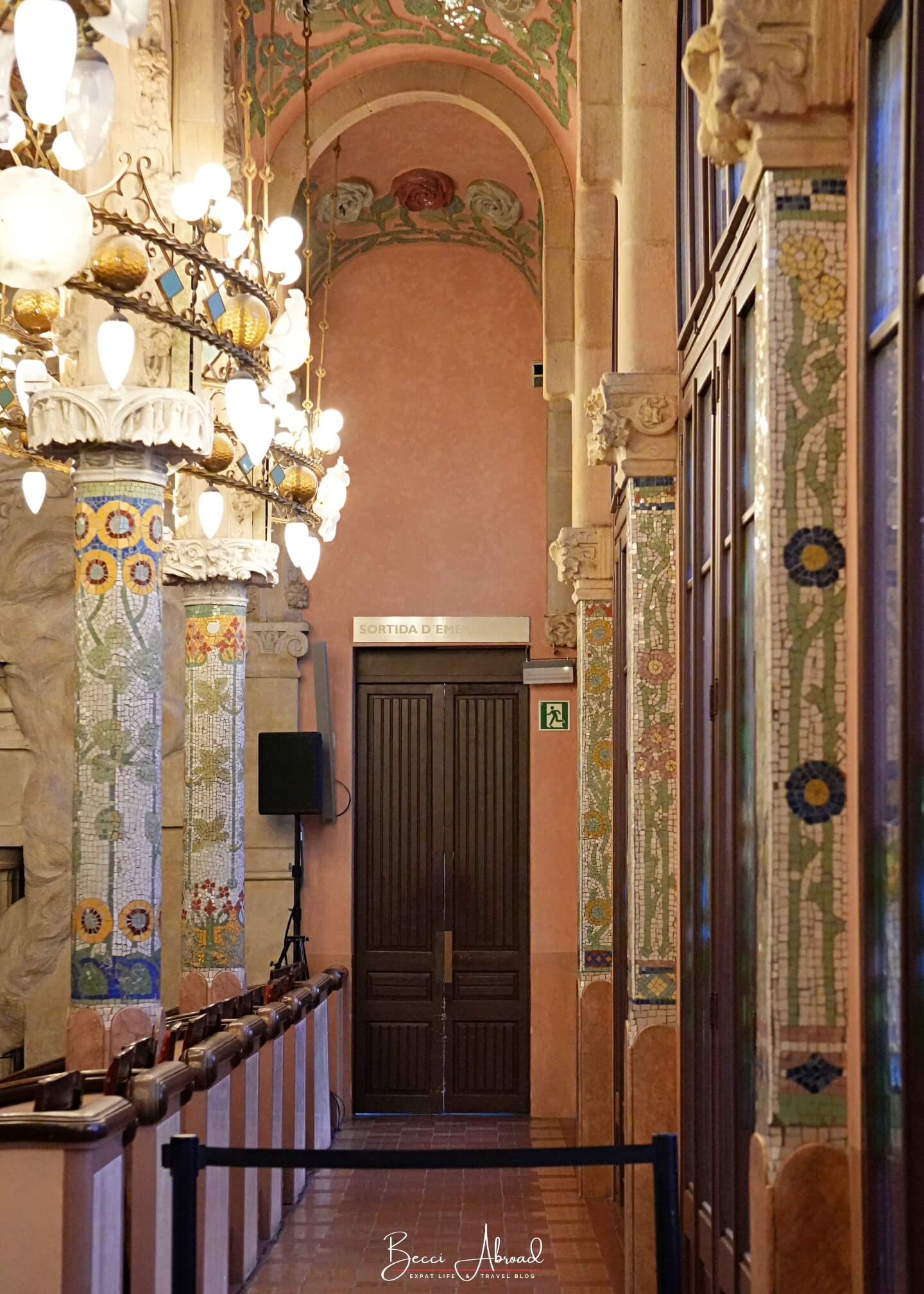
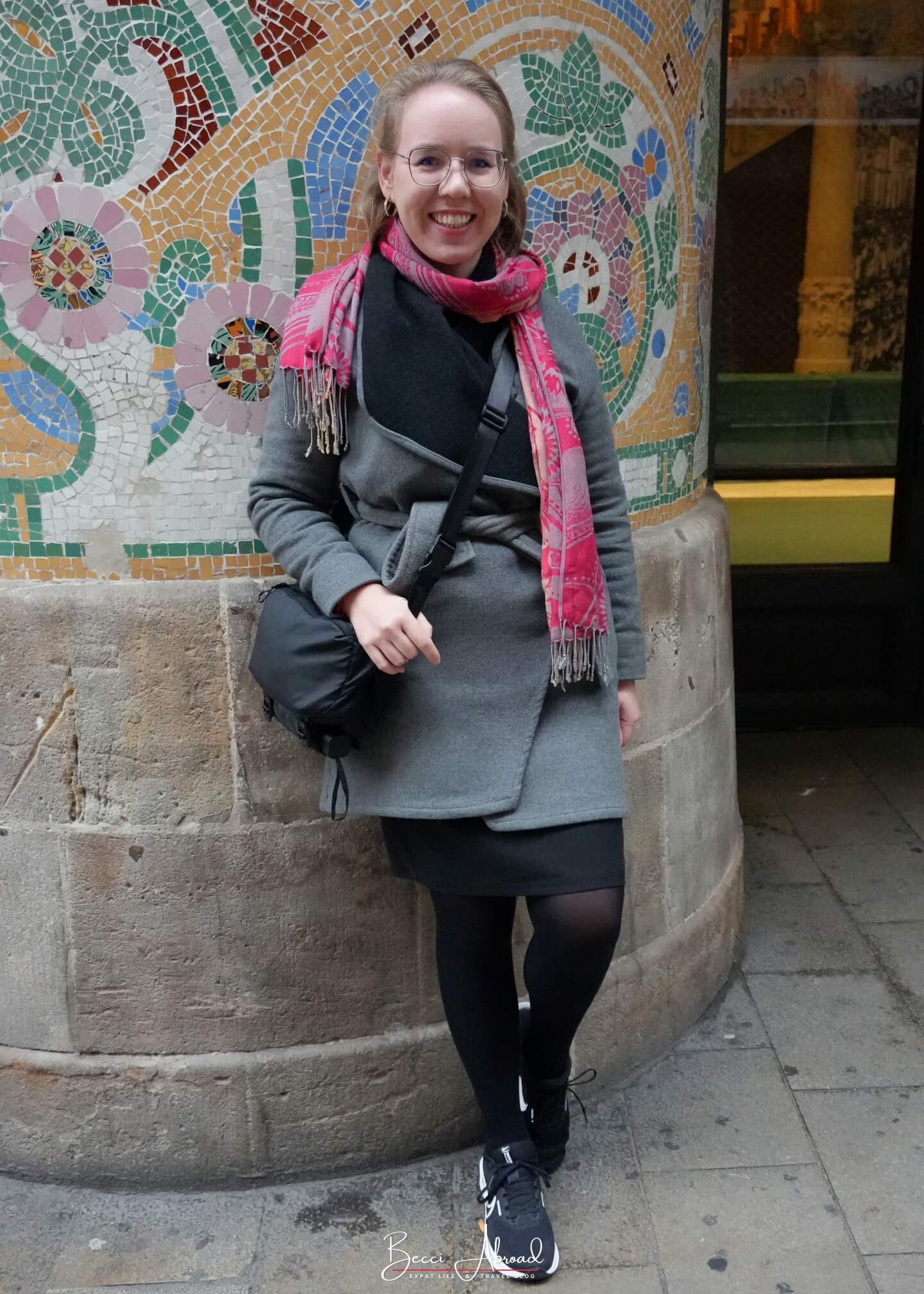
From the Lluís Millet Hall, you can access a small balcony with double rows of mosaic-covered columns decorated with beautiful floral motifs.
The decorated columns are one of the most Instagrammable places in Palau de la Música Catalana, and you have almost certainly already seen the pictures while researching for your Barcelona trip.
The balcony is also known as the “stone garden of Palace of Catalan Music”, and each of the columns represents different flowers.
The guide on our tour told us that the architect, Domènech i Montaner, knew a lot about flowers and plants as he had also studied botany.
The modernists’ search to include nature in their architecture was a response to the industrialization happening at the time, where the modernist movement emerged in Catalunya.
In my opinion, it’s one of the most beautiful places in the Palace of Catalan Music. But it’s also one of the hardest places to get beautiful pictures because it is rarely empty. Since we had chosen the first guided tour at 9 am, we were lucky to get photos without anybody around – and we even had time to play around a bit with the camera!
The Concert Hall from the Second Floor
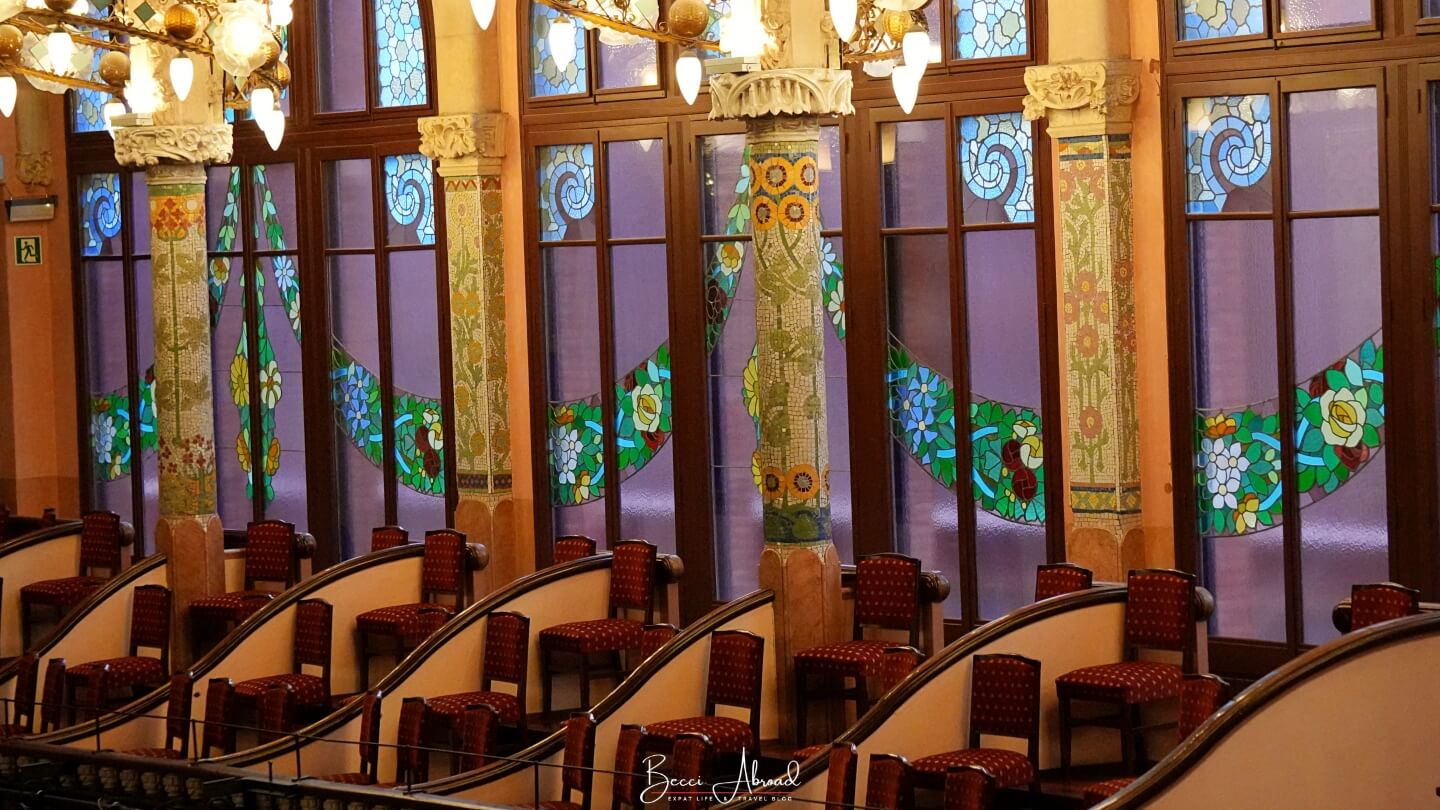
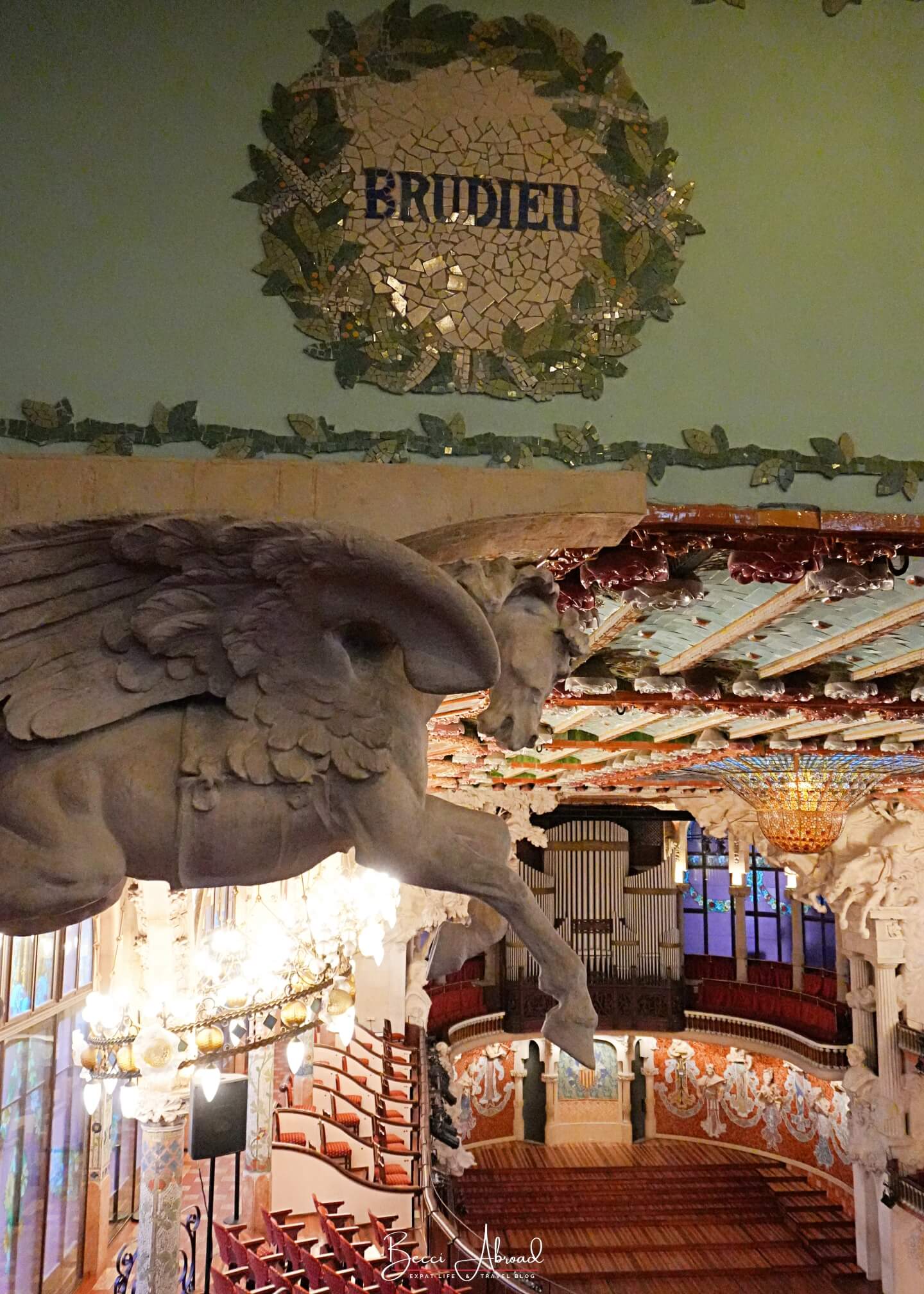
The last part of the tour takes you up the second floor of the Palace of Catalan Music, from where you get an even better view of the impressive concert hall.
The view of the concert hall from the third floor is one of the most popular places at the Palau for photos, and on busy days, I can only imagine the crowd that will be there to get the right picture.
The right benefit of the guided tour is that you get to sit in a part of the concert hall on the second floor that is normally closed for visitors.
Even though it is not right in the center, where the popular picture spot is, you get a good spot for taking pictures over the concert hall without all the crowds.
On either side of the concert hall, there are two galleries with beautifully mosaic-covered columns in a similar style to the columns on the balcony on the first floor.
In the ceiling and walls, you can find the names of famous musicians created in beautiful mosaics.
In 2003, the Palace of Catalan Music was expanded when the church right next to the concert hall were demonished. On the top floor, you can see how the last rows, the decorations on the walls, and the windows in the back are slightly different
At the entrance to the concert hall on the second floor, you’ll meet with a simplistic hall with few decorations. The guide told us that this was because the higher floors were meant for the poor, whereas the lower, more decorated floors were for the better-off part of society.
The guided tour ends on the second floor, but afterwards, you are free to explore the Palace of Catalan Music on your own for as long as you want!
Book your tickets to the Palace of Catalan Music
Essential Information for Visiting the Palace of Catalan Music
Here are some of the essential and practical pieces of information you’ll want to know before visiting the Palace of Catalan Music.
Palau de la Música Catalana tickets
Tickets to Palau de la Música Catalana can be purchased online either through Palau de la Música Catalana’s official website, Barcelona’s Tourist Office, or GetYourGuide.
It’s a good idea to buy the tickets ahead of time, especially in high season.
There are four different ways to visit the Palace of Catalan Music:
- Guided tour
- Self-guided visit
- Themed guided tour
- Attending a concert
If you’re short on time, the guided tour is the most efficient way to see everything.
Let’s explore the options in detail!
Guided tours tickets – My recommended option!
For the guided tour, a guide shows you around Palau de la Música Catalana and tells you the story of the place.
You get to see parts of the building that are normally not accessible with the self-guided tour. For example, you get access to the rehearsal hall, and when I went in January 2026, we also got to go up on the stage (however, this doesn’t always seem to be possible).
As I mentioned above, with the guided tour, you can stay as long as you want inside the concert hall after the tour finishes.
So, actually, you get the same option as the self-guided visit plus the guided tour for just € 4 more!
The guided tour tickets cost €24 (28 USD), and children below 9 years old are free.
You can book the tickets for the guided tour online via Palau de la Música Catalana’s official website, Barcelona’s Tourist Office, or GetYourGuide.
Self-guided visit
For the self-guided tour, you get an informative booklet at the entrance and can wander the Palace of Catalan Music at your own speed.
Some parts of the concert hall will not be accessible to you with the self-guided visit. The main parts, such as the concert hall, the staircase, and the balcony with the mosaic columns, are available with the self-guided visit.
The ticket price for the self-guided visits is €20 (23 USD), and honestly, for the small price difference, I would choose the guided tour.
You can book the tickets for the guided tour online via Palau de la Música Catalana’s official website, Barcelona’s Tourist Office, or GetYourGuide.
Themed guided tours
There are also some options for visiting the Palace of Catalan Music with a special themed guided tour. There is only limited availability for the tours based on the season and weekends.
The ticket prices vary depending on the type of visit.
Here is a list of the themed guided tours of the Palace of Catalan Music and their ticket prices (as of January 2026):
- Palau Premium (€130 / 152 USD) – An exclusive visit including a glass of cava and local pastries, as well as special access to parts of Palau Música Catalana that are normally closed to the public.
- Essence Palau (€30 / 35 USD) – A guided tour of the Catalan Music Palace, challenging all your senses, from smell, touch, and sight. Only available on selected days from March through June.
- The Palau in a Female Voice (€30 / 35 USD) – A guided tour focused on women’s stories and their role in shaping Palau de la Música Catalana. Only available from November through January.
- The Architecture of the Palau (€30 / 35 USD) – A guided tour focused on the architecture, structure, and techniques used in Palau de la Música Catalana. Only available in Spanish and Catalan, and on selected Fridays, Saturdays, and Sundays
You can check the schedule and book the ticket for the themed visits through Palau de la Música Catalana’s official website.
Concert tickets
Throughout the year, Palau de la Música Catalana hosts different events and concerts, including the popular Candlelight shows.
One of the most popular concerts to attend at the Palau de la Música Catalana is a guitar concert and flamenco performance. This is a great way to experience traditional Spanish flamenco in an exceptional setting.
You can find the full program of events and concerts on the Palau’s official website.
If you’re attending a concert rather than doing a guided tour, there’s a good chance it might be held at Petit Palau.
Petit Palau translates to “small palace,” and it is a modern, minimalist underground auditorium designed to complement the original building. The minimalist auditorium stands in strong contrast to the richly decorated main hall above.
So, keep an eye out for this when booking your concert tickets, in case your goal is to experience the main concert hall.
Palau de la Musica Catalana Opening Hours
Palau de la Música Catalana is open:
- Monday to Saturday from 8:30 am to 9 pm
- Sunday and public holidays from 8:30 am to 3:30 pm.
The guided tours run throughout the day. The guided tours in English are available at:
- 9 am
- 10 am
- 11 am
- 12 am
- 1 pm
- 2 pm
- 3 pm
For attending concerts, the Palau opens 2 hours before the start of the concert. I recommend checking the official website the day before you go, just to avoid any surprises.
How to Get to Palau de la Musica Catalana?
The Palace of Catalan Music is located on Carrer Palau de la Música in the El Born neighborhood of Barcelona.
It is very easy to get to Palau de la Música Catalana from almost anywhere in Barcelona.
The best ways to get to Palau de la Música Catalana are:
- On Foot – You can easily walk to Palau de la Música Catalana if you are staying near Plaça de Catalunya or in the Gothic Quarter. The walk from Plaça de Catalunya to Palau de la Música Catalana takes around 10 minutes.
- By Metro – You can also easily get to the Palau de la Música Catalana by metro. Take the red L1 or the yellow L4 line to the Urquinaona metro station or the yellow L4 to Jaume I. From the Urquinaona, it’s a 3-5-minute walk (depending on which exit you take). From Jaume I, it’s around an 8-minute walk.
- By Bus – Several bus lines stop nearby on the busy Via Laietana street.
In my opinion, combining your visit to Palau de la Música Catalana with a visit to the El Born neighbourhood or the Gothic Quarter makes for a perfect half-day plan for Barcelona.
Insider Tips for Visiting Palau de la Música Catalan
- Buy your tickets in advance
- Look up, look down, look all around – to not miss a detail
- Arrive early for your tour to soak in the atmosphere and grab a drink in the café
- Remember your camera to capture all the beauty
- Consider doing a combo with a guided tour in the morning and a concert at night
- Dress comfortably and enjoy the walk
Frequently Asked Questions about Palau de la Musica Catalana
Find answers to commonly asked questions about Palau de la Música Catalana in Barcelona.
Final Thoughts: Is a Visit to the Palau de la Música Catalana Worth It?
Yes, Palau de la Música Catalana is absolutely worth visiting!
The Palace of Catalan Music is one of my absolute favorite modernist buildings in Barcelona. Visiting the Palau with a guided tour is a great way to learn more about the building’s history and symbolism.
Even if you think “I’m not that into concert halls,” a visit to the Palau de la Música Catalana is different!
A visit inside the Palace of Catalan Music is a colorful and impressive experience, and a journey through Catalan history and legends.
So, if you’re deciding whether to squeeze a visit to Palau de la Música Catalana into your Barcelona itinerary, I recommend doing it!
Palau de la Música Catalana is a true masterpiece in Catalan modernism, and you shouldn’t miss the chance to experience it firsthand!

Rebecca
Rebecca is the voice behind Becci Abroad, a travel blog inspiring you to get under the skin of the world. She is a long-term expat with more than 10 year of living abroad from Spain to Argentina, Cuba, and Sweden.


You May Also Like
Is Barcelona Expensive? An Insider’s Review for Travellers

A Self-Guided Tour of Street Art in Poblenou, Barcelona